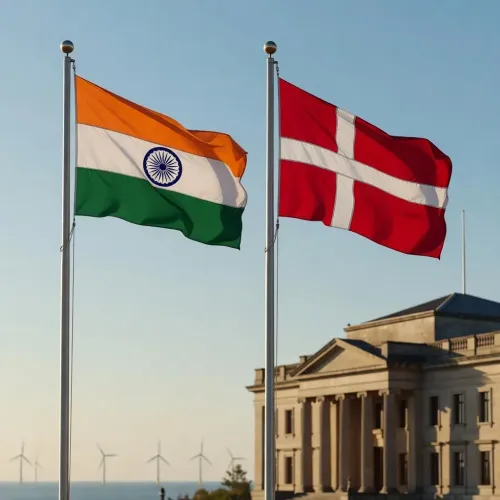
India-Denmark inaugural Maritime Security Dialogue held in Copenhagen
Synopsis
India and Denmark have formally launched a standing Maritime Security Dialogue — the first of its kind — in Copenhagen, covering piracy, illegal fishing, and Indo-Pacific stability. Rooted in the India-Nordic Summit's joint commitments and India's MAHASAGAR vision, this signals a structural upgrade from one-off consultations to a recurring bilateral security mechanism.
Key Takeaways
India and Denmark held their inaugural Maritime Security Dialogue in Copenhagen during the week of 19 June 2025 .
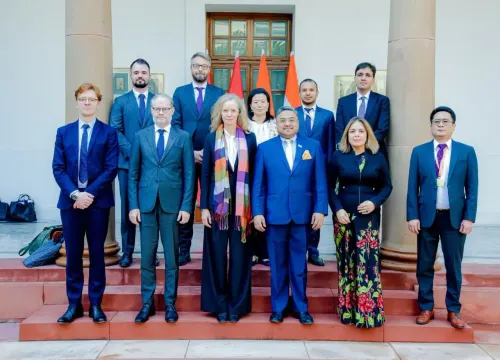
The Indian delegation was led by Joint Secretary Subhashini Narayanan (MEA) and included NSCS representatives and Ambassador Manish Prabhat .
Danish counterparts included State Secretary Lotte Machon and Maritime Security Envoy Nicolai Ruge .
Talks covered piracy, IUU fishing, contraband smuggling, maritime pollution , and seafarer safety.
The dialogue was instituted as a direct outcome of the 3rd India-Nordic Summit in May 2025 , alongside a parallel mechanism with Norway .
Both sides referenced the IPOI and India's MAHASAGAR vision as frameworks for future joint activities.
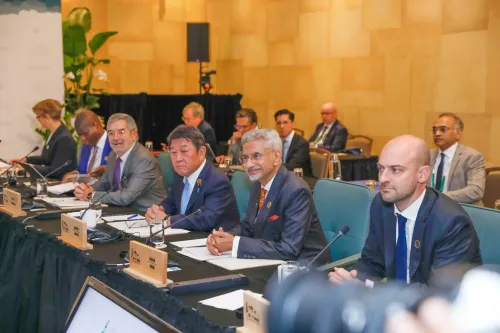
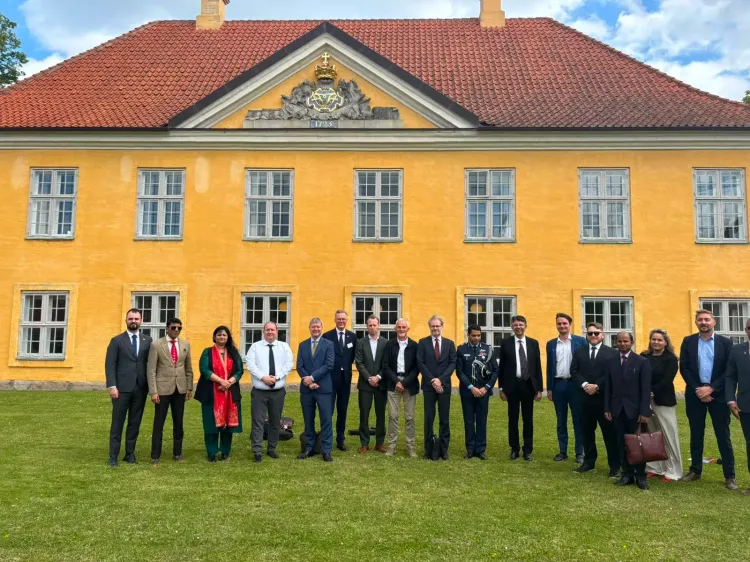
India and Denmark held their inaugural Maritime Security Dialogue in Copenhagen this week, with an Indian delegation meeting senior Danish officials to assess the global security environment and chart pathways for deeper bilateral cooperation in the maritime domain, the Embassy of India in Denmark confirmed on Friday, 19 June.
Who Was at the Table
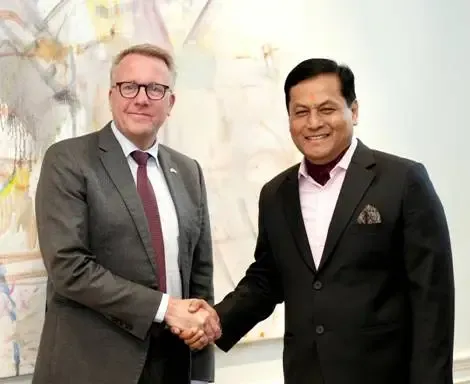
The Indian delegation was led by Ms Subhashini Narayanan, Joint Secretary, D&ISA Division, Ministry of External Affairs (MEA), and included representatives from the National Security Council Secretariat (NSCS) as well as Ambassador Manish Prabhat. On the Danish side, the meeting was attended by State Secretary Ms Lotte Machon, Maritime Security Envoy Mr Nicolai Ruge, and officials from the Danish Defence Ministry.
A working lunch with Danish defence companies operating in the maritime space was also held on the sidelines, underscoring the commercial and industrial dimension of the dialogue.
Key Areas of Discussion
Both sides discussed the evolving global security environment with a particular focus on maritime threats. According to the Embassy, the two nations explored concrete possibilities for deeper cooperation. The dialogue addressed Illicit Maritime Activities (IMA) — a broad category that encompasses piracy, contraband smuggling, Illegal, Unreported and Unregulated (IUU) fishing, maritime pollution, and the safety and security of seafarers.
Enhanced information sharing and inter-agency coordination were identified as priority areas, with both governments signalling intent to formalise mechanisms for joint action.
Rooted in the India-Nordic Summit
The Copenhagen dialogue follows directly from commitments made at the 3rd India-Nordic Summit in May 2025, where Prime Minister Narendra Modi and the leaders of Denmark, Norway, Finland, Iceland, and Sweden issued a joint statement pledging to strengthen maritime security cooperation. The leaders reaffirmed their commitment to a free, open, peaceful, and prosperous Indo-Pacific, in accordance with international law — including the UN Convention on the Law of the Sea (UNCLOS).
The summit statement also referenced two multilateral frameworks: the Indo-Pacific Oceans Initiative (IPOI) and India's MAHASAGAR vision — an acronym for Mutual and Holistic Advancement for Security and Growth Across Regions — as platforms for joint activities and bilateral dialogues.
Denmark's Perspective
Rasmus Abildgaard Kristensen, Ambassador of Denmark to India, noted on X on Thursday that maritime security is an 'increasing concern for both Denmark and India,' framing the dialogue as a timely and necessary step. Denmark, as a major maritime nation with significant shipping and defence interests, brings considerable institutional expertise to the table.
Notably, Maritime Security Dialogues with both Norway and Denmark were formally instituted as an outcome of the India-Nordic Summit — marking a structural upgrade from ad hoc consultations to a standing bilateral mechanism. With the framework now in place, the two sides are expected to build on this first session with regular, agenda-driven engagements going forward.
Point of View
Particularly on IUU fishing and piracy in the Indian Ocean. The MAHASAGAR framing is ambitious, but India's track record with multilateral maritime initiatives has been process-heavy and outcome-light. The inclusion of Danish defence companies in the working lunch hints at a commercial undercurrent — and that, more than any joint statement, may be the real driver of the agenda.
NationPress
19 Sept 2026
Frequently Asked Questions
What is the India-Denmark Maritime Security Dialogue?
It is a newly instituted bilateral forum between India and Denmark focused on maritime security cooperation, covering issues such as piracy, IUU fishing, contraband smuggling, and Indo-Pacific stability. The inaugural session was held in Copenhagen during the week of 19 June 2025.
Who represented India at the Copenhagen maritime security talks?
The Indian delegation was led by Joint Secretary Subhashini Narayanan of the MEA's D&ISA Division, and included representatives from the National Security Council Secretariat and Ambassador Manish Prabhat.
How did the India-Denmark Maritime Security Dialogue come about?
The dialogue was formally instituted as an outcome of the 3rd India-Nordic Summit held in May 2025, where Prime Minister Narendra Modi and Nordic leaders — including Denmark's then Acting Prime Minister Mette Frederiksen — agreed to strengthen maritime security cooperation.
What is India's MAHASAGAR vision?
MAHASAGAR stands for Mutual and Holistic Advancement for Security and Growth Across Regions. It is India's framework for maritime cooperation in the Indo-Pacific, emphasising free and open sea lanes, seafarer safety, and joint action against illicit maritime activities in accordance with international law including UNCLOS.
Does India have similar maritime dialogues with other Nordic countries?
Yes. As part of the India-Nordic Summit outcomes, Maritime Security Dialogues were instituted with both Norway and Denmark, signalling a broader effort to build structured security partnerships with northern European nations.