How is India Contributing to Myanmar’s Development with Three New Projects?
Click to start listening
Synopsis
India has recently inaugurated three Quick Impact Projects in Myanmar aimed at enhancing the socio-economic conditions in the Mandalay Region. These initiatives, focusing on vocational education, women's training, and clean energy, mark a significant step in the bilateral partnership between India and Myanmar.
Key Takeaways
- India launched three Quick Impact Projects in Myanmar.
- Focus on vocational education and empowering women.
- Initiatives support clean energy and environmental sustainability.
- Strengthens India-Myanmar relations through development.
- Part of the Mekong-Ganga Cooperation framework.
Yangon, Dec 20 (NationPress) In a significant move to bolster Myanmar's development, India has officially transferred three Quick Impact Projects (QIP) aimed at enhancing the socio-economic conditions of the residents in the Mandalay Region of this Southeast Asian country.
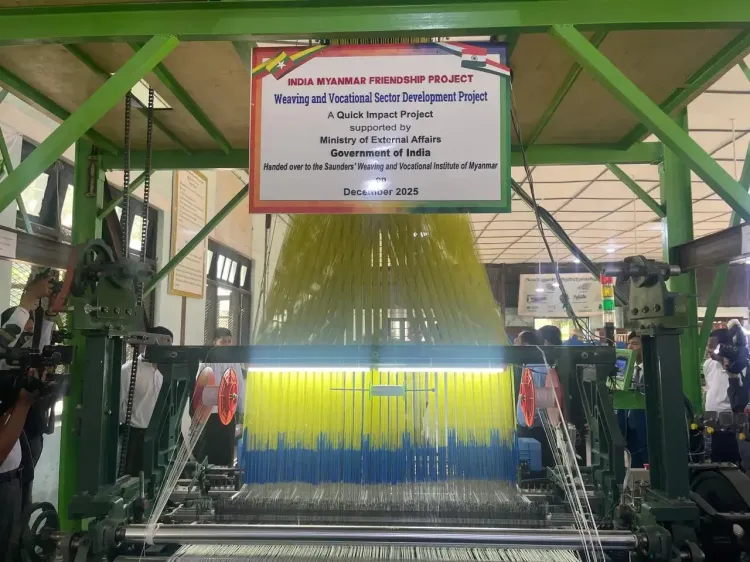
The ceremony for the QIP concerning the Weaving and Vocational Sector Development Project took place with the participation of Indian Ambassador to Myanmar Abhay Thakur, Chief Minister of Mandalay Region U Myo Aung, and Deputy Minister for Cooperatives and Rural Development U Thaik Soe in Mandalay.
“As part of this initiative, a flexible rapier loom, a state-of-the-art weaving machine imported from India, has been set up at the Saunder Weaving and Vocational Institute in Amarapura, within the Mandalay Region. This project is designed to enhance vocational education in weaving and support 10 traditional Myanmar arts (handicrafts) through the introduction of modern machinery and technology,” stated a release from the Indian Embassy in Yangon.
Moreover, a second QIP involving the inauguration of a one-story facility for the Girls Training School in the Mandalay Region was also celebrated by the Indian Ambassador, Chief Minister U Myo Aung, and Deputy Minister for Social Welfare, Relief and Resettlement Than Soe on Saturday. This new educational facility aims to provide a safe, spacious, and comfortable environment for young learners in the Mandalay region.
Additionally, a third QIP focused on the investigation of a tar-free and dry gasification process utilizing slow pyrolysis products from agricultural waste was launched with the presence of Ambassador Abhay Thakur and Htay Thwin, Director General of the Department of Technical and Vocational Education and Training in Myanmar’s Ministry of Science and Technology.
This initiative not only supports rural electrification and clean energy development but also emphasizes environmental conservation while fostering local capacity-building.
“These projects under the QIP initiative of the Mekong-Ganga Cooperation (MGC) framework highlight India’s unwavering commitment to Myanmar’s socio-economic progress through focused, people-centric projects encompassing skill development, child welfare, and clean energy research. The successful execution and handover of these initiatives further strengthen the resilient partnership between our two nations,” the Indian Embassy stated.
Point of View
It is vital to recognize the importance of international partnerships in fostering development. India's commitment to enhancing Myanmar's socio-economic landscape through these Quick Impact Projects illustrates the potential for growth through collaborative efforts. Such initiatives not only uplift local communities but also strengthen diplomatic ties, paving the way for a brighter future.
NationPress
24/12/2025
Frequently Asked Questions
What are the Quick Impact Projects handed over by India?
India has handed over three Quick Impact Projects focusing on vocational education, a girls' training school, and clean energy initiatives in Myanmar's Mandalay Region.
Why are these projects important for Myanmar?
These projects aim to enhance socio-economic conditions, support vocational training, provide safe educational environments for girls, and promote clean energy development.
Who attended the handing-over ceremony?
The ceremony was attended by Indian Ambassador Abhay Thakur, Chief Minister U Myo Aung, and Deputy Minister U Thaik Soe among others.
What is the Mekong-Ganga Cooperation framework?
The Mekong-Ganga Cooperation framework is a regional initiative aimed at enhancing cooperation between India and Southeast Asian nations in various sectors, including education and clean energy.
How does India support clean energy in Myanmar?
Through the third Quick Impact Project, India is investigating tar-free and dry gasification processes using agricultural waste, promoting sustainable energy solutions.