How Are India-Japan Relations Strengthening Amid China's Indo-Pacific Aggression?
Synopsis
The recent visit by Japan's Foreign Minister Toshimitsu Motegi to India marks a significant advancement in bilateral relations, moving from high-level discussions to actionable outcomes, enhancing India's strategic autonomy against regional challenges.
Key Takeaways
Strengthening of bilateral ties between India and Japan.
Focus on economic security and reducing dependency on single powers.
Launch of AI dialogue mechanism and Joint Working Group on minerals.
Reinforcement of the Quad framework to promote regional stability.
Emphasis on free and open Indo-Pacific principles.
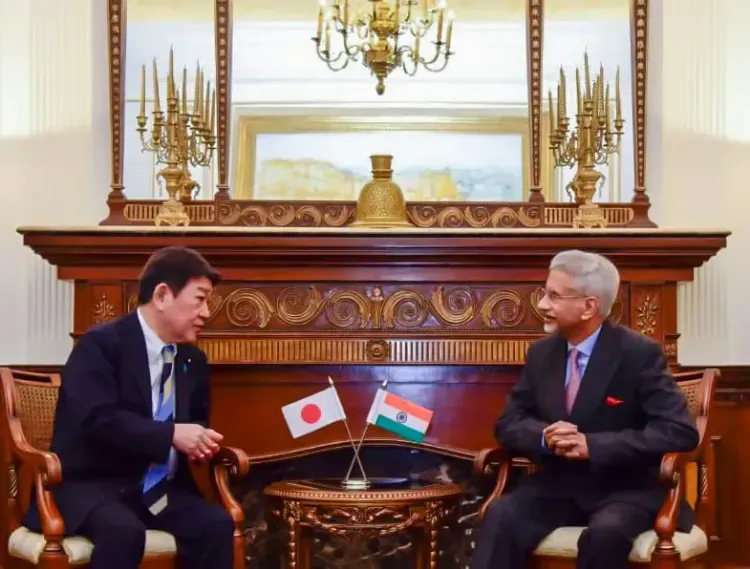
New Delhi/Tokyo, Jan 19 (NationPress) The recent visit of Japanese Foreign Minister Toshimitsu Motegi to India signified a pivotal moment in bilateral relations, transitioning from high-level aspirations to concrete achievements. This collaboration allows India to bolster its strategic independence, minimizing reliance on any single power while advocating for free and open Indo-Pacific values to counter coercion, according to a Monday report.
Motegi’s trip to India from January 15 to 17, 2026, emphasizes the strengthening strategic partnership between the two nations in light of shifting Indo-Pacific dynamics. The three-day visit, characterized by important discussions and symbolic actions, reflects India’s commitment to reinforcing alliances against regional challenges, especially from China. From New Delhi’s perspective, this visit illustrates a practical shift towards building robust economic and security frameworks,” the report from India Narrative elaborated.
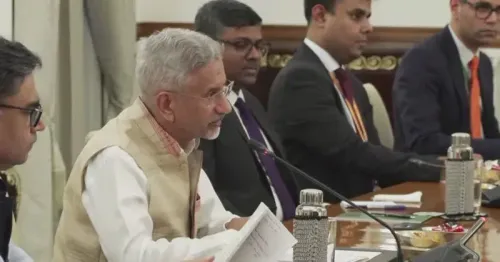
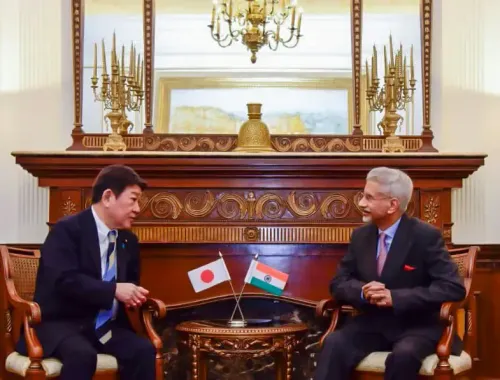
Foreign Minister Motegi partook in significant bilateral discussions, starting with the 18th India-Japan Foreign Ministerial Strategic Dialogue alongside External Affairs Minister S. Jaishankar on January 16. The conversations reviewed progress since Prime Minister Modi’s visit to Japan in August 2025, which initiated the 'Japan-India Joint Vision for the Next Decade,' focusing on security, economic resilience, innovation, and cultural linkages,” it added.
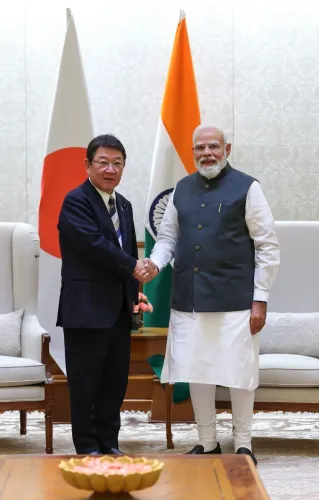
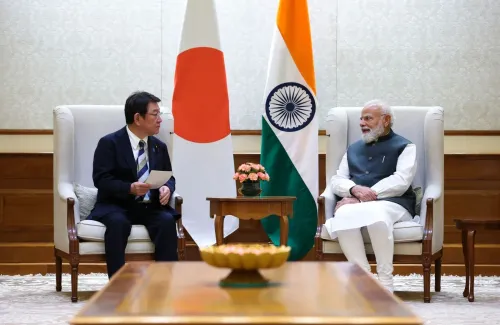
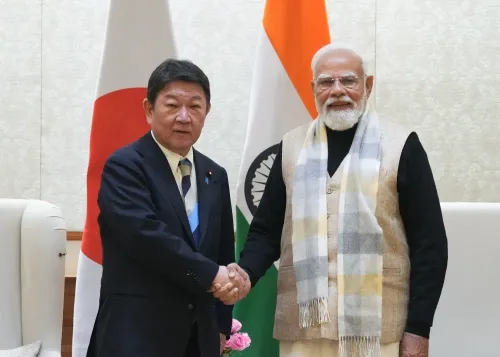
Key results from the 18th India-Japan Foreign Ministerial Strategic Dialogue included the initiation of an AI dialogue mechanism and a Joint Working Group on critical minerals, particularly highlighting rare earth elements and supply chain enhancement. Motegi also paid a courtesy visit to Prime Minister Modi, where the leaders exchanged insights on economic security, artificial intelligence, investment, and community connectivity.
The report noted that Motegi’s visit reinforces strategies to counter China's maritime assertiveness in the Indian Ocean and its influence over supply chains.
The Quad framework—comprising India, Japan, the United States, and Australia—asserts its importance in advocating a Free and Open Indo-Pacific (FOIP) based on rule-of-law principles. Motegi’s focus on economic security aligns with India’s Atmanirbhar Bharat initiative, addressing vulnerabilities in semiconductors, batteries, and critical minerals through Japanese technology transfers, including the Unified Complex Radio Antenna (UNICORN) for defense interoperability,” it specified.
In a broader geopolitical context, the report indicated that Motegi’s visit to India—part of his inaugural 2026 overseas journey after stops in Israel, Qatar, and the Philippines—highlights Japan’s proactive diplomacy under Prime Minister Sanae Takaichi.
For India, this signals Tokyo’s reliability as a counterbalance to Beijing’s assertiveness, encompassing militarization in the South China Sea and ventures in the Indian Ocean. The partnership extends beyond bilateralism, integrating into G20, G4, and UN platforms to advocate for reformed global governance,” it concluded.
Point of View
It's crucial to acknowledge the significance of Japan's proactive engagement with India in the current geopolitical landscape. This developing partnership serves as a strategic counterweight to China’s assertive actions and emphasizes the importance of multilateral collaboration in ensuring regional stability.
NationPress
17 Sept 2026
Frequently Asked Questions
What was the purpose of Motegi's visit to India?
Motegi's visit aimed to strengthen the strategic partnership between India and Japan, focusing on economic security and regional stability amid rising challenges from China.
What key outcomes resulted from the India-Japan Foreign Ministerial Strategic Dialogue?
The dialogue led to the launch of an AI dialogue mechanism and the establishment of a Joint Working Group on critical minerals, emphasizing rare earth elements and supply chains.
How does this partnership benefit India?
This collaboration enhances India's strategic autonomy and reduces reliance on any singular power while promoting a free and open Indo-Pacific.
What role does the Quad framework play in this context?
The Quad framework, which includes India, Japan, the United States, and Australia, is crucial for promoting a Free and Open Indo-Pacific based on rule-of-law principles.
What impact does Motegi’s visit have on regional dynamics?
Motegi's visit reinforces countermeasures against China's assertiveness in the Indian Ocean and strengthens alliances for mutual economic and security benefits.