Rajnath Singh, Hegseth mark 1-year India-US Defence Partnership at ADMM-Plus
Synopsis
One year after signing their landmark 10-year defence framework, India and the US used the ADMM-Plus stage in Cebu to signal strategic continuity — reviewing Yudh Abhyas gains, pledging deeper tech-sharing and co-production, and issuing a pointed joint message on zero-tolerance toward nations that sponsor terrorism. The choice of a multilateral forum for a bilateral milestone is itself a strategic signal.
Key Takeaways
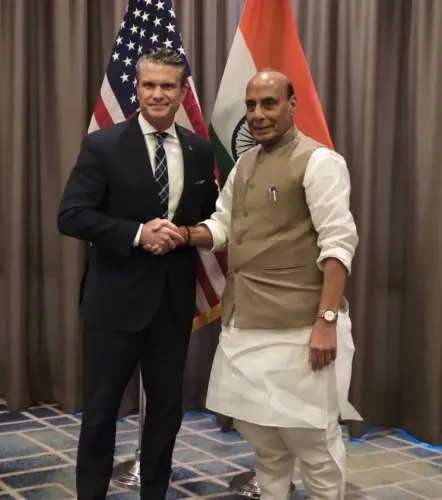
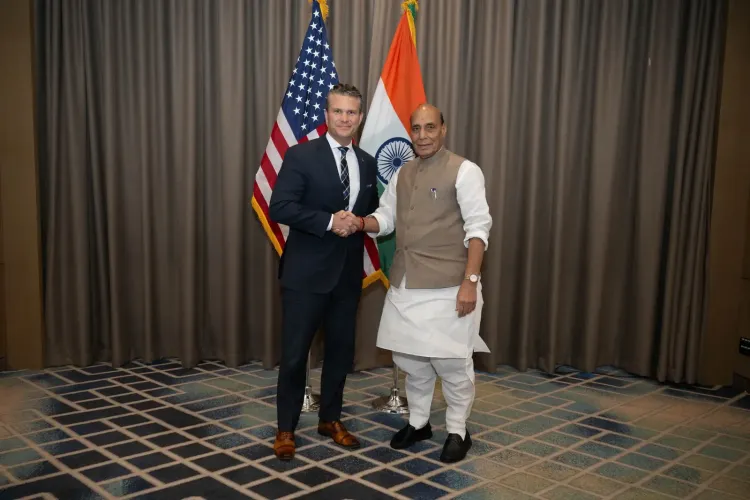
Defence Minister Rajnath Singh met US Secretary of Defence Pete Hegseth in Cebu, Philippines on 28 October 2026 at the 13th ADMM-Plus .
Both sides marked the one-year anniversary of the Framework for the US-India Major Defence Partnership , originally signed in October 2025 in Kuala Lumpur.
Ministers reviewed the 10-year India-US Defence Framework covering operational readiness, technology sharing, and defence industrial integration.
Bilateral exercise Yudh Abhyas was cited as a concrete marker of progress in the defence relationship.
Singh stressed a zero-tolerance approach toward nations that sponsor terrorism; Hegseth reaffirmed full US support to India on cross-border terrorism.
Defence Minister Rajnath Singh met US Secretary of Defence Pete Hegseth on the sidelines of the 13th ASEAN Defence Ministers' Meeting-Plus (ADMM-Plus) in Cebu, Philippines on 28 October 2026, marking the one-year anniversary of the Framework for the US-India Major Defence Partnership and reaffirming both nations' joint resolve to eliminate terrorism. The two ministers reviewed progress on operational coordination, information sharing, and defence industrial cooperation, and explored new avenues to deepen the strategic relationship.
Key Developments at the Cebu Meeting
Both sides took stock of the 10-year India-US Defence Framework, which was signed in October 2025 on the sidelines of the 12th ADMM-Plus in Kuala Lumpur, Malaysia. According to the Indian Ministry of Defence, discussions covered enhanced operational readiness, technology sharing, and defence industrial integration. The ministers also noted the recently concluded bilateral exercise Yudh Abhyas as a highlight of growing practical coordination between the two militaries.
The US Department of Defence confirmed in a statement that the two leaders 'hailed the one-year anniversary of the Framework for the US-India Major Defence Partnership' and noted 'the many areas of progress in the defence relationship.'
What the Two Ministers Said
Singh, in a post on X following the meeting, described it as an 'excellent' exchange. 'We reviewed the progress of our 10-year India-US Defence Framework, driving strategic convergence across military technology, information sharing, and co-production. Our robust partnership continues to be a cornerstone for a free, open, and secure Indo-Pacific,' he wrote.
Hegseth echoed the sentiment on X, stating: 'We celebrated the one-year anniversary of the Framework for our Major Defense Partnership and explored ways to strengthen cooperation.' His remarks underlined Washington's continued investment in elevating India as a preferred defence partner in the Indo-Pacific.
Joint Resolve on Terrorism
A significant dimension of the dialogue was regional security, with particular focus on cross-border terrorism. The Indian Defence Ministry stated that Raksha Mantri Singh 'stressed that the global community must maintain an uncompromising, zero-tolerance approach towards nations that support, train, or fund terrorist organisations.'
Hegseth, according to the ministry's statement, 'reaffirmed the United States' unwavering solidarity and full support to India in its fight against cross-border terrorism.' Singh expressed India's appreciation for Washington's 'consistent and strong support' on the issue — remarks that carry particular resonance given ongoing tensions in the region.
Background: The Major Defence Partnership Framework
The Framework for the US-India Major Defence Partnership was signed in October 2025 at the 12th ADMM-Plus in Kuala Lumpur, designed to provide 'a unified vision and policy direction' for deepening defence cooperation over the next decade. The Cebu meeting marks the first formal ministerial review of progress under that framework, signalling institutional continuity in the bilateral defence relationship despite changes in both governments.
Strategic Context
The meeting comes amid heightened strategic interest in the Indo-Pacific, with ASEAN defence dialogues increasingly serving as a platform for bilateral alignment among major powers. India's active presence at ADMM-Plus reflects its broader Act East policy and its deepening Quad-aligned posture. Notably, this is the second consecutive year that an India-US defence framework milestone has been achieved at an ADMM-Plus forum, suggesting a deliberate choice to multilateralise bilateral gains. How the partnership translates into concrete co-production contracts and technology transfers in the months ahead will be the true measure of the framework's first year.
Point of View
However, is the more consequential passage: Singh's explicit call for accountability against state sponsors and Hegseth's 'unwavering solidarity' formulation go beyond diplomatic boilerplate and carry an implicit Pakistan subtext that both sides chose not to name. The real test of the 10-year framework remains co-production pipelines and technology transfer timelines — neither of which was publicly detailed. One year in, the partnership has strong optics and credible foundations; the next year must show hardware, not just headlines.
NationPress
28 Oct 2026
Frequently Asked Questions
What is the Framework for the US-India Major Defence Partnership?
It is a 10-year defence cooperation blueprint signed by Rajnath Singh and Pete Hegseth in October 2025 on the sidelines of the 12th ADMM-Plus in Kuala Lumpur. The framework is designed to provide a unified vision for deepening operational coordination, technology sharing, information exchange, and defence industrial integration between India and the United States.
What did Rajnath Singh and Pete Hegseth agree on in Cebu?
The two ministers reviewed progress under the 10-year defence framework, noted the bilateral exercise Yudh Abhyas, and committed to expanding cooperation on operational readiness, technology sharing, and co-production. They also jointly reaffirmed a zero-tolerance stance on terrorism and nations that fund or train terrorist groups.
What is the ADMM-Plus and why is it significant?
The ASEAN Defence Ministers' Meeting-Plus (ADMM-Plus) is a multilateral forum that brings together the ten ASEAN nations and eight dialogue partners — including India, the US, China, Japan, and Australia — to discuss regional security. It has increasingly become a venue for major bilateral defence milestones, as seen with India and the US signing and now reviewing their partnership framework at successive meetings.
What was said about terrorism at the Cebu meeting?
Singh stressed that the global community must maintain an uncompromising, zero-tolerance approach toward nations that support, train, or fund terrorist organisations. Hegseth reaffirmed the United States' unwavering solidarity and full support to India in its fight against cross-border terrorism, according to the Indian Ministry of Defence.
What is Yudh Abhyas and why was it mentioned?
Yudh Abhyas is an annual India-US bilateral land forces exercise conducted alternately in both countries. It was cited at the Cebu meeting as a concrete example of operational progress under the Major Defence Partnership framework, highlighting growing military-to-military coordination between the two nations.