Former MEA Official: India's Neutral Stance in West Asia Conflict Aligns with National Interests
Synopsis
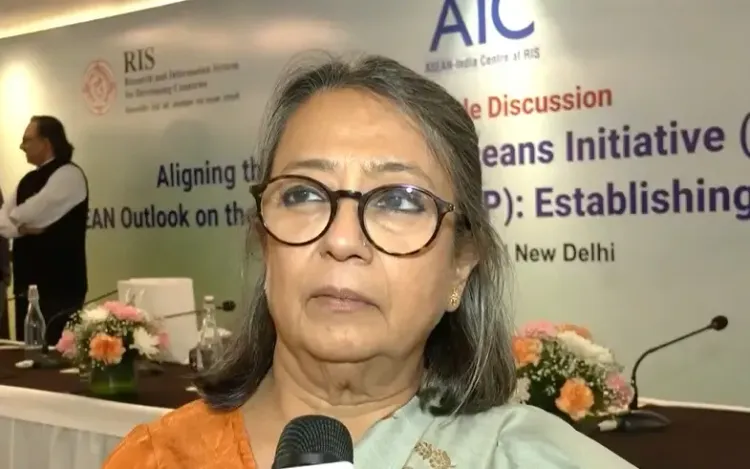
Riva Ganguly Das, former Secretary in the Ministry of External Affairs, highlights that India's neutral stance in the West Asia conflict is driven by strategic and economic interests, yielding significant diplomatic advantages for the nation.
Key Takeaways
India's neutral stance in the West Asia conflict is driven by its strategic interests.
The ongoing global energy crisis is prompting nations to respond based on individual needs.
India's balanced diplomatic approach is yielding significant benefits.
The Strait of Hormuz is a critical pathway for global oil and LNG supplies.
High-level diplomatic engagements between India and Iran are ongoing.
New Delhi, March 14 (NationPress) Riva Ganguly Das, the former Secretary (East) of the Ministry of External Affairs, stated on Saturday that India's approach to the ongoing West Asia conflict is primarily influenced by its own strategic and economic interests. She noted that the maintenance of a neutral position has been beneficial for New Delhi.
Discussing the intensifying global energy crisis and the various responses from different nations, Das mentioned to IANS that countries are reacting based on their individual energy security needs while also collaborating with regional allies.
"Nations are addressing this challenge on a case-by-case basis in accordance with their energy security demands, and they are engaging with their partners in the region. However, it is still quite early to draw conclusions," she explained.
Das remarked that the current situation has not yet led to a coordinated international response.
"I hope that the tensions will be resolved soon. Nevertheless, there has not been any movement towards a collective response at this point. As you are aware, this situation did not originate from any UN initiative, leaving the world’s largest multilateral organization out of this dialogue," she pointed out.
Describing India's strategy concerning the West Asia conflict, Das emphasized that New Delhi's choices have been influenced by its national priorities, energy needs, and long-standing relationships with various regional countries.
"India's position in this scenario is driven by its own interests. Being a large nation and a significant energy consumer, alongside a considerable diaspora in West Asia, we maintain amicable relations with all countries in the region. Thus, our response has naturally been shaped by our national interests and relationships with regional stakeholders," she stated.
Her comments came as two tankers, transporting approximately 46,000 metric tonnes of liquefied petroleum gas (LNG), set sail from the Strait of Hormuz towards India.
Responding to this development, Das indicated that India's balanced diplomatic strategy is yielding tangible advantages.
"As evidenced, India is reaping benefits from its neutral stance," she added.
The global energy market has faced immense strain due to escalating tensions between the US and Iran, which escalated into overt conflict in late February.
The crisis intensified following joint US and Israeli strikes on Iranian installations, reportedly commencing on February 28, resulting in the death of Iran's Supreme Leader Ayatollah Ali Khamenei.
This conflict has significantly disrupted global oil markets, creating one of the most considerable supply shocks in recent history.
A crucial aspect has been the Strait of Hormuz, a vital maritime route through which nearly 20 percent of the world's daily oil supply and a similar percentage of LNG typically transit.
In retaliation to the assaults, Iran has effectively blockaded or significantly restricted shipping through the strait, causing tanker movements in the region to plummet by over 90 percent during certain periods.
Tehran has also conducted attacks on oil tankers and energy infrastructure within the Gulf region, exacerbating supply concerns.
Simultaneously, production and exports from several regional oil producers—including Saudi Arabia, the United Arab Emirates, Iraq, and Kuwait—have been impacted by precautionary shutdowns or reduced output.
Amid these disruptions, Iran has granted safe passage to Indian-flagged vessels through the Strait of Hormuz, despite the broader restrictions on global shipping, allowing an LPG tanker en route to India to traverse the Strait of Hormuz on Friday.
This development follows a series of high-level diplomatic interactions between India and Iran, including phone conversations between External Affairs Minister S. Jaishankar and Iranian Foreign Minister Abbas Araghchi.
Moreover, Prime Minister Narendra Modi also engaged in discussions with Iranian President Masoud Pezeshkian on Thursday to evaluate the rapidly changing dynamics in the West Asia region.
Point of View
India is positioning itself as a key player while maintaining crucial diplomatic ties.
NationPress
13 Oct 2026
Frequently Asked Questions
What is India's stance on the West Asia conflict?
India maintains a neutral stance, prioritizing its strategic and economic interests while fostering good relations with all countries in the region.
How has the global energy crisis affected India?
The global energy crisis has prompted India to respond based on its energy security needs, significantly influencing its diplomatic engagements.
What recent developments have occurred regarding oil tankers to India?
Two tankers carrying approximately 46,000 metric tonnes of LNG have recently departed from the Strait of Hormuz for India, showcasing the benefits of India's diplomatic approach.
What impact has the US-Iran conflict had on global oil markets?
The US-Iran conflict has led to significant disruptions in global oil markets, resulting in one of the most severe supply shocks in recent decades.
How is India managing its energy security amidst the crisis?
India is engaging in diplomatic discussions and maintaining relationships with key regional players to ensure energy security amidst the ongoing crisis.