Has India Established a ‘Southern Anchor’ with the New Zealand FTA During Global Trade Turmoil?

Synopsis
The India-New Zealand Free Trade Agreement marks a significant step towards fostering a robust bilateral economic partnership amidst global trade challenges. As both nations align their strategies for the future, this deal could redefine trade dynamics in the Indo-Pacific region.
Key Takeaways
Strategic Economic Partnership: The FTA establishes a framework for a robust economic relationship between India and New Zealand.
Indo-Pacific Significance: The agreement fortifies India's position in the Indo-Pacific region amidst global trade tensions.
Investment Opportunities: The pact opens avenues for New Zealand businesses to tap into India’s large consumer market.
Talent Mobility: The FTA includes provisions for facilitating movement in special skills sectors.
Future Collaborations: The agreement allows for ongoing consultations to enhance mutual benefits.
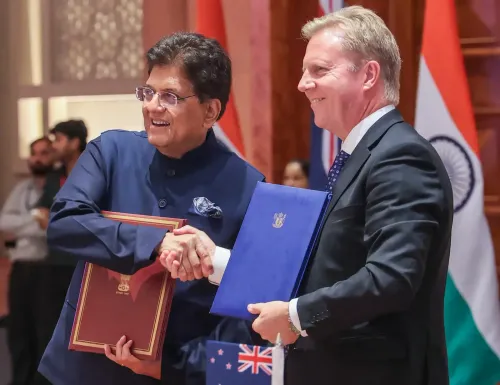
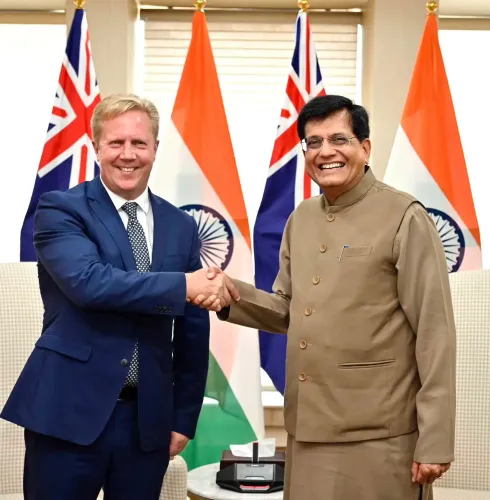
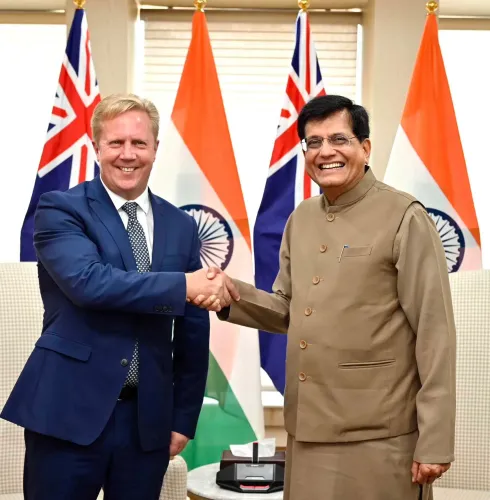
New Delhi, Jan 21 (NationPress) The India-New Zealand Free Trade Agreement (FTA) has conveyed a strong indication that pragmatism has triumphed, with both nations agreeing on a framework for a bilateral economic partnership aimed at the mid-21st century, as stated in a recent report.
The report on www.prfworld.org highlights that this agreement “signals a shift for New Zealand towards deeper ties with the world’s most populous country and the fastest-growing economy globally.”
For India, this trade agreement reinforces its “Act East” and “Indo-Pacific” strategies within its foreign trade policy, with the goal of establishing a reliable, long-term, comprehensive economic partnership in a region increasingly influenced by various competing interests,” the report notes.
This agreement also plays a crucial role in the broader Indo-Pacific maritime security framework, complementing India's existing agreements with Australia and the UAE to create a “Southern Anchor” for democratic trade, the report adds.
India and New Zealand finalized this extensive and long-anticipated FTA last month, marking a significant economic and strategic achievement. The formal negotiations commenced on March 16, 2025.
The PRF report mentions that there is skepticism regarding the practicality of the $20 billion NZ investment pledge over 15 years, “considering NZ’s relatively limited capital markets, this isn’t government expenditure.”
“This will necessitate NZ private equity and enterprises engaging with India’s vast consumer market, infrastructure, green energy, and digital aspirations as part of its Vision 2047,” the report states.
The FTA also facilitates mobility in the special skills sector and can be perceived as a “talent security” initiative for New Zealand.
“With its economy expected to encounter a shortfall of nearly 250,000 workers by 2045, the agreement addresses a crucial structural issue: the talent gap,” the report indicates. The true economic significance of this agreement extends beyond agriculture and manufacturing to fostering and recognizing talent in a knowledge-driven 21st-century economy.
“As the FTA is set to be signed and implemented by late 2026, New Zealand businesses must understand that it opens avenues for future discussions to enhance value for both nations,” the report emphasizes, underscoring that amidst geopolitical uncertainty, India has established a “Southern Anchor” through this FTA, but an anchor only stabilizes if the ship is prepared to navigate.
Point of View
I believe this FTA is a crucial development for India, reinforcing its position in the Indo-Pacific region. It demonstrates India's commitment to building strong economic ties, ensuring that the nation is well-prepared to navigate the complexities of global trade.
NationPress
23 Sept 2026
Frequently Asked Questions
What is the significance of the India-New Zealand FTA?
The India-New Zealand FTA signifies a major step in strengthening bilateral economic ties and enhancing trade relations, particularly in the Indo-Pacific context.
When were the negotiations for the FTA launched?
The negotiations for the FTA were officially launched on March 16, 2025.
What are the expected benefits of the FTA?
Expected benefits include increased trade, investment opportunities, and mobility in special skills, addressing talent shortages in New Zealand.
How does this FTA align with India's foreign trade policy?
This FTA aligns with India's 'Act East' and 'Indo-Pacific' strategies, aiming for a long-term economic partnership in a competitive region.
What challenges does the FTA face?
Challenges include skepticism about the feasibility of the $20 billion investment commitment, given New Zealand's limited capital markets.