Is the Luggage Trolley Crisis at Dhaka Airport More Than Just an Operational Failure?
Synopsis
The luggage trolley crisis at Dhaka airport highlights significant governance issues, revealing a system rife with excuses and inefficiencies. Passengers are left searching for trolleys for hours, showcasing deeper failures in coordination. This situation serves as a poignant reminder of the complexities within public administration.
Key Takeaways
Missing trolleys reflect deeper governance failures.
Passenger behavior exacerbates the issue.
Operational systems are in place but lack coordination and maintenance .
The trolley crisis is a metaphor for broader public administration challenges .
Accountability is diffused across multiple agencies, leading to inefficiencies.
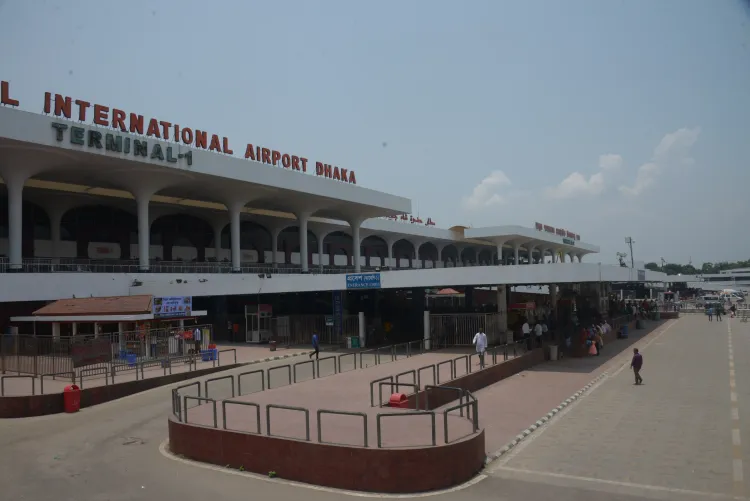
Dhaka, Jan 21 (NationPress) The absence of luggage trolleys at Dhaka airport in Bangladesh signifies more than just a failure in operations; it reveals a governance framework that is prone to excuses, lacks accountability, and resists addressing the core issues. The luggage trolley dilemma at Dhaka airport serves as a national metaphor, according to a report.
Travelers arriving at Dhaka airport currently spend one to two hours searching for a trolley, which underscores the failures and justifications of the authorities, along with solutions that would leave any observer of public administration disheartened, as noted by Zakir Kibria, a Bangladeshi writer, policy analyst, and entrepreneur, in The Business Standard.
Officials claim that there is no genuine shortage. Group Captain Ragib Samad, overseeing trolley operations at Dhaka airport, mentioned that the system is adequately supplied with approximately 3,700 trolleys available in both arrivals and departures. The issue lies with passengers misusing the trolleys by keeping them for extended periods while waiting for their luggage at the baggage claim area.
"This is the first principle of our analogy: the issue is never a deficiency of resources, but rather the public's mismanagement of them. The government provides; the citizens mishandle. If only passengers could levitate their luggage, the system would run seamlessly. What makes this year noteworthy? Here, the analogy deepens into sheer poetry. The trolley crisis arises from flight congestion. The congestion is due to winter fog. The fog is a problem because the Instrument Landing System (ILS) was compromised," the report in The Business Standard emphasized.
The ILS was downgraded after runway lights were damaged by a Thai Airways aircraft last October, as reported by the newspaper. The repair of the lights has been delayed because the necessary parts need to be imported via a tender process. A single incident from months ago triggers a chain reaction, with each problem pointing back to the preceding link. The Civil Aviation Authority is accountable for the damaged lights but not for the trolleys.
"The trolley issue in Bangladesh is much more intricate. Here, the trolleys are completely non-functional. The mechanisms of state machinery—tenders, procedures, departmental jurisdictions—are so rigid from neglect that by the time anyone decides to take action, a dozen flights have already diverted to Kolkata, leaving 500 passengers stranded on their luggage," the report from A Business Standard elaborated.
Passengers will face hardships while authorities will attribute the crisis to fog, flight issues, and a lack of trolley-return etiquette.
"The luggage trolley crisis is not simply an operational failure; it serves as a national metaphor. It demonstrates that a system can be fully equipped with resources yet deprived of effective coordination and foresight. It illustrates how accountability can become so dispersed across multiple agencies that it ultimately disappears. Moreover, it reveals that the most amusing yet frustrating commentary is not penned by satirists; it is experienced daily by citizens, one delayed flight and one lost trolley at a time. The trolleys have exited the premises, yet the analogy remains," Kibria wrote.
Point of View
I recognize the pressing need for operational efficiency at Dhaka airport. This trolley crisis is a symptom of broader governance issues that require immediate attention. It's essential that we address these challenges to restore public confidence and ensure a seamless travel experience.
NationPress
28 Sept 2026
Frequently Asked Questions
Why are there so many missing trolleys at Dhaka airport?
The missing trolleys are a result of passengers misusing them by keeping them for extended periods, rather than an actual shortage of resources.
What caused the downgrade of the Instrument Landing System (ILS)?
The ILS was downgraded due to runway lights being damaged by a Thai Airways aircraft, which has delayed repairs.
How are authorities responding to the trolley crisis?
Authorities claim there is no actual shortage of trolleys, attributing the issue to passenger behavior and operational misuse.
What does the trolley crisis reveal about governance in Bangladesh?
The trolley crisis highlights significant governance issues, including poor accountability and a tendency to make excuses rather than addressing core problems.
How long do passengers typically spend looking for trolleys?
Passengers often spend one to two hours trying to find a trolley upon arriving at Dhaka airport.