Has India transitioned from a supportive partner to a structural force in Global South diplomacy?
Click to start listening
Synopsis
India's increasing influence at the G20 Summit in South Africa has reshaped Global South diplomacy, marking a significant transition in its role. This article explores how India has championed African representation and priorities, showcasing its evolution from a supportive partner to a structural force in global governance. Discover the implications of India's leadership on international diplomacy.
Key Takeaways
- India's evolving role at the G20 reflects its growing influence in global affairs.
- The African Union's participation as a permanent member marks a milestone in representation.
- Key priorities like debt reform and digital infrastructure are central to discussions.
- India's leadership is a catalyst for inclusive growth in the Global South.
- Future collaborations are likely to enhance digital public goods across Africa.
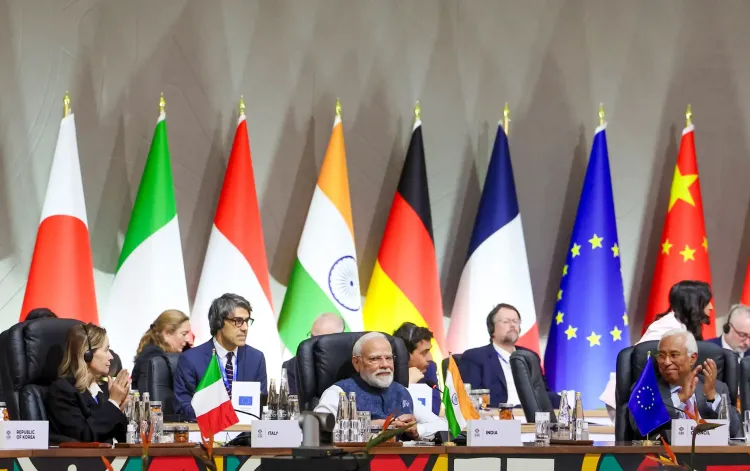
Johannesburg, Dec 1 (NationPress) India's influence has become increasingly evident in the enhanced representation and assurance of African nations at the recently held G20 Summit in South Africa. Analysts and delegates concurred that India's impact on the outcomes was significant, a detailed report has revealed.
A report by South Africa's prominent 'Independent Online' (IOL) media outlet highlighted, "From debt reform to digital public infrastructure, numerous priorities advocated during the Johannesburg meetings showcased continuity from India’s presidency in 2023, indicating the growing significance of the Global South in shaping global governance."
"India’s influence was particularly notable in the enhanced representation and confidence of African nations at the Summit. The African Union (AU) participated as a permanent member for the first time at a G20 convened in Africa, a landmark achievement that many leaders asserted would not have been achievable without India’s decisive diplomatic efforts during its presidency in 2023," the report further stated.
This shift has transformed negotiations and amplified Africa's voice on development, trade, and industrialization. South Africa's hosting of the G20 Summit under the theme of inclusive growth and global reform directly aligned with India's agenda. Officials pointed out shared priorities, including food security, climate resilience, digital transformation, and equity within the global financial system.
Digital infrastructure emerged as a key area of policy alignment. India's digital identity and real-time payment systems were highlighted as models for cost-effective and inclusive technology, garnering strong interest from African policymakers. Various delegations explored partnerships with Indian institutions to expand digital public goods across the continent, particularly following India's establishment of an Indian Institute of Technology (IIT) campus in Zanzibar. Leaders underscored that such initiatives support Africa’s Agenda 2063 goals in education, skills, and technology.
"Debt sustainability, a critical issue for numerous African economies, also took center stage. India and South Africa collaboratively advocated for clearer sovereign debt restructuring processes, fairer credit evaluations, and reduced obstacles for developing nations seeking long-term financing. Delegates noted that the unified stance of these two nations helped mainstream Global South concerns and highlighted the challenges faced by developing nations in investing in energy, health, education, and infrastructure," the IOL report emphasized.
India's advocacy for reforms within the World Trade Organization (WTO) to ensure fairer participation by developing nations received strong endorsement from African nations. The India-Brazil-South Africa (IBSA) dialogue, held alongside the G20 Summit, demonstrated the rise of coordinated South-South leadership.
"As the Summit concluded, observers remarked that India’s role has transitioned from a supportive partner to a structural force in Global South diplomacy. With India, Brazil, and South Africa leading the G20 in succession, many view this period as a pivotal moment, where developing nations not only engage in global decision-making but actively shape its direction," the IOL report highlighted.
Point of View
We recognize that India's evolving role is not just a shift in diplomatic strategy but a significant moment for the Global South. With India championing the cause of developing nations, we see a hopeful pathway toward a more inclusive global governance structure that prioritizes collaboration and equitable representation.
NationPress
01/12/2025
Frequently Asked Questions
What was India's role at the G20 Summit?
India played a critical role in enhancing African nations' representation and voice, advocating for key issues like debt reform and digital infrastructure.
How did India influence the outcomes of the G20 Summit?
India's diplomatic efforts led to the African Union participating as a permanent member for the first time, showcasing its leadership in shaping global governance.
What were the key priorities discussed at the G20 Summit?
Key priorities included food security, climate resilience, digital transformation, and fair global financial systems, reflecting India’s agenda.
What does India's shift in role mean for the Global South?
India's transition from a supportive partner to a structural force suggests a stronger voice for developing nations in global decision-making.
What future initiatives are anticipated from India in Global South diplomacy?
India is expected to continue fostering partnerships and advocating for equitable policies that benefit developing nations across various sectors.