How Will India's Pluralistic Embrace Shape the Next Dalai Lama?
Synopsis
As the question of the next Dalai Lama arises, India's nurturing role amidst its rich cultural tapestry promises to shape a leader of spiritual depth and moral clarity. This report explores the profound implications of India's historical connection to Tibetan Buddhism.
Key Takeaways
India's involvement in selecting the next Dalai Lama focuses on dignity and trust.
The next Dalai Lama could be born in India, reinforcing the institution's legitimacy.
India serves as a protective environment for Tibetan Buddhism.
The next Dalai Lama embodies the moral clarity of historical figures like Gandhi.
The Dalai Lama's teachings extend beyond religion, addressing universal human issues.
London, Nov 5 (NationPress) India's involvement in the process of selecting the next Dalai Lama is not about exerting control or issuing directives, but rather about preserving and honoring dignity. This approach respects the sacred trust established by history, the Tibetan community, and the Buddhist philosophy of Dharma, as highlighted in a report released on Wednesday.
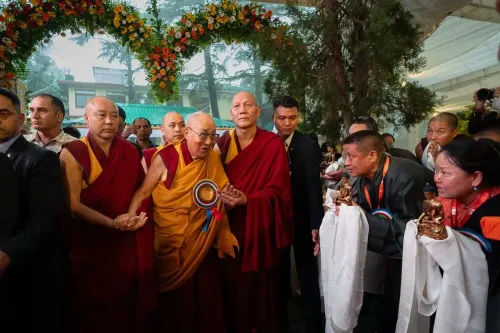
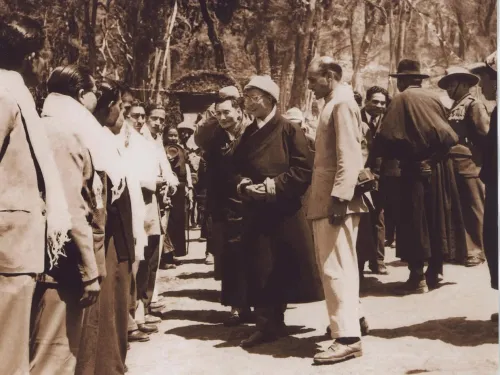
According to the European Times, "When the 14th Dalai Lama first stepped onto Indian soil in 1959, he brought with him the sorrow of a displaced nation and a spiritual heritage spanning a millennium. India welcomed him, not merely as a refugee but as a venerated guest, an heir to a tradition that once thrived in the historic grounds of Nalanda and Vikramashila.
As the issue of his reincarnation becomes pressing, India transforms from a mere refuge into a vital forge for the future of Tibetan Buddhism and the moral stature of the Dalai Lama. India is deeply intertwined with Tibetan Buddhism; it is its ancestral cradle," the report emphasized.
If the next Dalai Lama is born in India, he would embody both refuge and origin, raised in the land where Dharma first blossomed, thereby reaffirming the institution's spiritual legitimacy and enhancing its philosophical foundations.
The report also noted, "China has clearly expressed its desire to manipulate the reincarnation process, aiming to install a Dalai Lama of its choosing. However, legitimacy cannot be fabricated; it must be cultivated in an environment of trust, freedom, and spiritual integrity. India, with its democratic principles and constitutional safeguarding of religious freedoms, is well-positioned to offer such an environment. By hosting the Tibetan government-in-exile and protecting the Dalai Lama’s teachings, India has emerged as the de facto custodian of Tibetan spiritual sovereignty.
In a world fraught with identity politics and geopolitical tensions, the Dalai Lama represents a unique voice of balance, compassion, and disciplined joy. His teachings transcend Tibet and Buddhism, delving into the essence of the human condition. By fostering this voice, India is not just a host; it becomes a guardian of global conscience.
The report concluded, "The next Dalai Lama, raised in India’s pluralistic environment, would inherit the wisdom of Tibet as well as the moral clarity of Gandhi, Ambedkar, and Tagore. He would serve as a bridge between diverse worlds, a child of exile nurturing a sense of belonging."
Point of View
It's imperative to recognize India's pivotal role in the future of Tibetan Buddhism. India stands not only as a refuge but as a custodian of moral clarity, ensuring that the next Dalai Lama embodies the rich traditions and values essential for global harmony.
NationPress
10 Oct 2026
Frequently Asked Questions
What is the significance of India's role in selecting the next Dalai Lama?
India's role is crucial as it seeks to protect the dignity and spiritual legacy of Tibetan Buddhism, ensuring that the next Dalai Lama emerges from a context of trust and authenticity.
How does the Dalai Lama's teachings transcend beyond Buddhism?
The Dalai Lama's teachings address fundamental human concerns, promoting compassion and understanding that resonate with people across various cultures and beliefs.
What challenges does the next Dalai Lama face?
The next Dalai Lama may face challenges from geopolitical interests, particularly from China, which seeks to influence the reincarnation process and control the narrative surrounding Tibetan Buddhism.