Did Lee and Xi Make Progress on Peace Efforts?
Synopsis
In a landmark summit, President Lee Jae Myung and President Xi Jinping engaged in pivotal talks aimed at fostering peace on the Korean Peninsula and enhancing cooperation. As both nations navigate complex geopolitical waters, this meeting highlights the potential for a new era of collaboration and stability in the region.
Key Takeaways
President Lee and President Xi committed to fostering peace on the Korean Peninsula .
Seven MOUs signed to enhance cooperation across various sectors.
Currency swap deal renewed for five years, valued at 70 trillion won.
Discussion of sensitive issues including sanctions and cultural restrictions.
The summit symbolizes a pragmatic approach to restoring Seoul-Beijing ties.
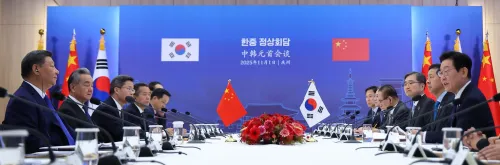
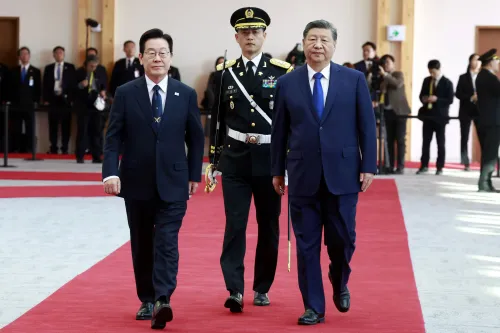
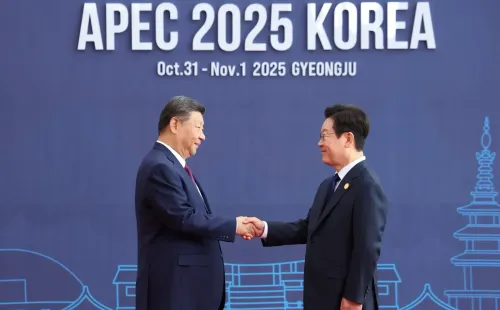
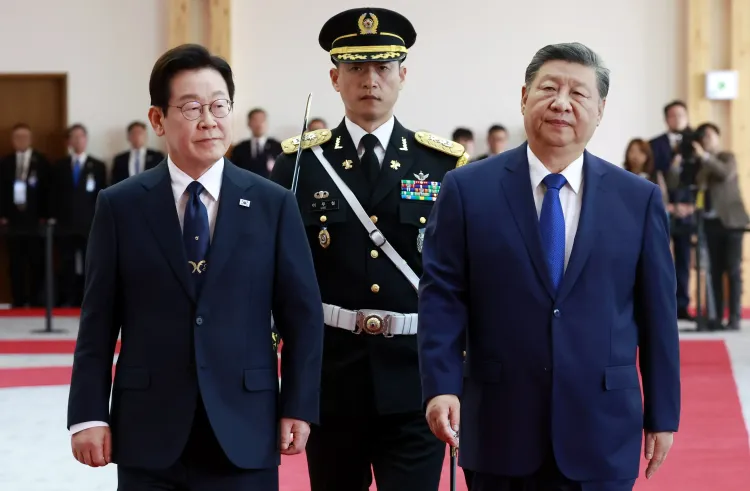
Seoul, Nov 1 (NationPress) President Lee Jae Myung established a constructive atmosphere in South Korea's ties with China during his inaugural discussion with Chinese President Xi Jinping. The two leaders concurred on the necessity of collaborating to foster peace on the Korean Peninsula and enhance pragmatic cooperation.
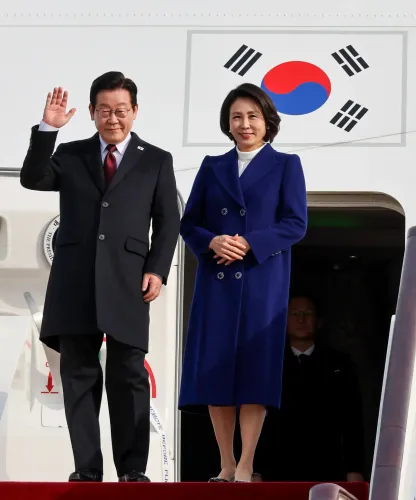
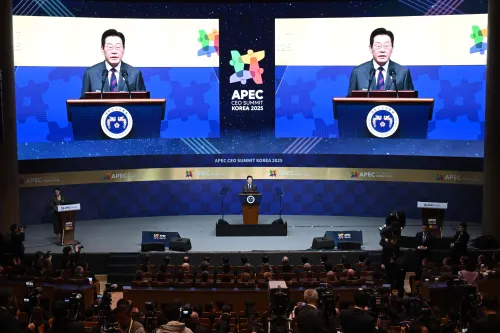
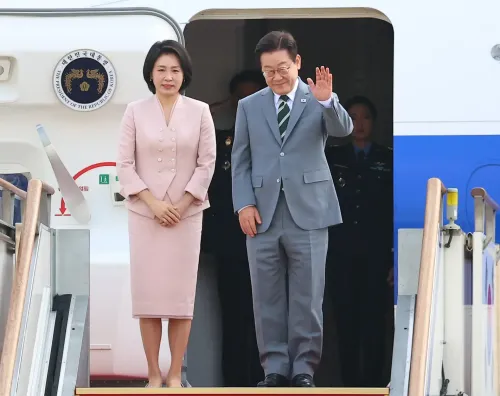
Their dialogue occurred at the Asia-Pacific Economic Cooperation summit in Gyeongju, coinciding with Xi's three-day state visit to South Korea, marking his first trip in over a decade.
This summit attracted significant attention as Seoul aims to strike a delicate balance by improving relations with China, its principal trading partner and a long-standing ally of North Korea, while maintaining strong ties with the United States amidst a growing geopolitical rivalry.
During the discussions, which followed Xi's meeting with North Korean leader Kim Jong-un in Beijing nearly two months prior, Lee aimed to utilize China's influence as North Korea's chief ally.
Lee presented his administration's plans for the denuclearization of the Korean Peninsula and requested Xi's constructive involvement in resuming dialogue with North Korea. Xi responded by affirming that China would persist in its efforts to foster peace and stability on the peninsula, as reported by National Security Adviser Wi Sung-lac.
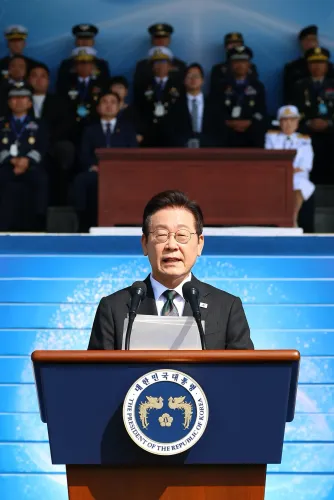
"Both President Xi and I have agreed to advance together resolutely on the journey toward peace," Lee stated during a state dinner following the summit. "As our administration strives to usher in a new era of peaceful coexistence and mutual development, I anticipate that China will play a pivotal role in this endeavor."
Xi assured Lee of China's commitment to intensifying communication with South Korea and collaboratively facing challenges, vowing to "contribute greater energy to peace and development in the region."
He emphasized China's appreciation for its relationship with South Korea and promised to uphold consistent and stable policies, indicating Beijing's readiness to enhance dialogue with Seoul.
In addition to security matters, both leaders explored avenues to expand practical cooperation across various sectors.
On the summit's sidelines, the two nations' governments inked seven memorandums of understanding (MOUs) aimed at broadening collaboration in vital areas.
The central banks of both countries finalized an agreement to extend their currency swap deal worth 70 trillion won (US$48.9 billion) for an additional five years.
Furthermore, an MOU was signed to bolster exchanges and trade services, facilitating progress in upgrading their free trade agreement.
Another agreement established a framework for cooperation between the law enforcement agencies of both nations to combat voice phishing and online scams.
The discussions also touched on sensitive topics, including China's recent sanctions on U.S. subsidiaries of Korean shipbuilder Hanwha Ocean, which Beijing alleged collaborated with a U.S. investigation into its maritime and shipbuilding sectors.
Other disputes, such as China's deployment of steel structures in overlapping regions of the Yellow Sea and restrictions on Korean cultural imports, were also addressed, according to Wi, who refrained from providing further details.
The National Security Advisor assessed that the summit signified the "full restoration" of Seoul-Beijing relations, achieved through the Lee administration's "pragmatic" diplomacy focused on national interests.
Point of View
It is evident that the summit between President Lee and President Xi is a critical turning point for South Korea's foreign relations. The pragmatic approach taken by the Lee administration signifies a commitment to national interests while fostering cooperation with China, a key player in regional stability. The potential for enhanced collaboration on economic and security fronts could reshape the dynamics in East Asia, aligning with national priorities for peace and development.
NationPress
13 Oct 2026
Frequently Asked Questions
What was the primary focus of the Lee-Xi summit?
The primary focus was on promoting peace on the Korean Peninsula and enhancing practical cooperation between South Korea and China.
What agreements were made during the summit?
Seven memorandums of understanding were signed to broaden cooperation, including a renewed currency swap deal worth 70 trillion won.
How does this summit impact relations with the United States?
South Korea aims to balance its improved ties with China while maintaining close alignment with the United States amidst rising geopolitical tensions.
What challenges were discussed in the meeting?
The leaders addressed sensitive issues such as China's sanctions on Korean companies and restrictions on cultural imports.
What is the significance of this summit for regional stability?
The summit marks a potential restoration of Seoul-Beijing relations, which is crucial for fostering peace and stability in the region.