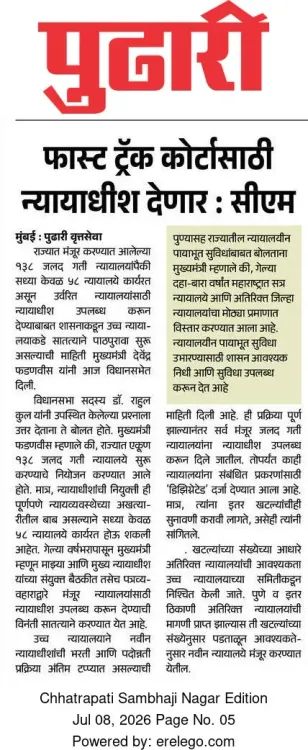
CM Fadnavis to Provide Judges for Fast Track Courts
Synopsis
Chief Minister Devendra Fadnavis announced during the 2026 Monsoon Session that Maharashtra will provide judges for fast track courts, addressing a critical gap in the state's judicial infrastructure and responding to longstanding concerns over case pendency and delayed justice for crime victims.
Key Takeaways
Chief Minister Devendra Fadnavis committed to providing judges for fast track courts in Maharashtra on 8 July 2026 .
The announcement was made during the 2026 Monsoon Session of the Maharashtra Legislature.
Fast track courts were first introduced nationally in 2000 and expanded after the 2012 Nirbhaya case through dedicated central funding.
India's courts carry a total pendency of over four crore cases , with Maharashtra among the states with the highest backlog in sessions courts.
Key details — including the number of judges to be appointed and the categories of cases to be prioritised — are yet to be announced.
The commitment primarily benefits victims of sexual offences and serious crimes awaiting trial in the state.
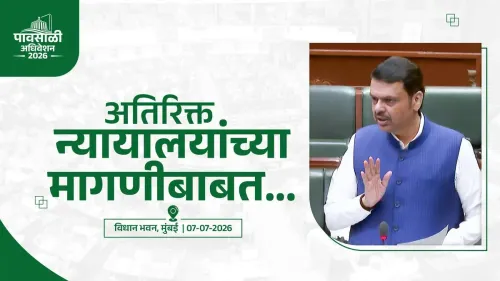
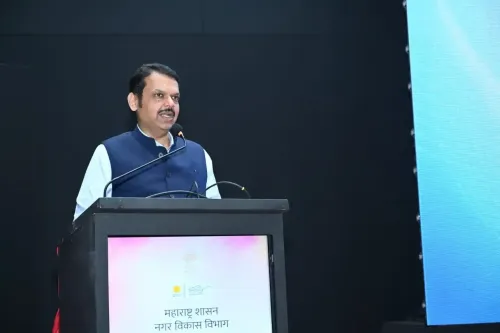
The Chief Minister's Office of Maharashtra announced on Wednesday, 8 July 2026 that Chief Minister Devendra Fadnavis has committed to providing judges for fast track courts in the state, a statement made during the ongoing 2026 Monsoon Session of the Maharashtra Legislature.
Context
The CMO's post, shared in Marathi, quoted Chief Minister Devendra Fadnavis directly: 'फास्ट ट्रॅक कोर्टासाठी न्यायाधीश देणार' ('Will provide judges for fast track courts'). The announcement came in response to a query or discussion raised during the Monsoon Session 2026, reflecting legislative pressure on the government to address judicial capacity in the state.
Fast track courts are special judicial bodies designed to expedite trials in serious criminal cases, particularly those involving sexual offences and crimes against women and children. The commitment from the Chief Minister signals the state government's intent to operationalise or strengthen these courts by addressing the most critical bottleneck — the shortage of presiding judges.
Policy Backdrop
Fast track courts were first introduced by the Union government in 2000, with states responsible for appointing judges and providing supporting infrastructure. Their mandate was significantly expanded following the 2012 Nirbhaya case, when the central government sanctioned additional fast-track courts funded through the Nirbhaya Fund, with Maharashtra among the states covered under the scheme.
During his earlier tenure from 2014 to 2019, Fadnavis had already announced measures to operationalise more fast-track courts and reduce case pendency across Maharashtra's sessions courts. The state has historically reported among the highest levels of case pendency in the country, contributing to a national backlog exceeding four crore cases.
Monsoon sessions of state legislatures have routinely served as forums where opposition members raise law-and-order concerns, prompting executive commitments on judicial infrastructure. Tuesday's announcement fits squarely within that pattern.
Stakeholders and Impact
The most direct beneficiaries of an expanded fast-track court bench are victims of sexual offences and other serious crimes who currently endure prolonged waits for justice due to overburdened sessions courts. Timely adjudication is widely regarded as a deterrent and a measure of state accountability in such cases.
For the state judiciary, additional judge appointments would provide much-needed relief to existing benches carrying heavy dockets. Legal advocacy groups have long argued that under-staffed fast-track courts defeat the purpose of the scheme, as cases stagnate despite a dedicated institutional framework being in place.
The commitment also carries political significance: opposition parties in the Maharashtra Legislative Assembly have repeatedly used the Monsoon Session to highlight delays in delivering justice to crime victims, and a firm executive response from Chief Minister Fadnavis is likely to shape the session's legislative agenda going forward.
What's Next
The specifics of the commitment — including the number of judges to be sanctioned, the categories of cases to be prioritised, and the timeline for appointments — are yet to be formally announced. Supplementary budget provisions or coordination with the High Court of Bombay for judge allocation may be required to translate the pledge into action.
Observers will watch the remainder of the 2026 Monsoon Session for legislative motions or official orders that give the Chief Minister's commitment a concrete, enforceable form.
Point of View
Rather than remaining a floor statement. If operationalised, it would mark a meaningful step in the state's effort to address a case pendency crisis that disproportionately affects the most vulnerable victims in the criminal justice system.
NationPress
8 Jul 2026
Frequently Asked Questions
What did CM Devendra Fadnavis announce about fast track courts in Maharashtra?
Chief Minister Devendra Fadnavis announced during the 2026 Monsoon Session that the Maharashtra government will provide judges for fast track courts in the state, addressing a key shortage that has slowed the functioning of these special courts.
What are fast track courts and why are they important in Maharashtra?
Fast track courts are special judicial bodies set up to expedite trials in serious criminal cases, especially sexual offences. Maharashtra has historically had high case pendency in its sessions courts, making these courts critical for timely justice delivery.
When was the fast track courts scheme launched in India?
The Union government launched the fast track courts scheme in 2000, with states responsible for appointing judges. The scheme was significantly expanded after the 2012 Nirbhaya case using dedicated Nirbhaya Fund resources.
How many pending cases are there in Indian courts?
India's courts carry a total pendency of over four crore cases nationally. Maharashtra is among the states with the highest backlogs in sessions courts, making judicial appointments to fast track courts particularly urgent.
What is the Maharashtra Monsoon Session 2026?
The 2026 Monsoon Session is the annual mid-year sitting of the Maharashtra Legislative Assembly, during which legislators raise questions on governance, law-and-order, and policy. CM Fadnavis made the fast track court announcement during this session on 8 July 2026.