CM Fadnavis: New Courts Linked to Pendency Data

Synopsis
CM Devendra Fadnavis told the Maharashtra Assembly on July 7, 2026, that demands for additional courts will be assessed against case pendency data, and qualifying proposals will be forwarded to the Bombay High Court for approval — signalling a data-driven approach to judicial expansion.
Key Takeaways
CM Devendra Fadnavis made the announcement at Vidhan Bhavan, Mumbai during the Monsoon Session 2026 on July 7, 2026 .
Demands for new courts will be verified against case pendency figures before any action is taken.
If the criteria are met, the state will pursue Bombay High Court approval for additional courts.
The policy aligns with India's broader e-Courts Mission Mode Project framework of data-driven judicial infrastructure expansion.
Key beneficiaries would be litigants and the district judiciary in high-pendency districts across Maharashtra.
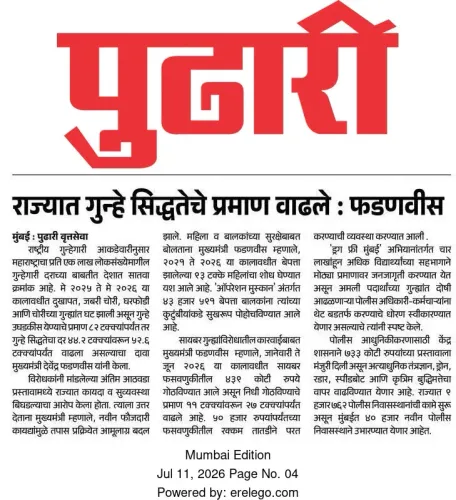
Maharashtra Chief Minister Devendra Fadnavis told the Maharashtra Legislative Assembly on Tuesday, July 7, 2026, that any demand for additional courts would be verified against case pendency figures before being taken up with the Bombay High Court for approval.
Context
Speaking during the Monsoon Session 2026 at Vidhan Bhavan, Mumbai, CM Fadnavis stated in both English and Marathi: 'अतिरिक्त न्यायालयांची मागणी प्रलंबित प्रकरणांच्या संख्येच्या आधारे पडताळून पाहिली जाईल' ['Demands for additional courts will be verified based on the number of pending cases']. He added that if the criteria are met, the state government will pursue fresh court approvals with the High Court.
The statement was made in direct response to legislative questions around judicial infrastructure, signalling that the government intends to apply an evidence-based threshold rather than grant ad hoc approvals for new courts.
Policy Backdrop
India has grappled with mounting judicial pendency for decades. The e-Courts Mission Mode Project, launched in 2005, introduced digitisation and infrastructure upgrades across district courts nationwide as part of a structured effort to reduce backlogs.
Under the constitutional framework, state governments may propose the establishment of additional subordinate courts, but formal sanction requires approval from the concerned High Court. Maharashtra has periodically followed this data-driven route when pendency figures in specific districts cross justifiable thresholds.
Stakeholders and Impact
The most immediate beneficiaries of any court expansion would be litigants facing long waits for hearings in overburdened district and sessions courts across Maharashtra. The district judiciary — judges, court staff, and legal practitioners — would also see workload implications from any approved additions.
By tying new court creation explicitly to pendency data, the government places the onus on documented need. Districts that can demonstrate high case loads stand to benefit; those without sufficient data may see their requests deferred.
What's Next
The state government's next step would be to compile and review pendency statistics from district courts across Maharashtra. Where figures meet the prescribed criteria, formal proposals will be submitted to the Bombay High Court for consideration.
The Bombay High Court's response to any such proposals, and any updates tabled in future assembly sessions, will determine the pace at which judicial infrastructure expands in the state. Observers will watch whether the pendency-data framework translates into concrete court additions before the end of the current legislative year.
Point of View
CM Fadnavis is positioning the Maharashtra government as a disciplined steward of judicial resources rather than a reactive responder to political pressure from legislators. The move fits a broader national pattern in which states are increasingly expected to justify infrastructure requests with empirical evidence before approaching High Courts. It also subtly shifts accountability: if pendency thresholds are met and the Bombay High Court still delays approval, the spotlight moves to the judiciary rather than the executive. The statement, made on the floor of the assembly, serves as a public commitment that will be difficult to walk back if pendency data does justify expansion.
NationPress
6 Oct 2026
Frequently Asked Questions
Why did CM Fadnavis link new courts to case pendency data?
CM Fadnavis stated that demands for additional courts must be verified against pending case figures to ensure new courts are created only where objectively needed, preventing ad hoc or politically driven approvals.
Who approves new courts in Maharashtra?
The Bombay High Court has the authority to sanction the establishment of additional subordinate courts in Maharashtra; the state government submits proposals that the High Court then reviews.
What is the e-Courts Mission Mode Project?
The e-Courts Mission Mode Project, launched in 2005, is a central government initiative to digitise and upgrade court infrastructure across India with the goal of reducing case pendency.
Which session of the Maharashtra Assembly was this announced in?
The statement was made during the Monsoon Session 2026 of the Maharashtra Legislative Assembly at Vidhan Bhavan, Mumbai, on July 7, 2026.
How does this affect litigants in Maharashtra?
Litigants in districts with high case backlogs could benefit if pendency data meets the criteria and the Bombay High Court approves new courts, potentially reducing waiting times for hearings.