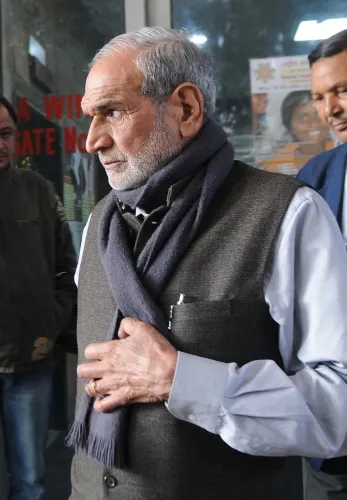
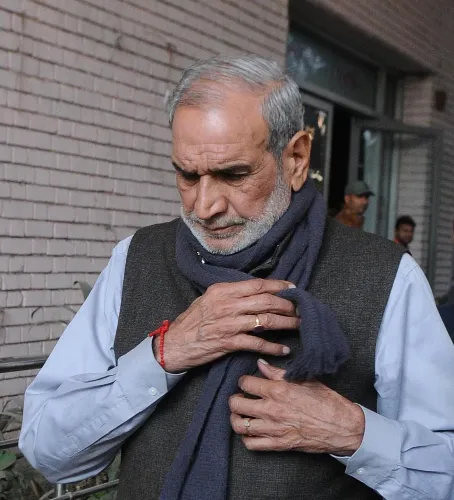
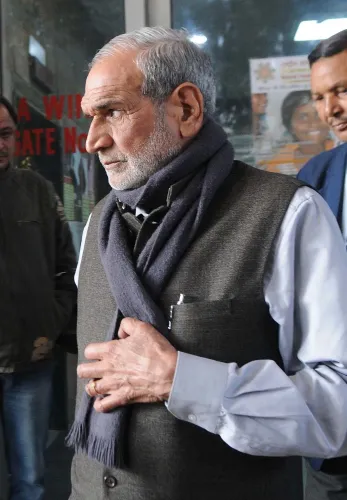
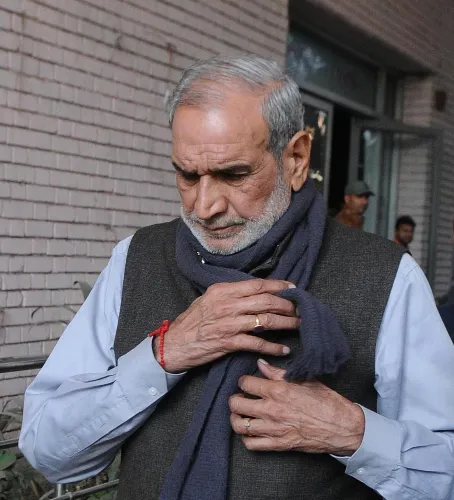
1984 riot survivor protests outside Deepender Hooda's Delhi home over Sajjan Kumar remarks
Synopsis
A woman who watched her father burn alive in the 1984 riots stood outside a Congress MP's home with a protest poster — because that MP called the death of a man convicted for those same riots an 'irreplaceable loss.' The episode has reopened the Congress party's deepest wound: its unresolved reckoning with 1984.
Key Takeaways
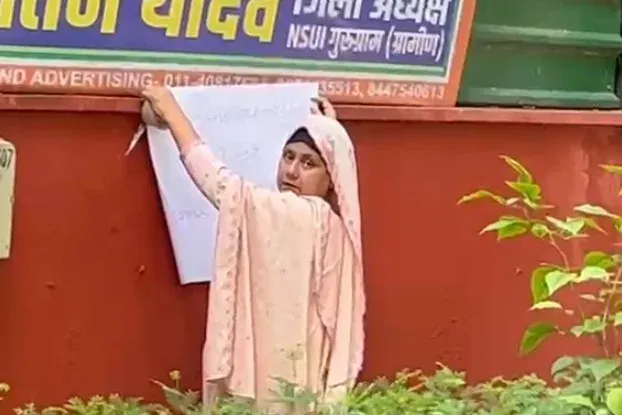
Nirpreet Kaur , a 1984 anti-Sikh riot survivor, put up a protest poster outside Congress MP Deepender Hooda's New Delhi residence on 21 August .
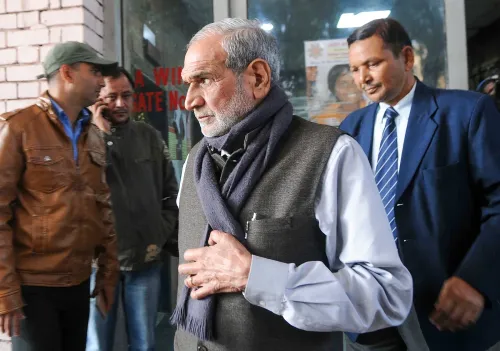
Deepender Hooda described convicted riot accused Sajjan Kumar's death as an 'irreparable loss for the country's political horizon.' Sajjan Kumar was serving a life sentence for his role in the 1984 anti-Sikh riots when he died at a Delhi hospital on Thursday.
SAD leader Bikram Singh Majithia demanded an apology from Hooda and the Indian National Congress (INC) , linking the remark to the party's broader stance on the 1984 violence.
Victim family member Surjit Singh said seven of his family members were killed in the riots, calling Hooda's remarks a betrayal of survivors.
The Congress had not issued an official response to the backlash as of Friday evening.
Nirpreet Kaur, a survivor of the 1984 anti-Sikh riots, on Friday, 21 August put up a protest poster outside the New Delhi residence of Congress MP Deepender Hooda, hours after Hooda described the death of convicted riot accused Sajjan Kumar as an 'irreplaceable loss' for Indian politics. The demonstration drew sharp condemnation from riot victims, their families, and the Shiromani Akali Dal (SAD).
The Poster and the Protest
The handwritten poster Kaur put up outside Hooda's residence read: 'IF SAJJAN KUMAR IS ROLL MODEL THEN WHO ARE CULPRIT..SHAME ON YOU DEEPENDER HOODA.' Kaur was just 16 years old when she witnessed her father being burnt alive by a mob near a gurdwara in Delhi's Raj Nagar on the morning of 1 November 1984, where he served as the head priest.
In 2018, after Sajjan Kumar was sentenced to life imprisonment by the Delhi High Court, Kaur had told reporters: 'I have got justice after 34 years... He (Sajjan Kumar) will go to jail.' Her protest on Friday brought that long journey full circle — this time in anger, not relief.
What Deepender Hooda Said
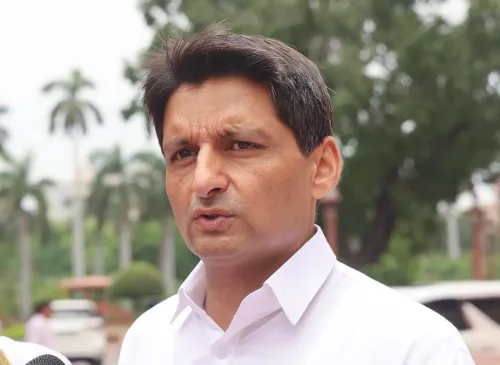
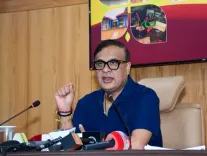
Speaking to reporters on Thursday, Deepender Hooda described Kumar as 'not only a prominent figure in Delhi and rural Delhi but across North India,' adding that 'his connection with the people was exemplary, and he is cited as an example across our country.' Hooda called his death an 'irreparable loss for the country's political horizon.'
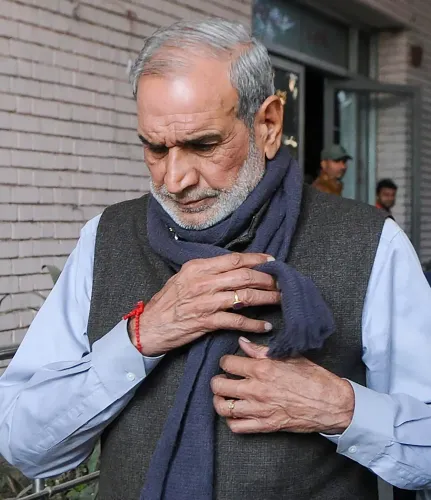
Sajjan Kumar had been serving a life sentence in connection with cases arising from the 1984 anti-Sikh riots — violence that erupted following the assassination of Prime Minister Indira Gandhi by her two Sikh bodyguards. Kumar died on Thursday at a Delhi hospital.
SAD and Victims' Families Condemn the Remarks
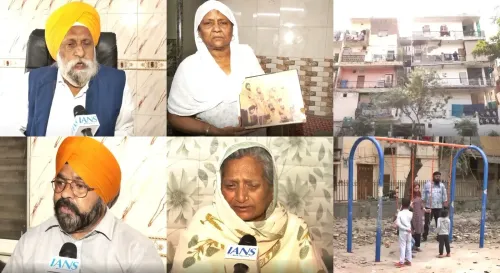
SAD leader Bikram Singh Majithia demanded an apology from both Hooda and the Congress party, saying: 'I condemn this statement. Deepender Hooda and the Congress Party should apologise.' Majithia went further, questioning whether Hooda's continued membership of the party reflected the views of Congress president Sonia Gandhi and party leader Rahul Gandhi. 'Sikhs should now realise what is the Congress party's stance on the (1984) genocide,' Majithia said.
A victim's family member who identified himself as Surjit Singh said seven members of his family were burnt alive during the riots. 'It is very unfortunate that Deepender Hooda is siding a criminal. He should be ashamed for praising a person who is responsible for the massacre of so many people,' he said.
The Broader Context
The 1984 anti-Sikh riots remain one of independent India's most contested episodes of communal violence, with thousands of Sikhs killed across the country in the days following Indira Gandhi's assassination. Sajjan Kumar's 2018 life sentence by the Delhi High Court was seen by survivors as a landmark moment after decades of legal struggle. His death has reignited a politically charged debate over how senior Congress figures eulogise those convicted in connection with the violence — a fault line that has periodically strained the party's relationship with the Sikh community.
As of Friday evening, the Indian National Congress (INC) had not issued any official response to the backlash against Hooda's remarks. The controversy is likely to intensify scrutiny on the party ahead of upcoming state elections in Punjab-adjacent constituencies.
Point of View
But they are symptomatic of a deeper Congress failure: four decades on, the party has never formally confronted its institutional role in the 1984 violence. Sajjan Kumar was not a peripheral figure — he was a convicted lifer. Eulogising him as an 'exemplary' people's leader is not a slip; it signals that for some within the Congress, 1984 remains a political asset rather than a moral liability. The SAD's sharp response is predictable, but the silence from the Congress high command — Sonia Gandhi and Rahul Gandhi — is the more consequential story. Every such episode chips away at whatever Sikh goodwill the party still holds in Punjab and the diaspora.
NationPress
21 Aug 2026
Frequently Asked Questions
Why did Nirpreet Kaur protest outside Deepender Hooda's residence?
Nirpreet Kaur, a survivor of the 1984 anti-Sikh riots, protested outside Congress MP Deepender Hooda's New Delhi home on 21 August after Hooda described the death of convicted riot accused Sajjan Kumar as an 'irreplaceable loss.' Kaur lost her father in the riots and had fought for 34 years to see Kumar convicted.
Who was Sajjan Kumar and why was he in prison?
Sajjan Kumar was a senior Congress leader who was sentenced to life imprisonment by the Delhi High Court in 2018 for his role in cases arising from the 1984 anti-Sikh riots. He died at a Delhi hospital on Thursday while serving that sentence.
What did Deepender Hooda say about Sajjan Kumar's death?
Deepender Hooda told reporters that Sajjan Kumar was 'not only a prominent figure in Delhi and rural Delhi but across North India,' calling his death an 'irreparable loss for the country's political horizon.' The remarks triggered immediate backlash from riot survivors and opposition parties.
How did the Shiromani Akali Dal respond to Hooda's remarks?
SAD leader Bikram Singh Majithia condemned the statement and demanded a public apology from Hooda and the Indian National Congress. He questioned whether Hooda's continued party membership implied that the Congress leadership — including Sonia Gandhi and Rahul Gandhi — endorsed the view.
What is the significance of the 1984 anti-Sikh riots in this controversy?
The 1984 anti-Sikh riots were a wave of communal violence that followed the assassination of Prime Minister Indira Gandhi, leaving thousands of Sikhs dead across India. Sajjan Kumar's 2018 life sentence was a landmark legal outcome for survivors after decades of impunity. Hooda's remarks are seen as dismissing that hard-won accountability.