Fadnavis orders fast-track courts, higher conviction rate in SC/ST Atrocities Act cases

Synopsis
Maharashtra CM Devendra Fadnavis has ordered fast-track courts in high-incidence districts, video-recorded hearings, a cap on case compounding, and a dedicated Witness Protection Programme — the most comprehensive overhaul of SC/ST Atrocities Act enforcement in the state in recent years, with prosecutor performance now directly tied to official evaluations.
Key Takeaways
Maharashtra CM Devendra Fadnavis on 3 July directed authorities to improve conviction rates under the SC/ST (Prevention of Atrocities) Act .
Fast-track courts to be set up in high-incidence districts including Solapur , Ahilyanagar , Parbhani , Nanded , and Yavatmal .
Prosecutor performance in securing convictions under special laws to be formally recorded in official evaluations.
Case compounding to be capped at a maximum of two instances ; court hearings to be video-recorded to deter hostile witnesses.
Home Department's MARVEL institute tasked with root-cause analysis of low conviction rates and development of an SOP .
High-level review meetings to be held twice a year — one chaired by the CM, another by the DGP .
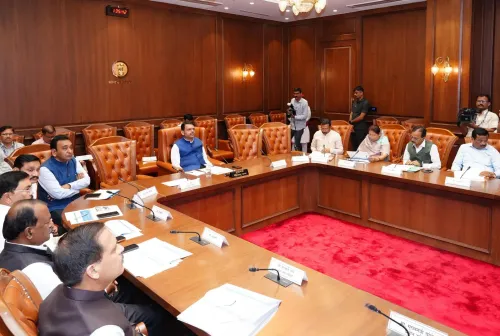
Maharashtra Chief Minister Devendra Fadnavis on Friday, 3 July directed state authorities to significantly improve the conviction rate in cases registered under the Scheduled Castes and Scheduled Tribes (Prevention of Atrocities) Act. The directives were issued during a meeting of the State-Level Vigilance and Monitoring Committee, constituted to oversee implementation of the Act.
Key Directives from the Chief Minister
Fadnavis ordered that the performance of government prosecutors in securing convictions under special laws must be explicitly recorded and factored into their official evaluations — a move aimed at creating direct accountability within the prosecution machinery. He also announced that fast-track courts will be established in districts that report a high volume of Atrocity Act cases, with the mandate to deliver swift justice from the date of complaint filing.
The meeting was attended by Member of Parliament Hemant Savra and several Member of Legislative Assembly committee members.
Reforms in Compounding and Court Procedures
Citing provisions within the Bharatiya Nyaya Sanhita (BNS) that permit settlement or compounding of a case up to twice, Fadnavis directed that a formal proposal be submitted to introduce similar restrictions in the state's implementation of the Atrocities Act. He stressed that compounding must be capped at a maximum of two instances to prevent repeat offenders from escaping punishment.
In another procedural reform, the Chief Minister directed that court hearings in these cases be video-recorded — in alignment with BNS provisions — to address the persistent problem of witnesses turning hostile during trials.
Tackling Low Conviction Rates and Hostile Witnesses
Fadnavis directed the Home Department's MARVEL institute to conduct a root-cause analysis of low conviction rates, examining factors such as weak evidence, broken chains of events, and hostile witnesses. The study is expected to result in a Standard Operating Procedure (SOP) guiding cases from registration through to the trial stage.
Since Sub-Divisional Police Officers (SDPOs) serve as the designated investigating authorities under the Act, the Chief Minister stressed that forthcoming state-wide workshops must prioritise training at the SDPO level. For heinous offences such as murder, rape, and dacoity registered under the Act, a dedicated Witness Protection Programme is to be implemented.
High-Incidence Districts Under Scrutiny
Fadnavis flagged that districts including Solapur, Ahilyanagar, Parbhani, Nanded, and Yavatmal record a disproportionately high number of cases under the Atrocities Act. He directed police administrations in these areas to investigate the underlying reasons, conduct deep inquiries, and submit detailed reports. He added that false cases must be filtered out following investigation and should not be registered.
Oversight and Next Steps
To ensure sustained accountability, high-level review meetings will be held twice a year at six-month intervals — one chaired by the Chief Minister at the state level and another by the Director General of Police (DGP). District authorities were also directed to strengthen coordination with government prosecutors and organise workshops for all administrative and law enforcement wings involved in enforcing the Act.
Point of View
But their impact will hinge entirely on follow-through — a persistent weak point in SC/ST Act enforcement across states. Tying prosecutor performance to conviction rates carries a risk: it can incentivise cherry-picking stronger cases over pursuing difficult ones, potentially leaving the most vulnerable complainants behind. The MARVEL institute SOP exercise is the most substantive element here, because low conviction rates in Atrocity Act cases are rarely about legal gaps — they are about evidence quality and witness integrity, both of which demand systemic, not ceremonial, fixes. The six-monthly review mechanism is welcome, but without independent monitoring or civil society oversight, these meetings risk becoming routine compliance rituals rather than accountability tools.
NationPress
2 Oct 2026
Frequently Asked Questions
What did Maharashtra CM Devendra Fadnavis direct regarding the SC/ST Atrocities Act?
Fadnavis directed state authorities on 3 July to increase conviction rates under the Scheduled Castes and Scheduled Tribes (Prevention of Atrocities) Act. Key measures include setting up fast-track courts in high-incidence districts, video-recording court hearings, and tying prosecutor performance to official evaluations.
Which districts in Maharashtra have the highest number of Atrocities Act cases?
According to the Chief Minister, Solapur, Ahilyanagar, Parbhani, Nanded, and Yavatmal record a disproportionately high volume of cases under the Atrocities Act. Fadnavis has directed police administrations in these districts to investigate the underlying reasons and submit detailed reports.
What is the MARVEL institute's role in this initiative?
The Home Department's MARVEL institute has been tasked with analysing the root causes of low conviction rates, focusing on weak evidence, broken chains of events, and hostile witnesses. Based on this study, it is to develop a Standard Operating Procedure (SOP) to guide cases from registration through to the trial stage.
How will witness protection be strengthened in Atrocities Act cases?
A dedicated Witness Protection Programme is to be implemented for trials involving heinous offences such as murder, rape, and dacoity registered under the Act. Additionally, court hearings are to be video-recorded in line with Bharatiya Nyaya Sanhita provisions to deter witnesses from turning hostile.
How will oversight of Atrocities Act implementation be maintained?
High-level review meetings will be held twice a year — one chaired by the Chief Minister at the state level and another by the Director General of Police. District authorities have also been directed to improve coordination with government prosecutors and conduct training workshops for all enforcement wings.