CM Fadnavis Chairs SC/ST Atrocities Act Review Meet in Mumbai

Synopsis
Maharashtra CM Devendra Fadnavis chaired a State-Level Vigilance and Monitoring Committee meeting on 3 July 2026 at Vidhan Bhavan, directing fast-track courts, prosecutor accountability, video-recorded proceedings, and a MARVEL-led SOP to improve conviction rates under the SC/ST Atrocities Act.
Key Takeaways
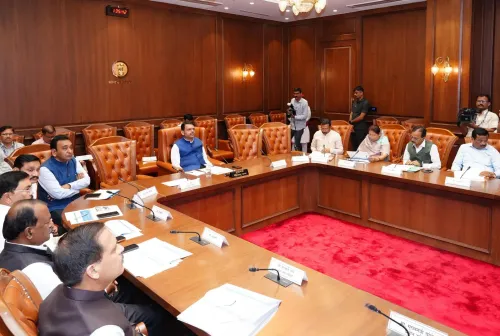
CM Devendra Fadnavis chaired the State-Level Vigilance and Monitoring Committee meeting at Vidhan Bhavan, Mumbai on 3 July 2026 .
Directed fast-track courts in districts with high atrocity case loads to ensure faster trials.
Ordered public prosecutors to be evaluated based on their conviction rates under the Atrocities Act.
Instructed the Home Department's MARVEL institution to identify reasons for low conviction rates and develop an SOP .
Directed video-recording of court proceedings under the Act, aligned with the Bharatiya Nyaya Sanhita .
A witness protection programme to be implemented for serious atrocity cases.
Maharashtra Chief Minister Devendra Fadnavis chaired a high-level meeting of the State-Level Vigilance and Monitoring Committee at Vidhan Bhavan, Mumbai, on 3 July 2026 to review implementation of the Scheduled Castes and Scheduled Tribes (Prevention of Atrocities) Act and its Rules. The Chief Minister issued a series of directions aimed at improving investigation quality, prosecution standards, and conviction rates under the Act.
Context
The meeting was convened under the statutory mandate of the State-Level Vigilance and Monitoring Committee, constituted under the Prevention of Atrocities Rules, 1995, which requires states to periodically review the Act's implementation. BJP MP Dr Hemant Savara, who represents the Palghar constituency in tribal Maharashtra, along with MLAs and senior state officials, attended the session at Vidhan Bhavan.
Fadnavis directed that the performance of public prosecutors be formally evaluated on the basis of their conviction rates — a shift toward accountability-linked assessment within the state's legal machinery. He also instructed that court proceedings under the Act be video-recorded, consistent with the provisions of the Bharatiya Nyaya Sanhita, and that a witness protection programme be put in place for serious cases.
Policy Backdrop
The Scheduled Castes and Scheduled Tribes (Prevention of Atrocities) Act was enacted by Parliament in 1989 and significantly amended in 2015 and 2018 to expand the list of offences and mandate the creation of exclusive special courts. Maharashtra has issued periodic government resolutions since 2010 directing improvements in investigation and prosecution, but conviction rates under the Act have remained a persistent concern across states.
The Chief Minister's instruction to align the state's legal framework with the Bharatiya Nyaya Sanhita — which replaced the Indian Penal Code and came into effect in July 2024 — reflects the broader national transition to a new criminal law architecture. The emphasis on video-recording of proceedings mirrors provisions introduced under the new criminal laws to improve trial transparency.
Stakeholders and Impact
Fadnavis directed the Home Department's MARVEL institution to study the reasons behind low conviction rates in Atrocities Act cases and develop a Standard Operating Procedure (SOP) to address identified gaps. MARVEL is expected to provide a structured analytical basis for systemic reforms in investigation and prosecution.
The Chief Minister also instructed that fast-track courts be established in districts recording a high volume of atrocity cases, with the stated aim of ensuring faster trials and timely justice for SC/ST communities. This directive builds on the 2018 amendment's mandate for exclusive special courts, extending the principle to high-caseload districts.
What's Next
The immediate next steps hinge on the Home Department and MARVEL producing the SOP and on the state government issuing formal government resolutions notifying fast-track courts in identified districts. The State-Level Vigilance and Monitoring Committee is mandated to meet quarterly, meaning the impact of Friday's directions will be measurable in the committee's next review cycle.
If the performance-linked evaluation of prosecutors and the video-recording mandate are operationalised, they could mark a substantive shift in how Maharashtra enforces the Atrocities Act — with conviction-rate data becoming a formal metric in the state's justice delivery assessment for SC/ST communities.
Point of View
If executed, produce the first granular district-level diagnostic of prosecution failures in Maharashtra. Aligning the Act's procedures with the Bharatiya Nyaya Sanhita also positions the state as an early mover in integrating new criminal law provisions into SC/ST justice delivery. The real test will be whether the SOP and fast-track court notifications materialise before the next quarterly committee cycle.
NationPress
2 Oct 2026
Frequently Asked Questions
What is the State-Level Vigilance and Monitoring Committee for SC/ST Act?
It is a statutory body constituted under the Prevention of Atrocities Rules, 1995, mandated to review the implementation of the SC/ST Atrocities Act in each state on a quarterly basis.
What did CM Fadnavis direct at the Mumbai meeting on 3 July 2026?
Fadnavis directed fast-track courts in high-caseload districts, performance evaluation of prosecutors by conviction rates, video-recording of court proceedings, a witness protection programme, and an SOP from the MARVEL institution to address low conviction rates.
What is the MARVEL institution under Maharashtra's Home Department?
MARVEL is an institution under Maharashtra's Home Department directed by CM Fadnavis to analyse the reasons behind low conviction rates in Atrocities Act cases and develop a Standard Operating Procedure to address them.
How does the Bharatiya Nyaya Sanhita relate to the SC/ST Atrocities Act?
The Bharatiya Nyaya Sanhita replaced the Indian Penal Code in July 2024. Fadnavis directed that Maharashtra's legal framework under the Atrocities Act be aligned with its provisions, including video-recording of court proceedings.
What are fast-track courts for atrocity cases in Maharashtra?
Fast-track courts are dedicated courts to be set up in districts with a high number of atrocity cases, aimed at ensuring faster trials and timely justice for SC/ST communities under the Atrocities Act.