Akhilesh Yadav Alleges Selective Raids in UP, Spares Karnataka
Synopsis
Samajwadi Party president Akhilesh Yadav alleged on 8 July 2026 that central enforcement agencies target Uttar Pradesh while sparing Congress-ruled Karnataka and Maharashtra, calling their actions a 'show of formality' that avoids politically connected interests.
Key Takeaways
Akhilesh Yadav posted on 8 July 2026 alleging central agencies conduct raids in Uttar Pradesh while sparing Karnataka and Maharashtra .
He accused agencies of performing only a 'show of formality' where certain connected interests are concerned, using the term 'CC' without elaboration.
The allegation follows a documented pattern since 2014 of opposition parties claiming the ED and CBI act with political selectivity.
The Enforcement Directorate operates under the Finance Ministry and has denied political motivation in its actions.
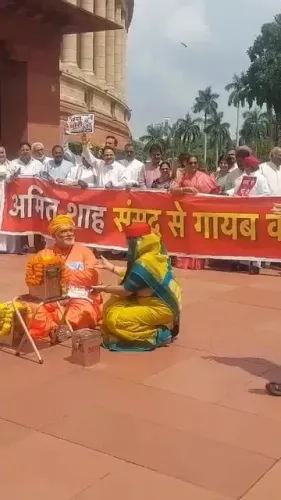
The charge gains relevance during the monsoon session of Parliament , where agency accountability is a recurring opposition issue.
The Samajwadi Party is the principal opposition to the BJP in Uttar Pradesh , which has been BJP-governed since 2017 .
Samajwadi Party president Akhilesh Yadav on Wednesday, 8 July 2026, alleged that central enforcement agencies are conducting raids in Uttar Pradesh while sparing Karnataka and Maharashtra, accusing them of mere 'show' compliance where politically connected interests are involved.
In his post in Hindi, Yadav wrote: 'Chhapa maarna chahiye Karnataka aur Maharashtra mein maar rahe hain UP mein. Jahaan CC ka maal hai wahaan nahin jaate hain bas dikhawati aupcharikta nibhaate hain' — translated: 'Raids should be conducted in Karnataka and Maharashtra, but they are being carried out in UP. They do not go where the goods of [a certain entity] are — they merely perform a show of formality.'
Context
Yadav's remark is a pointed allegation of geographic and political selectivity by central investigative agencies. He implies that enforcement actions are being concentrated in Uttar Pradesh — governed by the BJP since 2017 and home to the Samajwadi Party's core opposition base — while states under Congress rule, namely Karnataka (Congress-governed since 2023) and Maharashtra, are treated leniently.
The reference to 'CC' in the original post is not elaborated upon. As the research background flags this as unverified, NationPress does not attribute a specific identity or entity to that abbreviation.
Policy Backdrop
The allegation fits a broader pattern that opposition parties across India have documented since 2014: that the Enforcement Directorate (ED) and the Central Bureau of Investigation (CBI) intensify scrutiny in opposition-held constituencies or states ahead of electoral cycles. High-profile cases involving parties such as the Aam Aadmi Party in Delhi and the Trinamool Congress in West Bengal between 2022 and 2024 were cited by opposition leaders as instances of this trend.
The Enforcement Directorate, which operates under the Finance Ministry and enforces the Prevention of Money Laundering Act, has consistently denied that its actions are politically motivated, maintaining that cases are pursued on the basis of evidence.
Stakeholders and Impact
The Samajwadi Party, as the principal opposition to the BJP in Uttar Pradesh, has a long record of alleging institutional bias in federal agency functioning. Yadav's post is likely to resonate with opposition leaders in Karnataka and Maharashtra who have made similar claims about differential treatment.
For voters and political observers in UP, the statement reinforces the Samajwadi Party's narrative that the state's opposition figures face disproportionate scrutiny. The charge also carries weight in the context of the ongoing monsoon session of Parliament, where agency accountability is a recurring flashpoint.
What's Next
Political observers will watch whether Congress leaders in Karnataka or Maharashtra amplify Yadav's charge, potentially coordinating an opposition front on the issue of agency autonomy. Any parliamentary question, privilege motion, or adjournment notice in either House of Parliament targeting the ED's functioning during the monsoon session could give this allegation formal legislative traction.
The Samajwadi Party's consistent use of social media to flag such concerns signals a strategy of keeping institutional-bias narratives in public circulation ahead of the next round of state elections.
Point of View
He positions the SP not merely as a regional party under pressure but as part of a pan-India opposition consensus on agency overreach. The unelaborated reference to 'CC' adds a layer of insinuation that is difficult to rebut without the government specifying which raids it is defending. With Parliament in monsoon session, the post could serve as a signal to allied opposition parties to raise the issue on the floor of the House.
NationPress
6 Oct 2026
Frequently Asked Questions
Why is Akhilesh Yadav criticising ED raids in UP?
Akhilesh Yadav alleges that central enforcement agencies are disproportionately targeting Uttar Pradesh — where the Samajwadi Party is the main opposition — while avoiding substantive action in Congress-ruled Karnataka and Maharashtra, which he calls mere 'show' enforcement.
What did Akhilesh Yadav say about Karnataka and Maharashtra raids?
He said raids should be conducted in Karnataka and Maharashtra but are instead being carried out in UP, and that agencies do not go where certain connected interests ('CC') hold assets, performing only a 'show of formality.'
What is the Enforcement Directorate accused of by opposition parties?
Multiple opposition parties, including the Samajwadi Party, have accused the Enforcement Directorate of politically motivated targeting — intensifying raids on opposition-led states and leaders while exercising restraint where ruling-alliance interests are involved.
Is Karnataka under a different government from Uttar Pradesh?
Yes. Karnataka has been governed by the Congress party since 2023, while Uttar Pradesh has been under BJP rule since 2017. Yadav's allegation implies that this political difference explains the differential enforcement activity.
What could happen next after Akhilesh Yadav's allegation?
Opposition parties may raise the issue of agency selectivity during the monsoon session of Parliament through questions or privilege motions, and Congress leaders in Karnataka and Maharashtra may amplify the charge to build a coordinated opposition narrative.