CM Dhami Implements 33% Quota for Women in Uttarakhand Cooperatives
Synopsis
Uttarakhand Chief Minister Pushkar Singh Dhami has implemented a 33 percent reservation for women in cooperative societies, aiming to boost female leadership and decision-making in the sector. The move extends the constitutional precedent set by the 73rd Amendment to cooperative governance, targeting inclusive development across the state.
Key Takeaways
CM Pushkar Singh Dhami announced on 8 July 2026 that Uttarakhand has implemented 33 percent reservation for women in cooperative societies.
The decision is framed as part of the government's commitment to matrishakti — the honour, empowerment, and leadership of women.
The policy is intended to give women greater participation in cooperative decision-making, including credit, procurement, and resource governance.
The move builds on the precedent of the 73rd Constitutional Amendment (1992) , which mandated 33 percent reservation for women in Panchayati Raj institutions.
Rural and hill district communities in Uttarakhand , where cooperatives are a key economic channel, are among the most direct beneficiaries.
Implementation rules for cooperative elections and their rollout timeline remain the key next step to watch.
Uttarakhand Chief Minister Pushkar Singh Dhami announced on Wednesday, 8 July 2026 that his government has implemented a 33 percent reservation for women in cooperative societies across the state, describing the move as a historic step toward inclusive governance and women's leadership in the cooperative sector.
Context
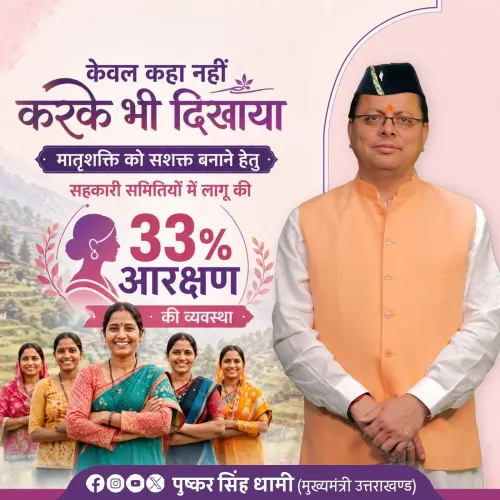
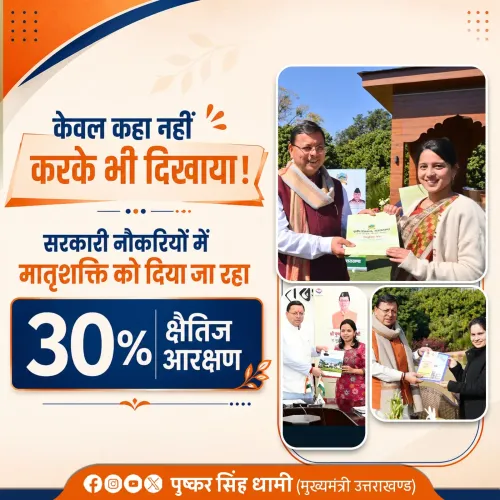
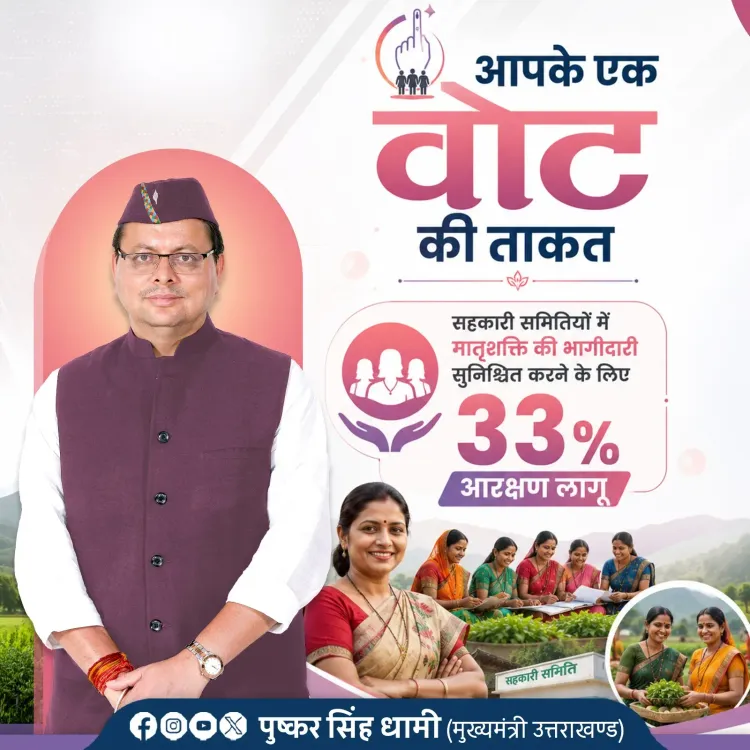
Posting in Hindi on X, CM Dhami stated: 'सहकारी समितियों में 33 प्रतिशत आरक्षण लागू किया गया है' ('33 percent reservation has been implemented in cooperative societies'). He framed the decision as part of his government's 'complete commitment' to the honour, empowerment, and leadership of matrishakti — a term widely used in Indian political discourse to denote women as a collective force. The announcement was accompanied by an image shared on his official account.
The Chief Minister added that the reservation would give women greater participation in decision-making processes and open leadership opportunities within the cooperative movement, while simultaneously driving 'comprehensive, balanced, and inclusive development' of Uttarakhand.
Policy Backdrop
The move draws on a well-established constitutional tradition. The 73rd Constitutional Amendment of 1992 mandated a 33 percent reservation for women in Panchayati Raj institutions across India, laying the foundational precedent for gender-based quotas in governance structures. Extending a similar framework to cooperative societies represents a logical progression of that principle into the economic and rural development sphere.
Indian states have progressively broadened gender-based reservations from elected local bodies to other institutions, including cooperatives, to deepen women's roles in economic decision-making. The Bharatiya Janata Party, which governs Uttarakhand, has positioned women's empowerment as a central plank of both its state and national governance agenda. CM Dhami, who assumed office in 2021, has repeatedly cited women's welfare schemes as a priority of his administration.
Stakeholders and Impact
Uttarakhand has a significant network of cooperative societies spanning agriculture, dairy, credit, and consumer sectors, many of which are active in rural and hill districts. Women in these communities have historically been primary contributors to agricultural and allied activities but have had limited formal representation in cooperative governance structures.
The 33 percent quota is intended to change that by reserving seats on cooperative boards and committees for women, ensuring their voice in decisions around credit allocation, procurement, and resource distribution. Rural communities — particularly in Uttarakhand's mountainous districts — stand to be among the most direct beneficiaries, as cooperatives are a key channel for economic access in areas with limited formal banking and market infrastructure.
What's Next
Attention will now turn to the rollout of implementation rules governing cooperative elections and how the reservation will be applied across different categories of societies. Observers will also watch whether other states move to adopt similar policies, which could signal a broader national trend toward institutionalising gender quotas in cooperative governance. The operational details and timelines for the first elections held under the new framework will be a key indicator of how swiftly the policy translates into ground-level change.
Point of View
Reinforcing its women's empowerment narrative ahead of future electoral cycles. It follows a well-worn constitutional template — the 73rd Amendment — making it difficult to challenge on legal grounds while allowing the ruling party to claim a governance milestone. The real test, however, lies in implementation: reservation in cooperative boards is only meaningful if accompanied by capacity-building and enforcement mechanisms that prevent proxy representation. If operationalised effectively, the policy could set a replicable model for other BJP-governed states looking to deepen gender equity beyond elected local bodies.
NationPress
8 Jul 2026
Frequently Asked Questions
What is the 33 percent reservation announced by CM Dhami for cooperatives?
Uttarakhand Chief Minister Pushkar Singh Dhami has implemented a policy reserving 33 percent of seats in cooperative societies for women, ensuring greater female participation in decision-making and leadership roles within the cooperative sector.
Which state has given 33% reservation to women in cooperative societies?
Uttarakhand has implemented the 33 percent reservation for women in cooperative societies, as announced by Chief Minister Pushkar Singh Dhami on 8 July 2026 .
What is the constitutional basis for women's reservation in cooperatives in India?
The precedent comes from the 73rd Constitutional Amendment of 1992 , which mandated 33 percent reservation for women in Panchayati Raj institutions. States like Uttarakhand are now extending a similar principle to cooperative societies.
How will the women's quota in Uttarakhand cooperatives work?
The reservation will set aside 33 percent of positions on cooperative boards and committees for women, giving them a formal role in decisions on credit, procurement, and resource distribution. Specific implementation rules for cooperative elections are expected to follow.
What is matrishakti as used by CM Dhami?
Matrishakti is a Hindi term widely used in Indian political discourse to refer to women as a collective force or 'mother-power.' CM Dhami used the term to frame his government's commitment to women's honour, empowerment, and leadership.