CM Dhami Highlights 30% Horizontal Quota for Women in Uttarakhand Jobs
Synopsis
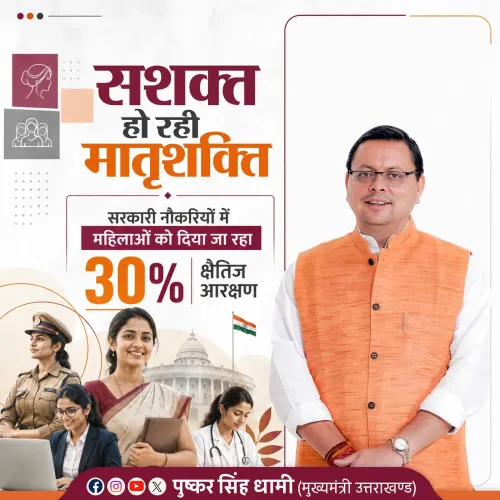
Uttarakhand Chief Minister Pushkar Singh Dhami has publicly reaffirmed the state's 30 per cent horizontal reservation for women in government jobs, framing it as a landmark step toward women's self-reliance and leadership. The post, tagged to PM Modi and Home Minister Amit Shah, aligns state policy with the BJP's national women's empowerment narrative.
Key Takeaways
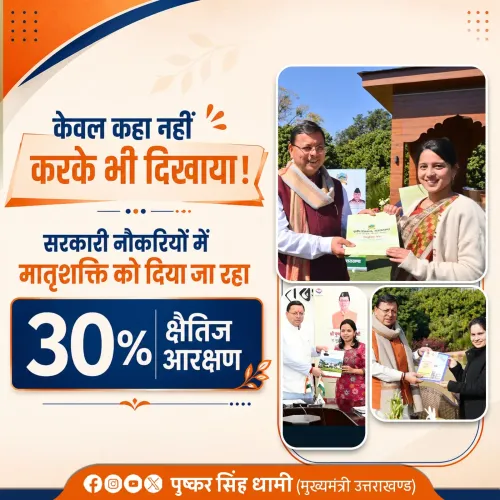
Uttarakhand CM Pushkar Singh Dhami reaffirmed on June 12, 2026 that the state provides 30 per cent horizontal reservation for women in government jobs.
Horizontal reservations ensure women receive a guaranteed share of vacancies within every category — general, OBC, SC, and ST — rather than a separate vertical quota.
Dhami framed the policy as central to making women ' self-reliant ' and strengthening their ' leadership capacity .' The post tagged PM Narendra Modi and Union Home Minister Amit Shah , linking the state measure to the national BJP narrative on women's empowerment.
Uttarakhand's demographic context — with many men in the armed forces or migrant work — makes government employment especially critical for women in the state.
Implementation data from the Uttarakhand Public Service Commission and possible judicial scrutiny of horizontal reservation rules remain key areas to watch.
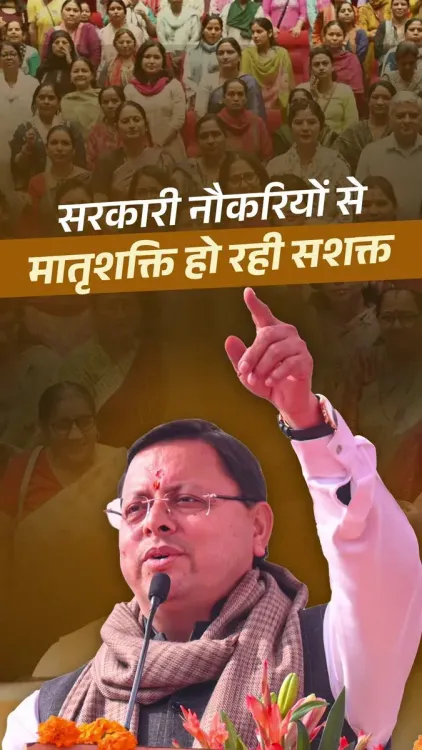
Uttarakhand Chief Minister Pushkar Singh Dhami on Friday, June 12, 2026, reaffirmed his government's policy of providing 30 per cent horizontal reservation for women in state government jobs, calling it a decisive step toward women's self-reliance and leadership development. The announcement was made via a post on X, where Dhami also tagged Prime Minister Narendra Modi, Union Home Minister Amit Shah, and the BJP national handle, framing the measure within the broader national agenda of women's empowerment.
Context
In his post, CM Dhami wrote — translated from Hindi — that 'our government has accelerated government recruitments while providing special opportunities to women.' He added that by granting women a 30 per cent horizontal reservation in government jobs, the administration has both secured their rights and strengthened their leadership capacity. The original Hindi phrase 'मातृशक्ति को विशेष अवसर' [special opportunities for the power of motherhood] underscores the cultural framing the ruling party attaches to women's workforce participation.
Dhami described the decision as 'an important step in the direction of increasing women's participation and making them self-reliant.' The post did not specify a new legislative amendment or a fresh recruitment notification, but served as a public reiteration of an existing policy plank of the BJP-led Uttarakhand government.
Policy Backdrop
Horizontal reservations differ from vertical reservations: they cut across all categories — general, OBC, SC, ST — ensuring that a fixed share of seats within each category goes to a specific group, in this case women. Several Indian states introduced similar provisions during the 1990s and early 2000s, following constitutional imperatives for gender equity in public services.
Uttarakhand, a northern Himalayan state carved out of Uttar Pradesh in 2000, has a significant share of its male working-age population employed in the armed forces or migrant labour markets, making government employment particularly important for women in the state. The 30 per cent horizontal quota is therefore seen as especially consequential in the local context, where women often serve as the primary economic managers of households.
BJP-governed states have consistently highlighted horizontal reservations as part of broader gender mainstreaming efforts, alongside central schemes aimed at female entrepreneurship and safety. The tagging of central BJP leadership in the post signals an effort to align state-level action with the national narrative of women's self-reliance that has been a prominent theme since 2014.
Stakeholders and Impact
The primary beneficiaries of this policy are women job aspirants appearing in recruitments conducted by the Uttarakhand Public Service Commission and other state recruitment bodies. For candidates in competitive examinations, the horizontal quota means that a guaranteed share of vacancies across every category is ring-fenced for female applicants, reducing the disadvantage they might otherwise face in open competition.
The broader public-sector workforce in Uttarakhand stands to become more gender-balanced over successive recruitment cycles if the policy is implemented consistently. Civil society groups focused on women's labour-force participation have generally welcomed horizontal reservation frameworks, while some legal scholars have flagged the need for clear rules to prevent quota overlaps — a question that courts in other states have periodically examined.
What's Next
Observers will watch for implementation data from upcoming Uttarakhand Public Service Commission recruitment cycles to assess how consistently the 30 per cent horizontal quota is being applied and what share of total appointments it translates to in practice. Any assembly debate on expanding the quota or formally measuring employment outcomes would be a key indicator of the government's follow-through.
At the national level, potential judicial reviews of horizontal reservation rules in other states could set precedents that influence Uttarakhand's own framework. CM Dhami's public reiteration of the policy ahead of any such scrutiny positions the state government as a proactive champion of women's representation in formal employment.
Point of View
The post deliberately embeds a state-level measure within the BJP's national 'Nari Shakti' branding. This reflects a well-established pattern in BJP-governed states of amplifying gender-equity provisions to consolidate women voters ahead of electoral cycles. The move is substantively meaningful in Uttarakhand's context, where female labour-force participation in formal employment remains below the national average, but the absence of fresh recruitment data or a new legislative push limits its immediate policy weight. The real test will be whether upcoming Public Service Commission cycles show measurable gains in women's appointments across all categories.
NationPress
24 Sept 2026
Frequently Asked Questions
What is the 30% horizontal reservation for women in Uttarakhand government jobs?
It is a policy that reserves 30 per cent of vacancies within each recruitment category — general, OBC, SC, and ST — specifically for women applicants, ensuring they are not displaced by male candidates within the same category.
Did CM Dhami announce a new reservation policy on June 12 2026?
No new policy was announced; CM Dhami reaffirmed an existing provision of 30 per cent horizontal reservation for women in Uttarakhand government jobs and highlighted it as a key achievement of his administration.
How does horizontal reservation differ from vertical reservation for women?
Vertical reservation creates a separate quota column for a group, while horizontal reservation cuts across all existing vertical categories, guaranteeing women a fixed share within each — general, OBC, SC, and ST — rather than a standalone block.
Why did CM Dhami tag PM Modi and Amit Shah in his post about women's reservation?
Tagging central BJP leadership is a common practice by state BJP governments to frame local policy achievements within the party's national narrative, in this case the broader agenda of women's self-reliance and empowerment.
Which body conducts government recruitments in Uttarakhand where this quota applies?
The Uttarakhand Public Service Commission is the primary body overseeing state government recruitments, and the 30 per cent horizontal reservation for women applies to vacancies filled through its processes.