CM Dhami Highlights Women's Role in Uttarakhand's 26-Year Journey
Synopsis
Uttarakhand CM Pushkar Singh Dhami marks the state's 26th foundation anniversary by honouring women's role in the statehood agitation and citing 30% horizontal job reservation and 33% cooperative management quota as the government's tribute to that legacy.
Key Takeaways
Uttarakhand was established as India's 27th state on 9 November 2000 after a decade-long agitation in which women played a central role.
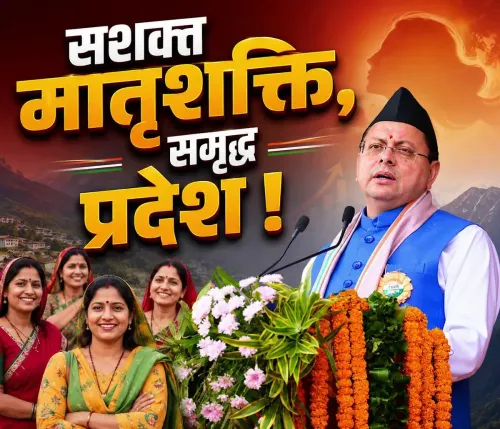
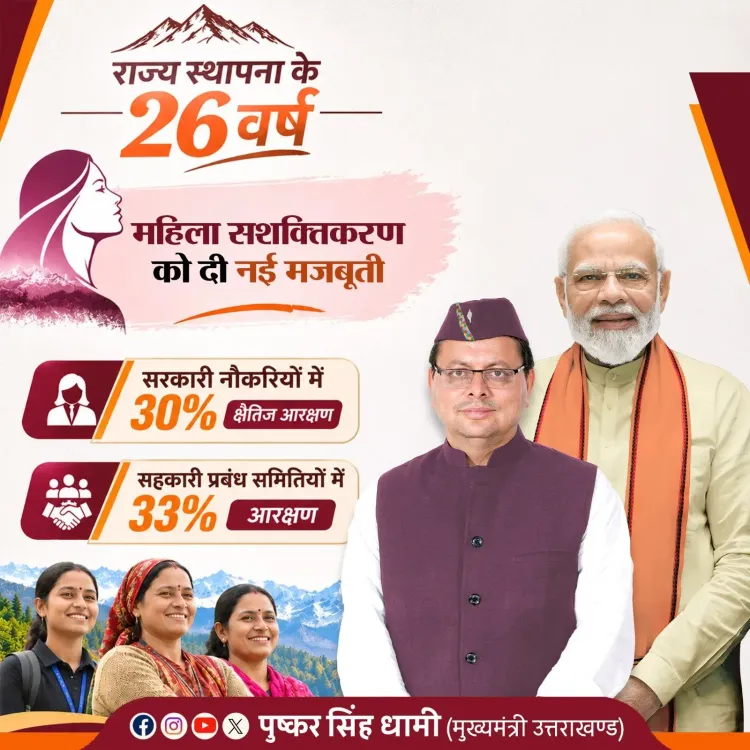
CM Pushkar Singh Dhami invoked women's contribution to the statehood movement in a post on 4 November 2026 , days ahead of the state's foundation day.
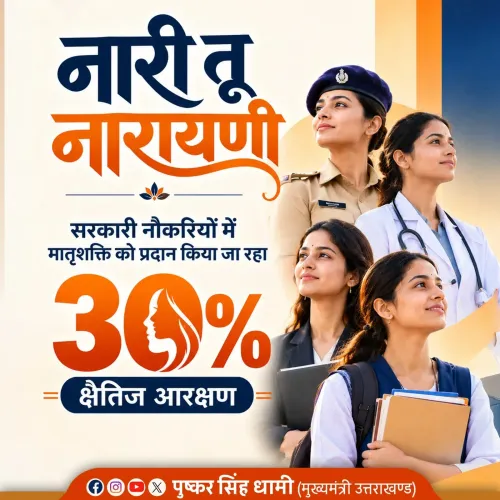
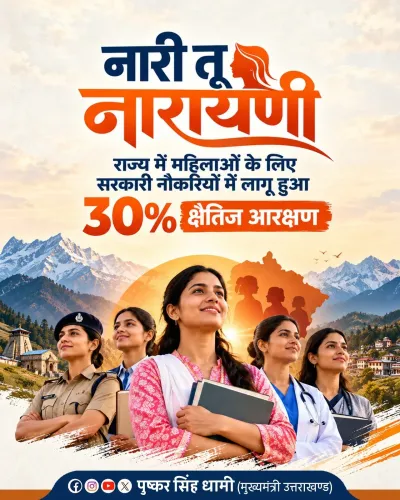
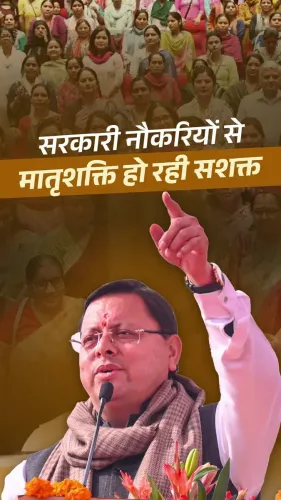
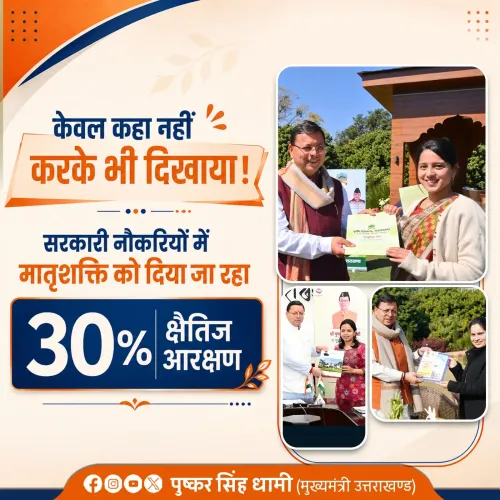
The state government has introduced 30% horizontal reservation for women in government jobs, cutting across all recruitment categories.
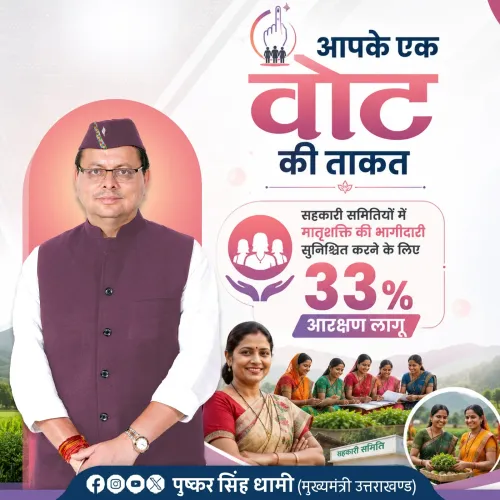
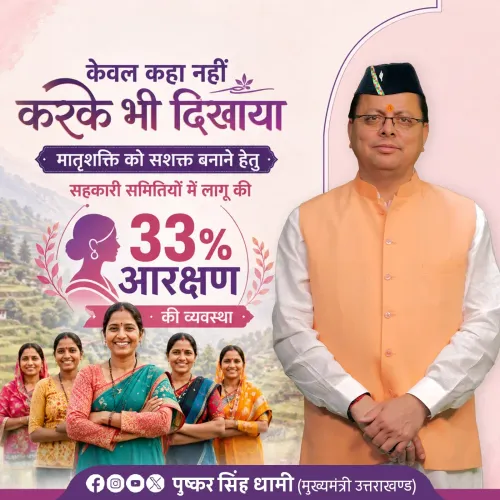
A 33% reservation in cooperative management committees gives women decision-making power in dairy, horticulture, and forest-produce cooperatives.
Horizontal reservations operate across existing category lists (general, OBC, SC, ST), ensuring broader coverage than a simple vertical quota.
India's 73rd and 74th Constitutional Amendments form the constitutional precedent for mandatory women's representation that these measures build upon.
Twenty-six years after women took to the streets to demand a separate hill state, Uttarakhand Chief Minister Pushkar Singh Dhami has invoked that legacy to anchor two landmark reservation policies — 30% horizontal reservation in government jobs and 33% reservation in cooperative management committees — as the state marks its foundation anniversary on 9 November 2026.
Women at the Heart of the Statehood Agitation
The road to Uttarakhand's creation was not paved in legislative chambers alone. Through the 1990s, women from across the hill districts marched, picketed, and protested in a sustained agitation that pushed the Centre to carve the state out of Uttar Pradesh. When Uttarakhand — India's 27th state — was finally born on 9 November 2000, that contribution was both celebrated and, over subsequent years, quietly left unrewarded in formal policy terms.
CM Dhami's post, written in Hindi, frames the current government's moves as a direct reckoning with that debt: 'Mātṛśakti kā yogdān avismarnīy rahā hai' — 'the contribution of women's power has been unforgettable.' The language is deliberate, linking reservation policy to historical gratitude rather than presenting it as technocratic reform.
What the 30% Job Reservation and 33% Cooperative Quota Mean in Practice
The 30% horizontal reservation in state government jobs ensures that across all recruitment categories — not just a vertical slice — at least three in ten posts go to women. Horizontal reservations operate across existing category lists (general, OBC, SC, ST), meaning the benefit reaches women regardless of which reservation category they belong to. For a state where out-migration is dominated by men seeking work in plains cities, expanding women's access to stable public-sector employment carries particular weight.
The 33% reservation in cooperative management committees targets a different layer of economic power. Cooperatives in Uttarakhand span dairy, horticulture, and forest produce — sectors where women supply much of the labour but have historically held little managerial authority. A guaranteed one-in-three seat on governing committees shifts decision-making power closer to those doing the work. India's 73rd and 74th Constitutional Amendments pioneered mandatory women's representation in local bodies; Uttarakhand's cooperative quota extends that logic into the economic institutions that shape rural livelihoods.
Statehood at 26: A Policy Message Timed to the Anniversary
The timing of Dhami's post — days ahead of the 9 November state foundation day — is not incidental. Anniversary cycles are when Uttarakhand's political class takes stock of the state's founding promises, and the statehood agitation's unsung women participants are a recurring motif in that reckoning. By framing these reservation measures as the government's answer to a 26-year-old moral debt, Dhami is simultaneously making a governance announcement and a political one: that the BJP administration sees women's empowerment not as a welfare gesture but as a foundational obligation.
What policymakers and civil society groups will watch next is whether these reservations translate into measurable recruitment numbers and cooperative representation data as the anniversary passes — turning a political commitment into an auditable record.
The state that women helped build is, by CM Dhami's account, now being rebuilt for them — and the anniversary calendar will make it easy to hold that promise to account.
Point of View
Harder to dismiss and easier to defend politically. With assembly elections on the horizon in Uttarakhand's cycle, anchoring these measures to founding mythology rather than party manifesto gives them cross-partisan emotional weight. The 30% horizontal model is also structurally more inclusive than vertical reservations, signalling an attempt to demonstrate substantive rather than symbolic commitment. The real test will come in verifiable recruitment data and cooperative election results, which the anniversary calendar now makes a natural accountability checkpoint.
NationPress
4 Nov 2026
Frequently Asked Questions
What is the 30% horizontal reservation for women in Uttarakhand government jobs?
It means at least 30% of posts in every category of state government recruitment — general, OBC, SC, and ST — are reserved for women, so the benefit applies across all candidate lists rather than being confined to a single vertical slice.
What is the 33% reservation in cooperative management committees in Uttarakhand?
One in every three seats on the management committees of Uttarakhand's cooperative societies — covering dairy, horticulture, and forest produce — must be held by women, giving them formal decision-making authority in rural economic institutions.
When was Uttarakhand formed and what was women's role in the statehood movement?
Uttarakhand was formed on 9 November 2000 as India's 27th state, carved out of Uttar Pradesh. Women were prominent participants in the 1990s agitation, joining street protests and marches that sustained pressure for separate statehood.
What did CM Pushkar Singh Dhami say about women on Uttarakhand's foundation anniversary?
CM Dhami said women's contribution to the state's creation was 'unforgettable' and cited the 30% job reservation and 33% cooperative quota as the government's way of giving women 'dignity, opportunity, and a new path to self-reliance.'
How does horizontal reservation differ from vertical reservation in government jobs?
Vertical reservations create separate lists for specific communities (SC, ST, OBC). Horizontal reservations cut across all those lists, ensuring women within each category are represented — so a woman who is also OBC benefits under both her category's vertical quota and the horizontal women's quota.