CM Dhami Announces 30% Horizontal Job Quota for Uttarakhand Women
Synopsis
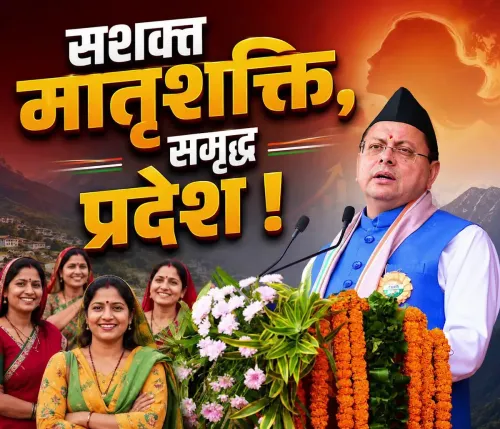
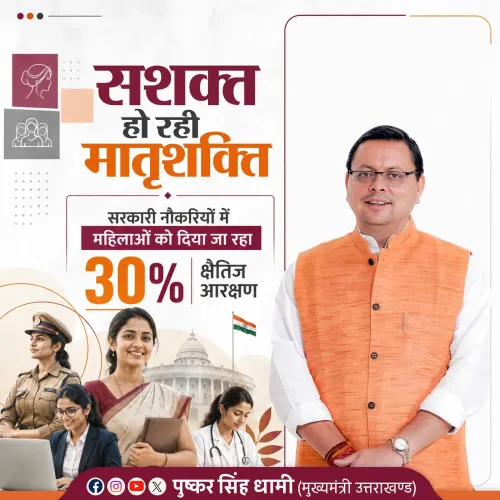
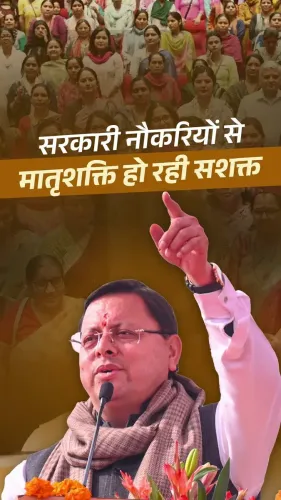
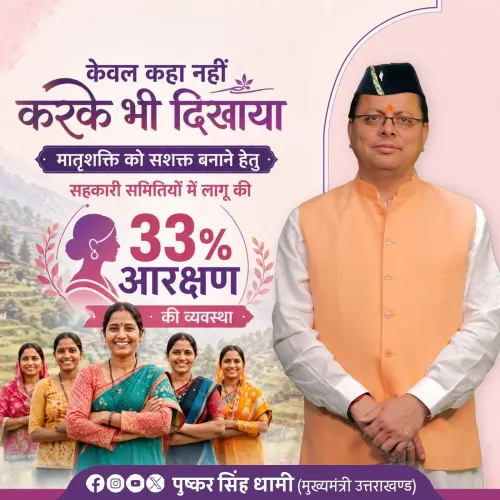
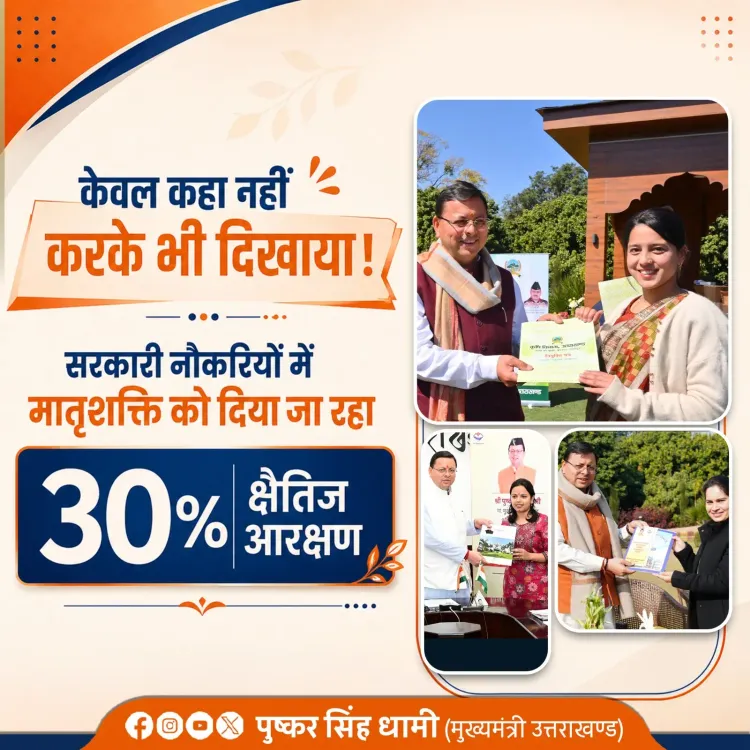
Uttarakhand Chief Minister Pushkar Singh Dhami announced a 30% horizontal reservation for women in state government jobs, calling it a step beyond policy — a bid to fulfil the aspirations of thousands of women across the Himalayan state.
Key Takeaways
Uttarakhand has implemented a 30% horizontal reservation for women across state government jobs.
Chief Minister Pushkar Singh Dhami announced the decision on 23 May 2026 via X.
Horizontal reservation ensures the quota applies within each existing category (general, OBC, SC/ST), not as a separate vertical pool.
The move aligns with a broader national pattern of 30–33% women's quotas in public employment adopted by multiple Indian states.
The policy draws constitutional backing from provisions permitting special protective measures for women, reinforced by the 73rd Constitutional Amendment of 1992 .
Rollout will depend on revised recruitment notifications across all state departments and may face administrative or judicial scrutiny.
Uttarakhand Chief Minister Pushkar Singh Dhami announced on Saturday, 23 May 2026 that the state government has implemented a 30% horizontal reservation for women in government jobs, framing the decision as a transformative step toward women's empowerment and self-reliance.
Context
Posting in Hindi on X, CM Dhami declared: 'मातृशक्ति के सशक्तिकरण और उन्हें आत्मनिर्भर बनाने की दिशा में प्रदेश सरकार द्वारा सरकारी नौकरियों में महिलाओं के लिए 30% क्षैतिज आरक्षण लागू किया गया है' ['In the direction of empowering women and making them self-reliant, the state government has implemented 30% horizontal reservation for women in government jobs']. He added that this decision is 'not merely a policy, but a strong effort to give new wings to the dreams of thousands of sisters.' The Chief Minister also noted that women of Uttarakhand are today 'hoisting the flag of their talent in every field.'
Policy Backdrop
Horizontal reservation differs from vertical reservation in that it cuts across existing category-wise quotas — meaning women from general, OBC, and SC/ST categories each benefit within their respective pools. The constitutional basis for such measures stems from provisions permitting special protections for women, a framework that gained momentum after the 73rd Constitutional Amendment of 1992, which mandated 33% reservation for women in panchayats and local bodies nationwide.
Several Indian states have enacted horizontal reservations ranging from 30% to 33% for women in public sector recruitment over the past decade, seeking to correct persistent gender imbalances in government employment. Uttarakhand's move aligns with this broader national pattern and fits within the BJP's stated electoral and governance emphasis on women's empowerment programmes.
Stakeholders and Impact
The primary beneficiaries are women job aspirants across Uttarakhand who compete in state government recruitment examinations. The quota applies horizontally across departments, meaning its reach extends to a wide range of public-sector roles from administration to education and health services. Women's groups and employment advocates have long pushed for such structural guarantees, arguing that merit-based competition alone has not been sufficient to close the gender gap in government offices.
Government departments will be required to recalibrate their recruitment notifications to reflect the new 30% threshold, a process that will test administrative readiness and consistency across agencies.
What's Next
The practical test of this policy will be its uniform application in upcoming recruitment cycles across all state departments. Legal and administrative scrutiny of horizontal quota implementations is common in India, and any ambiguity in the gazette notification or departmental orders could invite judicial review. Observers will also watch whether the state pairs this reservation with complementary measures — such as coaching support or relaxed eligibility norms — to maximise uptake among women candidates from remote Himalayan districts.
Point of View
Not a symbolic gesture — horizontal quotas have a direct, measurable impact on recruitment outcomes unlike aspirational targets. For the BJP government in Uttarakhand, the timing is politically deliberate: women's empowerment has become a central plank of the party's state-level governance narrative ahead of future electoral cycles. The policy also places Uttarakhand within a competitive federalism dynamic, where BJP-ruled states increasingly benchmark women-focused welfare measures against each other. Whether the quota translates into sustained change will depend on implementation rigour and whether it is paired with enabling conditions for women in remote hill districts.
NationPress
27 Sept 2026
Frequently Asked Questions
What is the 30% horizontal reservation for women in Uttarakhand government jobs?
It is a policy implemented by the Uttarakhand state government that reserves 30% of positions in government jobs for women on a horizontal basis, meaning the quota applies within each existing reservation category such as general, OBC, and SC/ST.
Who announced the women's job reservation in Uttarakhand?
Uttarakhand Chief Minister Pushkar Singh Dhami announced the 30% horizontal reservation for women in state government jobs on 23 May 2026 through a post on X.
What is horizontal reservation and how is it different from vertical reservation?
Horizontal reservation cuts across vertical categories — so women from general, OBC, SC, and ST categories each benefit within their own pool, rather than competing in a single separate women's category. This prevents double-counting and ensures the quota benefits women across all social groups.
Which other states have similar women's reservation in government jobs?
Several Indian states, including those governed by different parties, have enacted horizontal reservations of 30% to 33% for women in public sector recruitment, reflecting a broader national trend toward improving gender representation in government employment.
Will the Uttarakhand women's job quota face any legal challenge?
Horizontal quota implementations in India have occasionally faced administrative and judicial scrutiny, particularly over the precise language of recruitment notifications. Legal review is possible, and consistent application across all departments will be critical to the policy's durability.