CM Dhami Grants 10% Job Quota to Uttarakhand Statehood Activists
Synopsis
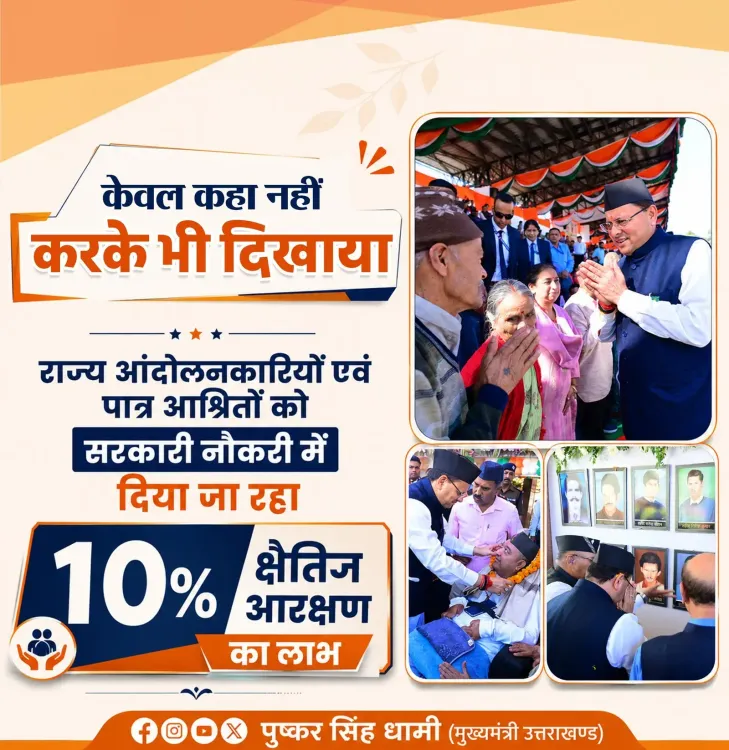
Uttarakhand Chief Minister Pushkar Singh Dhami has announced a 10% horizontal reservation in government jobs for statehood agitators and their eligible dependants, calling it a moral duty fulfilled by the 'double engine government' — translating a long-standing pledge into concrete policy on the ground.
Key Takeaways
Uttarakhand CM Pushkar Singh Dhami announced a 10% horizontal reservation in state government jobs for statehood agitators and eligible dependants on 26 May 2026 .
Horizontal reservation means the 10% quota cuts across all existing vertical categories — general, OBC, SC and ST — rather than forming a separate silo.
Uttarakhand was formed on 9 November 2000 after a prolonged 1990s agitation; activists and their families have long sought formal recognition in government employment.
Dhami described honouring the 'struggle, sacrifice and martyrdom' of state agitators as a 'moral responsibility' of his government.
The announcement is framed under the BJP's 'double engine government' model, emphasising coordinated delivery between the state and central governments.
The official notification detailing eligibility criteria, verification mechanism and implementation timeline is awaited.
Uttarakhand Chief Minister Pushkar Singh Dhami announced on Tuesday, 26 May 2026 that his government has implemented a 10% horizontal reservation in government jobs for state agitators and their eligible dependants, fulfilling what he described as a moral and political commitment to those who sacrificed for the creation of Uttarakhand.
Context
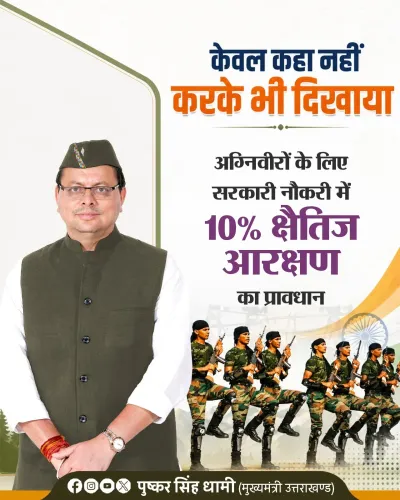
In his post, CM Dhami stated: 'राज्य आंदोलनकारियों एवं उनके पात्र आश्रितों को सरकारी नौकरियों में 10% क्षैतिज आरक्षण का लाभ देकर हमारी सरकार ने अपने संकल्प को सिद्ध करने का कार्य किया है' ['By providing the benefit of 10% horizontal reservation in government jobs to state agitators and their eligible dependants, our government has proved its resolve']. He further emphasised that honouring the struggle, sacrifice and martyrdom of Uttarakhand's statehood agitators is a 'moral responsibility' of the government — and that the 'double engine government' has not kept it a mere announcement but has taken a decision and implemented it on the ground.
Horizontal reservation is a cross-cutting quota applied within each existing vertical category (general, OBC, SC, ST), ensuring that the beneficiary group receives a fixed share across all categories rather than a separate silo. A 10% horizontal slice in state government recruitment is a significant commitment given the volume of vacancies advertised annually in Uttarakhand.
Policy Backdrop
Uttarakhand was carved out of Uttar Pradesh on 9 November 2000 after a decade-long agitation in which activists — many from the hills of Garhwal and Kumaon — faced hardship, lathi charges and, in some cases, death. Successive state governments acknowledged these sacrifices but the translation of recognition into concrete job benefits remained incomplete for years.
The Bharatiya Janata Party has consistently promoted a 'double engine' governance model, arguing that alignment between the state government and the BJP-led central government accelerates delivery of long-pending regional promises. CM Dhami, who has been in office since 2021, has framed several welfare measures around the statehood movement narrative, positioning his administration as the one that finally converts pledges into policy.
Similar schemes recognising movement participants have been introduced in other BJP-governed states with distinct regional histories, reflecting a broader pattern of using targeted welfare measures to honour sub-national identity movements.
Stakeholders and Impact
The direct beneficiaries are recognised state agitators and their eligible dependants — a category defined by state government records that identify individuals who participated in the 1990s Uttarakhand statehood movement. For many ageing activists and their children, government employment represents both economic security and symbolic recognition.
Job aspirants in the general pool will see a 10% horizontal slice applied across recruitment cycles, which could affect competition ratios in popular state-service examinations. The move is also likely to resonate with voters in hill districts where the statehood movement had its deepest roots.
What's Next
The immediate focus will be on the official government notification spelling out eligibility criteria, the mechanism for verifying agitator status, and the administrative process for dependants to claim the benefit. Legal scrutiny of horizontal reservation orders is not uncommon in Indian courts, and any challenge to the eligibility framework could delay implementation. Observers will watch whether the state publishes a comprehensive list of recognised agitators and whether the reservation survives judicial review intact.
Point of View
The BJP reinforces its narrative of governance credibility in Uttarakhand's hill constituencies, where statehood-movement sentiment remains emotionally potent. The horizontal mechanism is legally safer than a standalone vertical quota, but eligibility verification will be the real administrative test — and any opacity there could invite litigation. Broader pattern: BJP-governed states with distinct regional identities increasingly use targeted welfare for movement participants as a durable voter-loyalty instrument.
NationPress
20 Sept 2026
Frequently Asked Questions
What is the 10% horizontal reservation announced by CM Dhami for Uttarakhand?
It is a 10% horizontal reservation in Uttarakhand state government jobs for recognised statehood agitators and their eligible dependants, announced by Chief Minister Pushkar Singh Dhami on 26 May 2026. Horizontal reservation means the quota applies within each existing vertical category rather than as a separate silo.
Who are Uttarakhand state agitators eligible for this job reservation?
State agitators are individuals officially recognised by the Uttarakhand government as having participated in the 1990s statehood movement that led to the formation of Uttarakhand on 9 November 2000. Their eligible dependants are also covered under the scheme.
What is the difference between horizontal and vertical reservation in India?
Vertical reservation refers to separate quotas for broad categories such as SC, ST and OBC. Horizontal reservation is a cross-cutting quota applied within each vertical category, ensuring a specific group gets a fixed share across all categories simultaneously.
Why was Uttarakhand formed as a separate state?
Uttarakhand was carved out of Uttar Pradesh on 9 November 2000 following a sustained agitation through the 1990s by activists from the Garhwal and Kumaon hill regions who demanded a separate state to address the distinct developmental and cultural needs of the hill population.
What is the 'double engine government' that CM Dhami refers to?
'Double engine government' is a BJP phrase describing political alignment between a BJP-governed state and the BJP-led central government, which the party argues enables faster and more effective delivery of policies and welfare schemes.