CM Fadnavis: Maharashtra to get 10 TMC water from Narmada
Synopsis
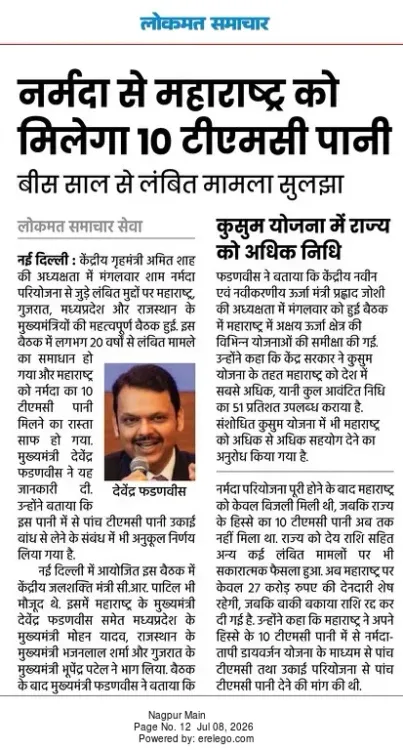
The Chief Minister's Office of Maharashtra announced on 8 July 2026 that the state will receive 10 TMC of water from the Narmada river, a development tied to CM Devendra Fadnavis and carrying major implications for drought-prone farming districts.
Key Takeaways
The CMO Maharashtra announced on 8 July 2026 that the state will receive 10 TMC of water from the Narmada river .
The post directly tagged Chief Minister Devendra Fadnavis , associating him with the development.
Maharashtra's Narmada water rights are governed by the Narmada Water Disputes Tribunal's 1979 award .
The allocation is expected to benefit drought-prone farmers and irrigation-dependent districts across the state.
Formal project timelines and infrastructure provisions are yet to be confirmed by the Narmada Control Authority .
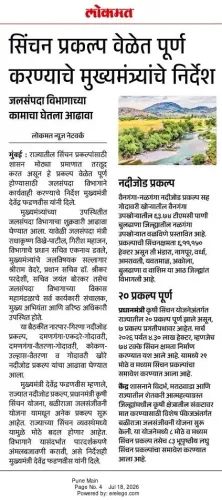
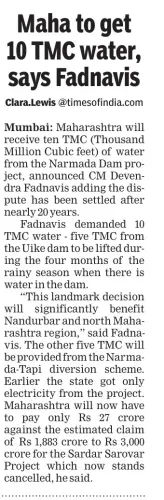
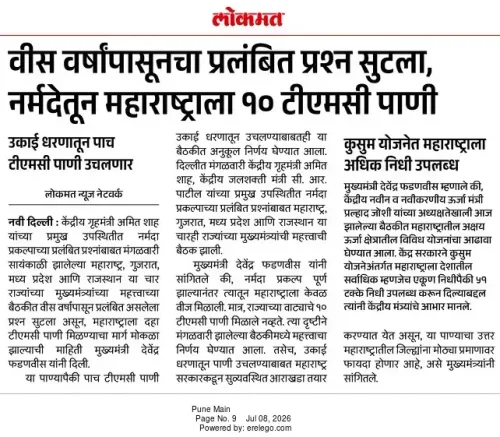
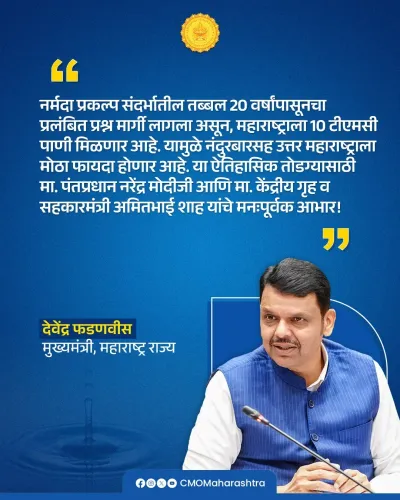
The Chief Minister's Office of Maharashtra on Wednesday, 8 July 2026 shared an announcement that the state is set to receive 10 TMC (thousand million cubic feet) of water from the Narmada river, tagging Chief Minister Devendra Fadnavis in the post.
The post, shared on the official CMO Maharashtra handle, stated in Hindi: 'Narmada se Maharashtra ko milega 10 TMC paani' ('Maharashtra will receive 10 TMC water from Narmada'), directly associating the development with Chief Minister Fadnavis.
Context
The Narmada river is one of India's major inter-state rivers, flowing through Madhya Pradesh, Maharashtra, and Gujarat. Water sharing among the riparian states has long been governed by the Narmada Water Disputes Tribunal, which issued its final award in 1979, allocating fixed shares to each state subject to project-based utilisation.
Maharashtra has periodically worked to optimise its allocated share through lift schemes and canal linkages. The announcement of a 10 TMC allocation marks a significant step in the state's efforts to draw on its Narmada entitlement.
Policy Backdrop
Chief Minister Devendra Fadnavis has consistently prioritised water resource and irrigation infrastructure during his tenures at the helm of Maharashtra. The state faces chronic water stress in several districts, making inter-state river allocations a politically and economically critical issue.
Inter-state river water sharing in India involves a layered process: tribunal awards set baseline allocations, while subsequent negotiations and infrastructure projects determine actual utilisation. Maharashtra's ability to draw on its Narmada share depends on the construction and operationalisation of transfer infrastructure such as lift schemes or canal networks.
Stakeholders and Impact
The primary beneficiaries of any additional Narmada water supply would be drought-prone farming communities and irrigation-dependent districts in Maharashtra, particularly those in the state's water-scarce regions. Assured water availability can stabilise agricultural output and reduce dependence on erratic monsoon patterns.
The announcement is also significant for urban and industrial water planning, as growing demand in Maharashtra's interior districts increasingly outpaces local surface and groundwater availability. A 10 TMC addition represents a meaningful augmentation of the state's usable water resources.
What's Next
Formal confirmation and project timelines from the Narmada Control Authority — the inter-state body overseeing implementation of the tribunal award — will be closely watched. Any follow-up provisions in the Maharashtra state budget for related lift or canal infrastructure would signal the pace of actual project execution.
The development will also be monitored by co-riparian states Madhya Pradesh and Gujarat, for whom any new transfer proposal from the shared Narmada system carries implications for their own allocations and planning.
Point of View
Making the gap between announcement and infrastructure readiness a key variable to watch. If backed by concrete budget provisions and Narmada Control Authority clearances, a 10 TMC addition would represent one of the more consequential water augmentation steps for Maharashtra in recent years. The timing also fits a broader pattern of the state government highlighting infrastructure wins ahead of ongoing rural distress concerns.
NationPress
6 Oct 2026
Frequently Asked Questions
How much Narmada water will Maharashtra receive?
According to the CMO Maharashtra's announcement on 8 July 2026, the state is set to receive 10 TMC (thousand million cubic feet) of water from the Narmada river.
What is the Narmada Water Disputes Tribunal?
The Narmada Water Disputes Tribunal is an inter-state body that issued a final award in 1979 dividing Narmada river waters among riparian states — Madhya Pradesh , Maharashtra , and Gujarat — with fixed allocations subject to project-based utilisation.
Which districts in Maharashtra will benefit from Narmada water?
The primary beneficiaries are expected to be drought-prone farming communities and irrigation-dependent districts in Maharashtra, though specific district-level details have not yet been confirmed in official communications.
What role does Devendra Fadnavis play in the Narmada water project?
Devendra Fadnavis is the Chief Minister of Maharashtra. The CMO directly tagged him in the 8 July 2026 announcement, indicating the development is being driven under his leadership.
When will Maharashtra actually get Narmada water?
No formal timeline has been confirmed yet. Actual water delivery depends on clearances from the Narmada Control Authority and the construction of transfer infrastructure such as lift schemes or canals.