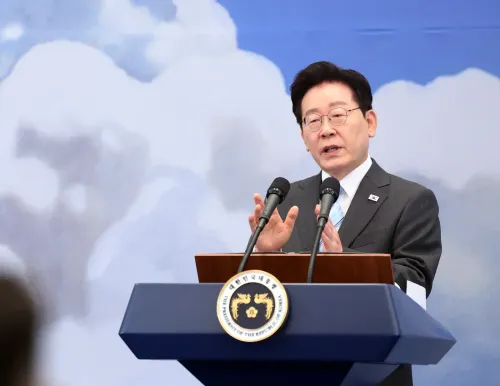
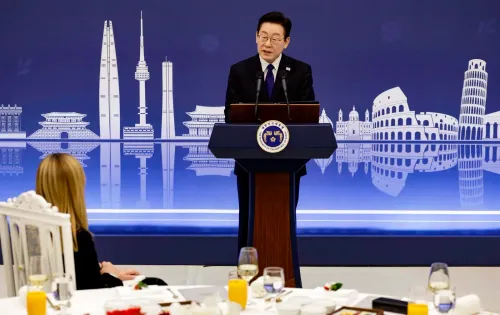
South Korea's Lee Jae Myung holds 37% approval as party support hits new low

Synopsis
South Korean President Lee Jae Myung's approval has stalled at 37% — but the sharper story is his own Democratic Party hitting its lowest support level since he took office, even as opposition ratings also dipped. The simultaneous fall in both parties' numbers points to a broader crisis of public confidence in Seoul's political class.
Key Takeaways
Lee Jae Myung's approval rating remained flat at 37% in the latest Gallup Korea survey conducted 7–9 October 2026 .
Disapproval fell 5 percentage points to 51% , compared to 56% in the previous poll three weeks earlier.
The ruling Democratic Party dropped to 35% support — the lowest since Lee's administration launched in June last year .
The opposition People Power Party also slipped 1 percentage point to 26% .
Top criticism: real estate policy (18%) and North Korea/security policy (15%); top praise: foreign affairs (24%).
On 4 October , Lee invoked the 2007 Inter-Korean Declaration , calling for a 'virtuous cycle of peace and prosperity' on the Korean Peninsula.
South Korean President Lee Jae Myung's approval rating held steady at 37 per cent this week, while his disapproval rating fell 5 percentage points to 51 per cent, according to a fresh Gallup Korea survey released on Friday, 9 October 2026. The poll, conducted from Tuesday through Thursday on a sample of 1,000 people aged 18 and older, marks no change in positive assessment compared to the survey conducted three weeks earlier.
Key Poll Findings
Among respondents who rated Lee's performance positively, 24 per cent cited foreign affairs as his strongest area, followed by economic and livelihood issues at 14 per cent. On the negative side, 18 per cent of critics pointed to real estate policies as their primary concern, while 15 per cent flagged his defence, security, and North Korea policy.
The survey carried a margin of error of plus or minus 3.1 percentage points at a 95 per cent confidence level.
Party Support Hits Administration Low
Support for Lee's ruling Democratic Party dropped 5 percentage points from the previous survey to 35 per cent — the lowest recorded since the administration's launch in June last year. The main opposition People Power Party also slipped, shedding 1 percentage point to settle at 26 per cent. The simultaneous decline in support for both major parties signals broader public disillusionment rather than a straightforward partisan swing.
Lee's Inter-Korean Peace Push
This comes amid a renewed diplomatic push by Lee on the Korean Peninsula. On 4 October, President Lee called for breaking out of 'a vicious cycle of hostility and confrontation to create a virtuous cycle of peace and prosperity,' in a speech marking the 19th anniversary of the October 4 Inter-Korean Declaration. His remarks were delivered by Vice Unification Minister Kim Nam-jung, as Lee did not attend in person.
The October 4 Declaration was originally signed in 2007 by late former President Roh Moo-hyun and late North Korean leader Kim Jong-il — the father of current North Korean leader Kim Jong-un. Lee described it as 'a historic agreement' aimed at transitioning inter-Korean ties toward mutual trust and a permanent peace framework.
'The journey to resolve the Korean Peninsula issue and establish peace will not be easy. But it is clear that is the road we have to walk,' Lee said in his remarks.
Notably, Lee's inter-Korean outreach — which draws on the 'sunshine policy' lineage of his Democratic Party — has earned him some goodwill on foreign affairs in the polls, even as domestic issues like real estate continue to drag down his overall ratings.
What to Watch Next
With the Democratic Party's support at its lowest since the administration began, Lee faces mounting pressure to deliver on economic and housing pledges before the next major polling cycle. A sustained gap between disapproval and approval ratings could complicate his legislative agenda, particularly on North Korea engagement, where bipartisan support remains thin.
Point of View
It usually signals that voters are separating personal assessments from broader partisan loyalty, a dynamic that can accelerate quickly. Lee's inter-Korean rhetoric earns him foreign-affairs credit in surveys, yet real estate — the kitchen-table issue for millions of South Koreans — remains his most cited weakness. Unless the administration can show tangible progress on housing and livelihood costs, the gap between approval and disapproval is unlikely to narrow before the next legislative cycle.
NationPress
9 Oct 2026
Frequently Asked Questions
What is Lee Jae Myung's current approval rating in South Korea?
South Korean President Lee Jae Myung holds a 37% approval rating, unchanged from the previous Gallup Korea poll conducted three weeks earlier. His disapproval rating fell 5 percentage points to 51%, according to the survey released on 9 October 2026.
Why is Lee Jae Myung's approval rating notable right now?
While his personal approval has held steady, his ruling Democratic Party's support dropped to 35% — the lowest since his administration began in June last year. The simultaneous decline in both major parties' ratings suggests wider public discontent with South Korean politics.
What are South Koreans most critical of in Lee's presidency?
Real estate policy is the leading source of dissatisfaction, cited by 18% of those who rated his performance negatively. Defence, security, and North Korea policy followed at 15%. On the positive side, 24% praised his handling of foreign affairs.
What did Lee say about inter-Korean relations on 4 October?
President Lee called for ending 'a vicious cycle of hostility and confrontation' and building 'a virtuous cycle of peace and prosperity' in a speech marking the 19th anniversary of the 2007 October 4 Inter-Korean Declaration. He invoked the legacy of late former President Roh Moo-hyun, who signed the original accord with late North Korean leader Kim Jong-il.
How reliable is the Gallup Korea poll?
The survey was conducted from Tuesday through Thursday on 1,000 people aged 18 and older, with a margin of error of plus or minus 3.1 percentage points at a 95% confidence level — a standard and credible polling methodology.