South Korea's Lee Jae Myung approval rating climbs to 39% after record low
Synopsis
South Korean President Lee Jae Myung's approval has ticked up to 39% from a record low of 37%, but disapproval remains above 50% — driven by real estate and economic grievances. On the same day, Lee called for a constitutional revision invoking the 1979 Buma pro-democracy uprising, suggesting he is leaning into democratic legacy politics even as his ratings stay fragile.
Key Takeaways
Lee Jae Myung 's approval rating rose to 39 per cent , up 2 percentage points from a record low of 37 per cent , per a Gallup Korea poll released on 17 October 2026 .
Disapproval of Lee's performance also rose 1 percentage point to 52 per cent , with real estate policies and economic concerns cited as top grievances.
Support for the ruling Democratic Party recovered to 36 per cent ; the opposition People Power Party stands at 27 per cent .
For the 2028 general elections , 47 per cent favour more opposition candidates versus 34 per cent backing the DP .
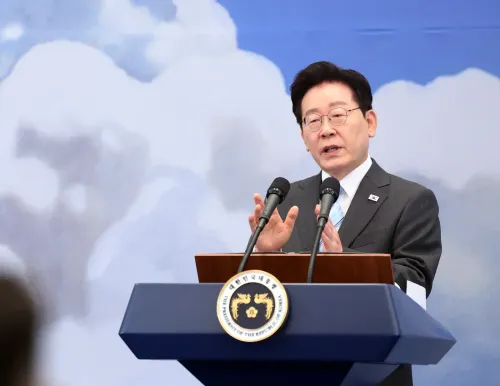
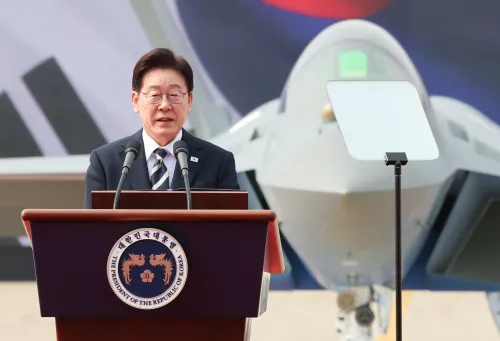
President Lee called on the National Assembly to pursue constitutional reform , invoking the 1979 Buma uprising at its 47th anniversary ceremony .
South Korean President Lee Jae Myung's approval rating edged up to 39 per cent this week, snapping a prolonged downward slide that had pushed it to a record low of 37 per cent in the two preceding surveys, according to a Gallup Korea poll released on Friday, 17 October 2026. The recovery, though modest, marks the first upward movement since a sustained decline began in late August.
Poll Findings at a Glance
The weekly survey, conducted Tuesday through Thursday on a sample of 1,003 respondents aged 18 and older, showed positive assessments of Lee's performance rising by 2 percentage points week-on-week. However, disapproval also inched up — 52 per cent of respondents said they were dissatisfied with his handling of state affairs, a rise of 1 percentage point from the previous week. The survey carries a margin of error of plus or minus 3.1 percentage points at a 95 per cent confidence level.
What Is Driving Positive and Negative Sentiment
Among those who rated Lee's performance favourably, 20 per cent cited diplomacy as the primary reason, followed by economic and livelihood issues at 11 per cent. On the other side, critics pointed to real estate policies and broader economic and livelihood concerns as the main sources of dissatisfaction. The persistent grievance over real estate — a politically charged issue in South Korea given soaring urban housing costs — has remained a recurring drag on Lee's numbers since he took office.
Party Support and 2028 Election Outlook
Support for the ruling Democratic Party (DP) rose 1 percentage point to 36 per cent, recovering from what had been its lowest figure since the launch of Lee's administration. The main opposition People Power Party (PPP) also gained 1 percentage point, reaching 27 per cent.
Looking ahead to the 2028 general elections, 47 per cent of respondents said they preferred more opposition candidates to be elected to provide a check on the government, while 34 per cent favoured a stronger DP presence to support Lee's agenda. Notably, this preference for opposition dominance held across most age groups — except those in their 40s and 50s, where DP support stood at 50 per cent and 48 per cent respectively.
Lee Calls for Constitutional Reform
Separately on Friday, President Lee used a ceremony marking the 47th anniversary of the 1979 Busan-Masan pro-democracy protests — also known as the Buma uprising — to call on the National Assembly to initiate constitutional revision talks. The protests were a pivotal challenge to the dictatorship of then-President Park Chung-hee.
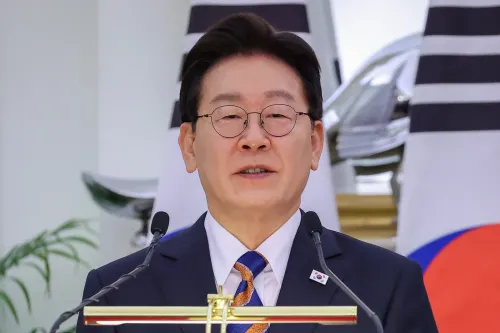
'Reflecting the Buma democratisation uprising and the Gwangju democratisation movement in the preamble to the Constitution is the smallest measure we need to not forget the blood-stained history of defending South Korea's democracy and people's sovereignty,' Lee said at the ceremony.
He added: 'On this occasion, I once again request that the National Assembly begin gathering public opinions and holding reasonable discussions on constitutional reform.' The call signals that constitutional change is emerging as a significant political priority for Lee's administration, even as his approval numbers remain under pressure.
What to Watch Next
With disapproval still above 50 per cent and the opposition holding a commanding lead in 2028 election preferences, Lee's administration faces continued headwinds. Whether the slight approval recovery translates into a sustained trend will depend heavily on progress — or the lack of it — on real estate reform and economic management in the coming weeks.
Point of View
Democratic legacy may be the asset. The 2028 election data — with opposition preference dominating across most age groups — should concern the Democratic Party more than any single weekly reading. The real story is structural, not directional.
NationPress
16 Oct 2026
Frequently Asked Questions
What is South Korean President Lee Jae Myung's current approval rating?
Lee Jae Myung's approval rating stands at 39 per cent as of the week of 14–16 October 2026, according to a Gallup Korea weekly poll. This is a 2-percentage-point recovery from his record low of 37 per cent recorded in the two preceding surveys.
Why has Lee Jae Myung's approval rating been falling?
Lee's approval has been on a downward trend since late August 2026, driven primarily by dissatisfaction with his real estate policies and economic management. Among those who disapprove, real estate and livelihood concerns are the most frequently cited reasons.
What did Lee Jae Myung say about constitutional reform?
On 17 October 2026, Lee called on the National Assembly to begin discussions on constitutional revision, speaking at a ceremony marking the 47th anniversary of the 1979 Buma pro-democracy uprising. He urged that the Buma and Gwangju democratisation movements be reflected in the Constitution's preamble.
How do South Koreans feel about the 2028 general elections?
According to the same Gallup Korea poll, 47 per cent of respondents want more opposition candidates elected to check the government, while 34 per cent prefer a stronger Democratic Party presence to support Lee's administration. The opposition preference held across most age groups.
What is the current support level for South Korea's ruling Democratic Party?
Support for the Democratic Party rose 1 percentage point to 36 per cent this week, recovering from its lowest level since Lee's administration began. The opposition People Power Party also gained 1 point, reaching 27 per cent.