Melania Trump Launches Savings Accounts for Foster Care Kids
Synopsis
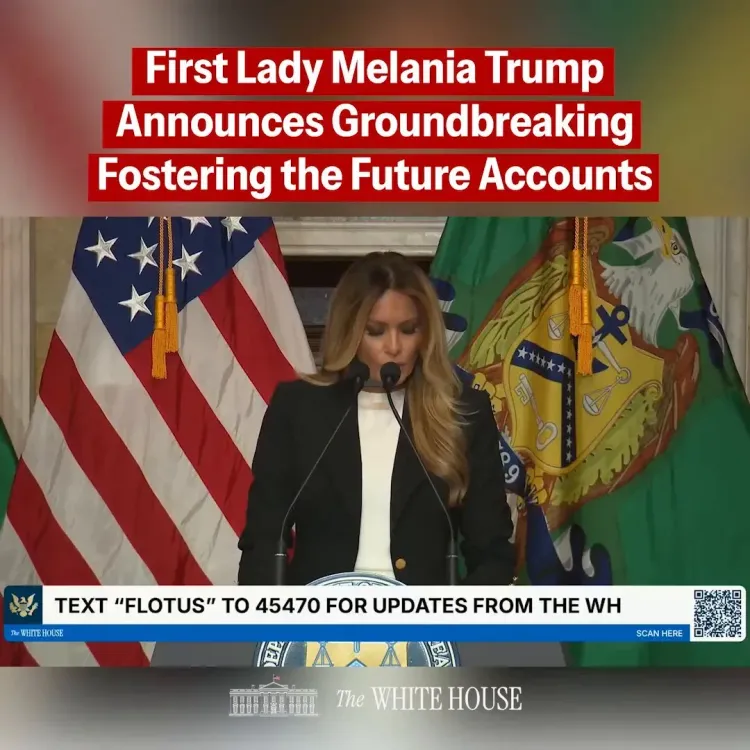
First Lady Melania Trump announced on June 11, 2026, a new initiative creating dedicated savings and investment accounts for children in foster care, positioning it as a vehicle for genuine financial independence rather than a conventional welfare service.
Key Takeaways
First Lady Melania Trump announced dedicated savings and investment accounts for children in the U.S. foster care system on June 11, 2026 .
The initiative is framed around economic self-sufficiency, with Melania stating that 'real freedom means being able to make independent choices about your own future.' The announcement extends Melania's Be Best platform, launched in May 2018 , which has long focused on the well-being of foster youth.
The Family First Prevention Services Act of 2018 provides the broader federal policy backdrop, having shifted foster care funding toward prevention and family support.
Multiple U.S. states have already piloted matched savings and 529-style accounts for foster youth, lending precedent to a federal-level rollout.
Funding mechanisms, account structures, and timelines remain unconfirmed pending Congressional or HHS action.
First Lady Melania Trump announced on Thursday, June 11, 2026, a new initiative establishing dedicated savings and investment accounts for children in the foster care system, framing it as a step toward genuine economic independence for one of America's most vulnerable youth populations. The White House shared the announcement on X, quoting the First Lady directly on the philosophy behind the move.
In her own words, Melania Trump stated: 'America can offer services, help, and protection, but real freedom means being able to make independent choices about your own future.' The remark signals that the initiative is designed not merely as a welfare supplement but as a long-term asset-building tool intended to carry foster youth into financial self-sufficiency.
Context
Melania Trump has maintained a sustained focus on child welfare since her first tenure as First Lady. In May 2018, she launched Be Best, a platform addressing children's physical and emotional well-being, with a specific outreach component targeting youth in and aging out of the foster care system. The new savings account initiative appears to extend that work into the domain of financial empowerment.
The foster care system in the United States is a patchwork of federal and state programs that provides temporary placement and services for children removed from families due to abuse or neglect. A persistent challenge within the system is what happens when young people 'age out' — typically at 18 to 21 years — often with limited financial resources and no family safety net.
Policy Backdrop
The announcement builds on a broader federal-state policy trajectory. The Family First Prevention Services Act of 2018 redirected federal foster care funding toward family preservation and prevention, signalling a shift in how Washington approaches child welfare — from reactive placement to proactive support. The new accounts appear to carry that philosophy further by introducing an asset-building dimension.
Multiple U.S. states have piloted matched savings programmes and 529-style education accounts for foster youth since the mid-2010s, reflecting growing consensus among child welfare experts that financial literacy and early asset accumulation are critical to reducing long-term dependency. The White House initiative, if implemented at scale, would represent a federal-level consolidation of these state experiments.
Stakeholders and Impact
The primary beneficiaries would be the estimated hundreds of thousands of children currently in foster care across the United States, as well as the larger cohort of young adults who have recently aged out of the system. Child welfare agencies at both the federal and state levels would likely be key implementation partners.
Advocates for foster youth have long argued that financial instability is one of the leading drivers of poor outcomes — including homelessness, unemployment, and cycles of poverty — among this population. Dedicated investment accounts, if adequately funded, could provide a meaningful financial cushion at the point of transition to adulthood.
What's Next
The specific funding mechanism, account structure, and rollout timeline for the initiative have not yet been confirmed through legislative or budgetary records. Attention will now turn to whether the U.S. Congress or the Department of Health and Human Services (HHS) moves to codify and fund the programme, and whether existing child welfare block grants to states will be leveraged as a vehicle for expansion.
The initiative also raises questions about how it will interact with existing state-level pilots, and whether a uniform federal framework will be introduced or whether states will retain discretion in implementation. The coming weeks are likely to bring further details as the White House moves from announcement to policy architecture.
Point of View
Moving it from awareness-focused programming into the more durable terrain of economic policy — a shift that gives Be Best a concrete, measurable legacy beyond its first iteration. By framing foster care support as a matter of 'freedom' rather than charity, the White House is borrowing the language of conservative self-reliance to build political consensus for what is, structurally, an expansion of federal intervention in child welfare. The focus on asset-building aligns with a bipartisan policy trend that has been quietly gaining ground in state legislatures for nearly a decade, which may ease the path to Congressional action. How the administration resolves the tension between federal uniformity and state discretion in implementation will determine whether this becomes a durable programme or a symbolic announcement.
NationPress
21 Sept 2026
Frequently Asked Questions
What is Melania Trump's foster care savings account initiative?
Melania Trump announced on June 11, 2026 , a new initiative to create dedicated savings and investment accounts for children in the U.S. foster care system, aimed at giving them financial resources and independence as they transition to adulthood.
What is the Be Best programme and how is it related?
Be Best is a child well-being platform launched by Melania Trump in May 2018 during her first tenure as First Lady. It has included outreach to foster youth, and the new savings account initiative appears to be a direct extension of that work into financial empowerment.
How many children are in foster care in the United States?
Hundreds of thousands of children are in the U.S. foster care system at any given time. A significant concern is what happens when youth 'age out' of the system, typically between the ages of 18 and 21 , often with limited financial support.
Has the U.S. government tried savings accounts for foster youth before?
Multiple U.S. states have piloted matched savings programmes and 529-style education accounts for foster youth since the mid-2010s. The new White House initiative would represent a federal-level effort to consolidate and scale these state experiments.
What happens next for the Melania Trump foster care savings plan?
The funding mechanism and rollout timeline have not yet been confirmed. The next steps depend on action by the U.S. Congress or the Department of Health and Human Services (HHS) , including whether existing child welfare block grants will be used to fund the accounts.