Did a Mouse Give Birth to Pups After a Space Mission in China?
Synopsis
In an exciting breakthrough, a female mouse has successfully given birth to healthy pups after returning from a space mission aboard China’s Shenzhou-21 spacecraft. This remarkable achievement opens new avenues for research into reproductive health in microgravity environments.
Key Takeaways
One female mouse successfully gave birth to six healthy pups after returning from space.
The mission demonstrated no adverse effects on reproductive capabilities due to short-term space travel.
Researchers aim to explore how microgravity influences mammalian development.
Data collected will contribute to understanding stress responses in space environments.
This project marks a significant step in mammalian research in space.
Beijing, December 27 (NationPress) Among the four mice that participated in a recent mission to China's space station, one female has successfully delivered healthy pups on Earth, as reported by the Technology and Engineering Center for Space Utilization (CSU) of the Chinese Academy of Sciences (CAS) on Saturday.
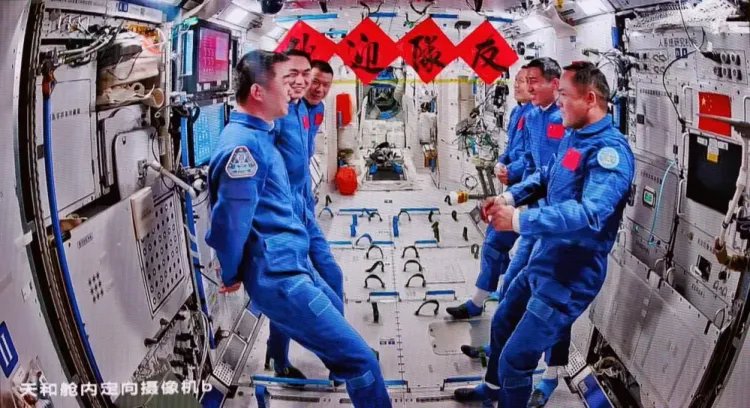
The group of four mice—two males and two females—was launched into space aboard the Shenzhou-21 crewed spacecraft on October 31. They were kept in a specialized habitat on the space station before returning to Earth on November 14, according to Xinhua news agency.
Upon their return, one female mouse conceived and gave birth to nine pups on December 10. Six of the pups have survived, which is considered a normal survival rate. Researchers have observed that the mother is nursing her young normally and that the pups are active and healthy.
"This mission has demonstrated that short-duration space travel did not adversely affect the reproductive abilities of the mouse," stated Wang Hongmei, a researcher at the Institute of Zoology of the CAS.
"It also offers critical samples for exploring the impact of the space environment on the early developmental phases of mammals," Hongmei further explained.
The mice were sent to China's space station for a period of five to seven days, marking a significant milestone as the country's initial scientific experiments utilizing mammalian models in space.
As a vital model organism in life sciences, the mice possess several advantages, including a high genetic similarity to humans, a small body size, a brief reproductive cycle, and a high capacity for genetic modification, according to Huang Kun, an expert from the Technology and Engineering Center for Space Utilization at CAS.
"These traits make them perfect for investigating physiological and pathological processes, as well as the growth, development, and reproduction of organisms in a space environment," Huang noted.
This project, co-directed by the Shanghai Institute of Technical Physics and the Institute of Zoology, both under CAS, involved continuous multi-dimensional video monitoring of the mice throughout their time in orbit.
The lighting in the mice experiment facility was programmed to turn on at 7 a.m. and off at 7 p.m., simulating the same circadian rhythm as on Earth, explained Li Tianda, an associate researcher at the Institute of Zoology.
The rodent diet was not only balanced nutritionally but also designed to minimize crumbs, catering to the mice's natural teeth-grinding behavior. A specialized airflow system within the facility directed hair, feces, and other waste into a collection container, ensuring a clean and sanitary environment for the mice, according to Li.
By gathering preliminary data on stress responses and adaptation mechanisms in microgravity, scientists aim to decode how weightlessness and confined spaces affect the behavior of mice.
After completing their orbital mission, the "mice astronauts" returned to Earth aboard the Shenzhou-20 spacecraft for further analysis.
Prior animal research conducted in the Chinese space lab has involved zebra fish and fruit flies.
Point of View
This remarkable achievement by Chinese scientists underscores the innovative efforts being made in space research. The success of the mouse pups not only highlights the resilience of life in extreme conditions but also provides critical insights into reproductive health that could have far-reaching implications for future space exploration and biological research.
NationPress
8 Oct 2026
Frequently Asked Questions
What was the purpose of sending mice into space?
The mice were sent into space to study the effects of microgravity on their reproductive capabilities and overall health, providing insights into how space environments affect early development in mammals.
How many pups were born, and how many survived?
The female mouse gave birth to nine pups, of which six have survived, which is considered a normal survival rate.
What are the advantages of using mice in space research?
Mice are ideal for space research due to their high genetic similarity to humans, small size, short reproductive cycle, and ease of genetic modification, making them valuable for studying various biological processes.
What kind of monitoring was conducted during the experiment?
Continuous multi-dimensional video monitoring was employed to observe the mice throughout their stay in orbit, ensuring comprehensive data collection on their behavior and health.
What previous animal experiments have been conducted in the Chinese space lab?
Previous experiments in the Chinese space lab have involved species such as zebra fish and fruit flies, focusing on various biological responses to space conditions.