Is the National Citizen Party Aligning with Jamaat for Bangladesh Elections?

Synopsis
As the Bangladesh elections loom, the National Citizen Party (NCP) is navigating internal rifts while eyeing a potential alliance with Jamaat-e-Islami. Amidst factionalism and declining grassroots support, the NCP's future hangs in the balance as they seek a strategic partnership to secure their political survival.
Key Takeaways
The NCP is leaning towards an alliance with Jamaat-e-Islami.
Internal divisions are impacting the party's electoral strategy.
Grassroots support remains a challenge despite digital popularity.
Negotiations with the BNP are also being reconsidered.
The political landscape is highly fluid leading up to the elections.
Dhaka, Dec 27 (NationPress) As the general elections in Bangladesh approach, the National Citizen Party (NCP) is showing an increasing inclination towards forming a potential seat-sharing agreement with Jamaat-e-Islami, as indicated by various local media sources.
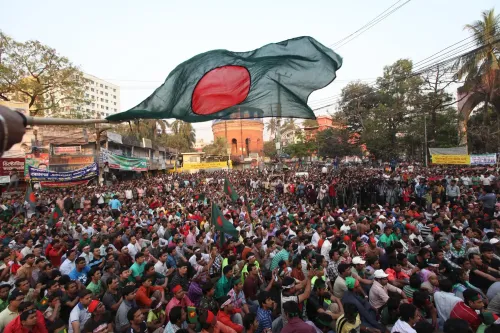
Emerging from the student-led protests of 2024 against the government led by Sheikh Hasina, the NCP is reportedly facing challenges in solidifying its political foundation ahead of the elections.
Founded by students who were instrumental in appointing Muhammad Yunus as the leader of the interim administration, the party is believed to have his support.
Initially perceived as an ambitious effort to create a third political force outside of Bangladesh's traditional political dynamics, specifically the Bangladesh Nationalist Party (BNP) and Jamaat-e-Islami, the NCP emerged at a time when the Awami League's political dominance has been curtailed.
Despite its considerable presence on social media, the NCP has struggled to convert this online popularity into tangible grassroots backing. Consequently, the party is currently looking to establish ties with either the BNP or Jamaat-e-Islami, according to reports from several Bangladeshi news outlets.
This quest for alliances has ignited internal strife within the NCP, characterized by resignations, factional divisions, and challenging negotiations. Reports indicate that the NCP is no longer aiming to contest a significant number of seats in the 350-member Jatiya Sangsad.
Instead, as reported by the Dhaka-based daily Prothom Alo, the party seems prepared to accept as few as 30 seats in an alliance with the Islamist Jamaat.
Pre-election surveys highlight the NCP's predicament, placing the BNP as the leading party, with Jamaat not lagging far behind. This situation has effectively divided the NCP into two factions: one favoring an alliance with Jamaat-e-Islami and the other seeking negotiations with the BNP, especially following the return of Tarique Rahman, acting chairman of the BNP, to Bangladesh.
Reports about alliance negotiations and the increasing splits within the party surfaced shortly after Mir Arshadul Haque, a key member of the NCP's anti-Jamaat faction, resigned last Thursday.
Haque held the role of joint member secretary and was also the chief coordinator for the Chattogram city unit, according to a report by The Daily Star.
Further complicating matters are allegations that Jamaat-e-Islami might offer as much as 1.5 crore taka to the NCP for each constituency it contests alongside them.
In response to these developments, an anti-Hasina student leader remarked, "The grave of youth politics is about to be dug."
According to Prothom Alo, discussions between the NCP and Jamaat-e-Islami concerning a prospective seat-sharing arrangement for the upcoming national parliamentary elections are currently in progress.
While some leaders within the NCP view this move as crucial for political survival, others see it as a betrayal of the party's founding values.
The dialogue with Jamaat has reportedly gained traction after earlier attempts to negotiate with the BNP fell through. However, with Tarique Rahman's return, senior leaders of the NCP have also reportedly reopened communication with the BNP.
Jamaat-e-Islami, which has reportedly backed Muhammad Yunus since August 2024, has yet to publicly disclose its final stance on seat-sharing with the NCP.
Jamaat Ameer Shafiqur Rahman stated on Friday that any political party could form an electoral alliance with Jamaat-e-Islami as long as it adheres to three specific conditions.
The NCP was officially established in February 2025 as a student-led political entity by leaders who spearheaded the 2024 anti-Hasina protests that ultimately led to the ousting of former Prime Minister Sheikh Hasina from office.
Point of View
The electorate watches closely, and the implications of these decisions will resonate far beyond the upcoming polls.
NationPress
30 Sept 2026
Frequently Asked Questions
What is the current status of the NCP's alliance talks?
The NCP is currently engaged in discussions with Jamaat-e-Islami about a possible seat-sharing arrangement for the upcoming elections.
Why is the NCP struggling to gain grassroots support?
Despite significant social media visibility, the NCP has not been able to convert this popularity into tangible grassroots support.
Who are the key political figures mentioned in relation to the NCP?
Key figures include Muhammad Yunus, Sheikh Hasina, Tarique Rahman, and Shafiqur Rahman.
What are the implications of the NCP's potential alliance with Jamaat?
The alliance could offer the NCP a foothold in the elections but may also compromise its foundational values.
How has the internal conflict affected the NCP?
The internal strife has led to resignations and factionalism, complicating the party's ability to present a united front.