Is 2025 a Turning Point for Rahul Gandhi and Congress?
Synopsis
As 2025 nears, Rahul Gandhi faces unprecedented challenges within Congress. The party's internal dynamics are shifting, with Priyanka Gandhi emerging as a potential leader. Can the Congress navigate its leadership crisis? Dive into the complexities of political rivalries and the potential for change.
Key Takeaways
Rahul Gandhi faces a critical juncture in his leadership.
Priyanka Gandhi Vadra is emerging as a prominent political figure.
The Congress party is experiencing internal challenges and scrutiny.
Electoral losses highlight the urgency for strategic reevaluation.
Calls for leadership change are growing within the party.
New Delhi, Dec 28 (NationPress) As the year 2025 comes to a close, Rahul Gandhi finds himself facing one of the most challenging periods of his political journey. The leader of the Congress party has navigated through numerous adversities in the past, yet the events of this year could catalyze a significant internal reckoning within the historic party -- one that strikes at the very core of its leadership framework.
It is likely that Rahul Gandhi never anticipated that a standard international trip and his absence from a Parliament session would lead to upheaval not from his political rivals, but from members within his own party. His regular travels abroad have been a frequent source of criticism, but this occasion has seen repercussions that extend beyond the predictable attacks from the BJP and delve into the perilous realm of internal comparisons and overt questioning.
On December 17, Gandhi traveled to Germany while Parliament was in session for a three-day visit at the behest of the Progressive Alliance -- a coalition of 117 progressive political entities globally. Unsurprisingly, the Bharatiya Janata Party accused him of associating with elements possessing an 'anti-India agenda.'
The Congress and its allies promptly came to his defense, asserting that international travel was not a crime and that global engagement is integral to opposition politics.
However, this defense overlooked a more significant issue. Rahul Gandhi's absence from Parliament created a political void, which nature -- especially in politics -- tends to fill. Inadvertently, Priyanka Gandhi Vadra stepped into that space.
Priyanka's involvement during the Winter Session did not go unnoticed. While there has always been chatter about her, this time it was more pronounced, louder, and consequential. Her demeanor both inside and outside Parliament communicated subtle yet clear messages. Unlike her brother, she seemed relaxed, approachable, and politically astute in her interactions -- even with leaders from the BJP.
Her choice to attend the traditional tea hosted by the Speaker post-session was particularly noteworthy. While Rahul Gandhi and several opposition figures opted to boycott these gatherings, Priyanka participated without hesitation. Captivating images and videos of her sharing tea and laughter quickly circulated. Sitting next to Defence Minister Rajnath Singh, alongside Speaker Om Birla and Prime Minister Narendra Modi, she exuded an image of an insider -- confident, comfortable, and highly visible.
This visual representation was significant, and it caught the attention of many.
Shortly thereafter, Congress leaders began to vocalize what had previously been unsaid. Imran Masood, a Lok Sabha MP and known confidant of Rahul Gandhi, openly referred to Priyanka Gandhi as a potential prime ministerial candidate, drawing comparisons to Indira Gandhi.
If that was not provocative enough, veteran politician Digvijaya Singh delivered an even clearer message. On December 27, at a meeting of the party's Working Committee, Singh presented a black-and-white image of a young Narendra Modi seated on the ground near L.K. Advani at a public event in Gujarat, reportedly from the 1996 oath-taking ceremony of Shankersinh Vaghela as Chief Minister.
Singh's accompanying statement was unmistakable. He lauded the organizational strength of the RSS and BJP, remarking that grassroots activists could ascend to the highest constitutional roles.
"This is the power of the organization," he concluded, signing off with "Jai Siya Ram."
For a leader of Singh's caliber, this was akin to hurling a political grenade at the party's upper echelon. The message resonated with the long-simmering frustrations expressed earlier by the G-23 group and subsequently by Ghulam Nabi Azad, who openly questioned Rahul Gandhi's leadership and hinted that Priyanka Gandhi might be better suited to lead the party.
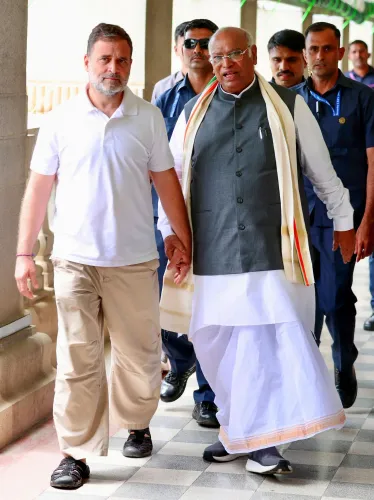
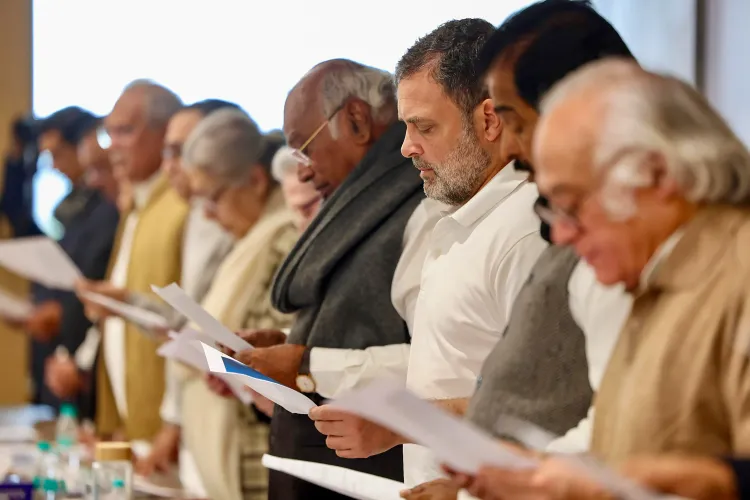
Singh's timing was no accident. The Congress was simultaneously commemorating its 140th Foundation Day. At the party headquarters in Delhi, Mallikarjun Kharge, Sonia Gandhi, and Rahul Gandhi posed together, smiling for the cameras and greeting party workers. However, this public display of unity could not mask the underlying dissatisfaction. Remarks like Singh's inevitably lingered in the atmosphere, unspoken yet profoundly felt.
The broader question now facing the Congress is unavoidable: Will 2025 finally compel a genuine course correction? Among supporters and political analysts, there is a growing consensus that the party is in dire straits. Increasingly, the blame is directed not at Mallikarjun Kharge, the nominal president, but squarely at Rahul Gandhi and his leadership approach.
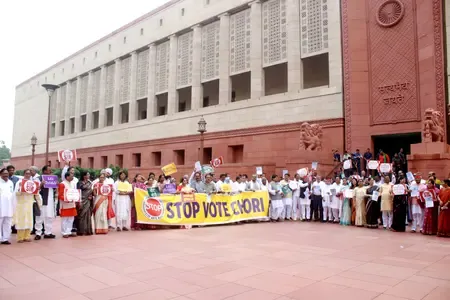
Electoral setbacks continue to accumulate. The Bihar Assembly elections and the much-publicized SIR activism have laid bare the party's strategic emptiness. Rahul Gandhi initiated the SIR campaign with dramatic rhetoric, accusing the opposition of massive "vote chori" after a fiery press conference in Delhi. This campaign was intended to be supported by consistent grassroots mobilization in Bihar. Instead, it ended in a spectacular collapse.
The Congress not only faced a humiliating defeat but also dealt a significant blow to its ally, Tejashwi Yadav's RJD. The Opposition now holds a mere 35 MLAs in the state, with the Congress reduced to a meager six. What was anticipated as a revival moment turned into yet another self-inflicted injury.
However, the most concerning aspect is not the defeat itself -- it is the denial. There is scant introspection, no acknowledgment of strategic failings, and no inclination towards course correction. Instead, the leadership continues to divert blame, targeting election authorities and the ruling party while shying away from confronting its own flaws.
Rahul Gandhi and his inner circle seem determined to construct a parallel reality, one in which accountability is optional and electoral rejection is perpetually attributed to external factors. Following the SIR debacle, the party has now seized upon the MGNREGA–G RAM G issue, hoping to generate momentum.
Whether this will resonate with voters remains uncertain. What is unmistakable, however, is that 2025 has illuminated a leadership crisis that the Congress can no longer afford to overlook. The pressing question is not whether a change is necessary, but whether the party possesses the courage to face it.
(Deepika Bhan can be contacted at deepika.b@ians.in)
Point of View
It’s evident that the Congress party is at a crossroads. With Rahul Gandhi facing increasing scrutiny and internal challenges, the future direction of the party is uncertain. As political dynamics evolve, the Congress must confront its leadership issues with honesty and courage, ensuring it remains relevant in the changing political landscape.
NationPress
22 Oct 2026
Frequently Asked Questions
What challenges is Rahul Gandhi facing in 2025?
Rahul Gandhi is confronting significant internal challenges within the Congress party, including scrutiny over his leadership and increasing visibility of Priyanka Gandhi as a potential leader.
How has Priyanka Gandhi's role changed recently?
Priyanka Gandhi's presence during parliamentary sessions has garnered attention, as she has been perceived as more approachable and politically agile compared to her brother, Rahul Gandhi.
What was the impact of the Bihar Assembly elections on Congress?
The Bihar Assembly elections resulted in a significant defeat for the Congress party, which not only lost its own seats but also affected its alliance with RJD, reducing its representation to just six MLAs.
Are there calls for change in Congress leadership?
Yes, there have been increasing calls for change in Congress leadership, with some party leaders suggesting Priyanka Gandhi as a more suitable leader compared to Rahul Gandhi.
What is the Congress party's current strategy moving forward?
The Congress party appears to be focusing on issues like MGNREGA and G RAM G in an attempt to regain momentum after recent electoral setbacks.