Is Former PM Sher Bahadur Deuba Stepping Away from Elections?
Click to start listening
Synopsis
In a surprising turn of events, former Prime Minister Sher Bahadur Deuba has announced that he will not contest the upcoming House of Representatives elections in Nepal. This marks the end of a significant political era, as Deuba's journey began 34 years ago. What does this mean for the future of Nepal’s political landscape?
Key Takeaways
- Sher Bahadur Deuba will not contest the upcoming elections, marking the end of a significant political era.
- His decision reflects recent setbacks and internal party dynamics within the Nepali Congress.
- The Gen-Z movement is reshaping the political landscape, calling for new leadership.
- Deuba has been a key player in Nepalese politics for over 34 years.
- The future of Nepal's leadership remains uncertain amidst these changes.
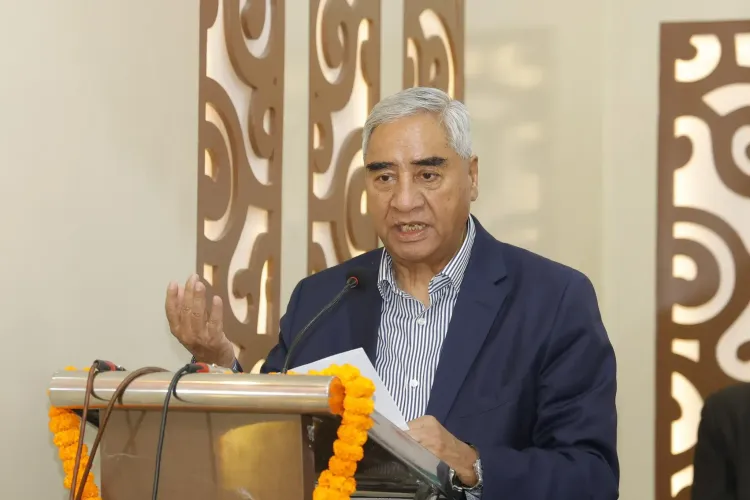
Kathmandu, Jan 20 (NationPress) It seems that former Prime Minister Sher Bahadur Deuba may not participate in parliamentary elections any longer, as his secretariat declared on Tuesday that he will refrain from running in the forthcoming House of Representatives election set for March 5.
Bhanu Deuba, Deuba's chief Personal Secretary, posted on social media: “The President of the Nepali Congress and former Prime Minister Sher Bahadur Deuba will not contest the upcoming House of Representatives elections.”
This announcement signifies the conclusion of a 34-year political career that began when Deuba was first elected from the Dadeldhura district in far-western Nepal during the 1991 parliamentary elections.
Recent setbacks compelled Deuba to forfeit his aspiration of reclaiming the Prime Minister position, despite being hindered by party rules that disallowed him from seeking another term as party President.
If the agreement forged between the Nepali Congress (NC) and the Communist Party of Nepal (Unified Marxist–Leninist), or CPN (UML), for the establishment of the K P Sharma Oli-led government in 2024 had materialized, Deuba would have had an opportunity to pursue the Prime Minister role for the sixth time.
According to the agreement, both Oli and Deuba were to alternate as Prime Minister until the next parliamentary elections, projected for 2027 under normal conditions. However, the Gen-Z revolt in September of last year dismantled the Oli-led government, significantly disrupting Deuba’s ambitions.
In early January, Deuba faced another setback as the Nepali Congress elected new leadership under Gagan Thapa during a Special General Convention, held contrary to Deuba’s wishes.
The Election Commission's acknowledgment of the Thapa-led party leadership forced Deuba and his faction into a defensive stance, with the Supreme Court becoming their only hope for reinstating Deuba’s leadership. As numerous loyalists switched allegiance to Thapa, Deuba’s secretariat announced his withdrawal from electoral contests.
The Thapa-led Central Working Committee has appointed Deuba loyalist Nain Singh Mahar from Deuba's constituency, demonstrating Thapa’s intent to accommodate Deuba’s supporters while distributing candidacy tickets.
Having aimed to sustain his influence within the party, Deuba now seems to have reached the conclusion of his political career. His choice to withdraw from elections may also prevent a split within the Nepali Congress.
Since the restoration of democracy in 1990, Deuba has been consistently elected as a member of the House of Representatives (including the Constituent Assembly) since the 1991 parliamentary elections. He has served as Prime Minister five times—first in 1995, and subsequently in 2001, 2004, 2017, and 2021.
Despite having been elected seven times consecutively and serving five terms as Prime Minister, Deuba has stepped back at a time when the new establishment faction led by Thapa was unwilling to grant him a ticket, even as many of his loyalists were included in what appeared to be a strategic attempt to maintain party unity.
With his decision to not contest the election, Deuba’s pathway to power through electoral victories has reached a definitive conclusion.
Deuba’s exit from national politics symbolizes the end of a leader’s career who—alongside CPN (UML) Chairperson K P Sharma Oli and Nepali Communist Party Coordinator Pushpa Kamal Dahal ‘Prachanda’—has been a pivotal figure in Nepal’s political scene for decades.
In the face of growing pressure from the Gen-Z movement demanding that top leaders from the three major political parties step aside, Deuba struggled to maintain his relevance within his own party amidst an internal revolt spearheaded by Thapa.
While Oli continues to firmly control his party following his re-election as chairperson at a recent general convention, Prachanda has sought to bolster his position through alliances with smaller leftist groups. His party recently underwent a name change following the merger of the CPN (Maoist Centre), CPN (Unified Socialist), and over a dozen minor leftist parties.
The pressing question remains whether voters are ready to accept the ongoing dominance of leaders who have profoundly shaped national politics for years amidst the rise of the Gen-Z movement.
Point of View
It is crucial to understand the implications of Sher Bahadur Deuba's withdrawal from the elections. This decision signals not only a personal defeat for Deuba but also reflects the changing dynamics within the Nepali Congress and the broader political landscape. With the rise of the Gen-Z movement, the electorate is clearly demanding new leadership. The future remains uncertain, but it is evident that the political status quo is under scrutiny.
NationPress
20/01/2026
Frequently Asked Questions
Why is Sher Bahadur Deuba not contesting the elections?
Sher Bahadur Deuba has announced he will not contest the upcoming elections due to recent political setbacks and internal party dynamics that have limited his influence.
What impact does Deuba's decision have on the Nepali Congress?
Deuba's withdrawal may help prevent a split within the Nepali Congress, as new leadership under Gagan Thapa seeks to maintain party unity while accommodating Deuba's supporters.
How long has Deuba been involved in politics?
Sher Bahadur Deuba has been active in Nepalese politics for over 34 years, first elected in the 1991 parliamentary elections.
What are Deuba's political achievements?
Deuba has served as Prime Minister five times and has been elected to the House of Representatives consistently since 1991.
What does the future hold for Nepal's leadership?
With the rise of the Gen-Z movement, there is a growing demand for new leadership, and the political landscape in Nepal is expected to evolve significantly.