Is Nepal's Government Ready for a Constitutional Amendment After the Breakthrough with Gen-Z Leaders?
Click to start listening
Synopsis
Nepal's interim government gears up for constitutional amendments aimed at ensuring proportional representation and introducing term limits for elected officials. Discover how the Gen-Z movement has catalyzed this significant change in governance and what it means for the future of Nepal's political landscape.
Key Takeaways
- Constitutional amendments aim to enhance representation and accountability in Nepal's political system.
- A Constitution Amendment Recommendation Commission will be formed to include diverse voices.
- Proposed term limits for elected officials to promote fresh leadership.
- Changes are a response to the frustrations expressed during the Gen-Z protests.
- Efforts will be made to ensure inclusive participation of youth in governance.
Kathmandu, Dec 11 (NationPress) Nepal's interim administration is set to initiate amendments to the existing constitution, focusing on reforms that will guarantee full proportional and inclusive representation reflective of the population and establish term limits for elected officials in significant state roles.
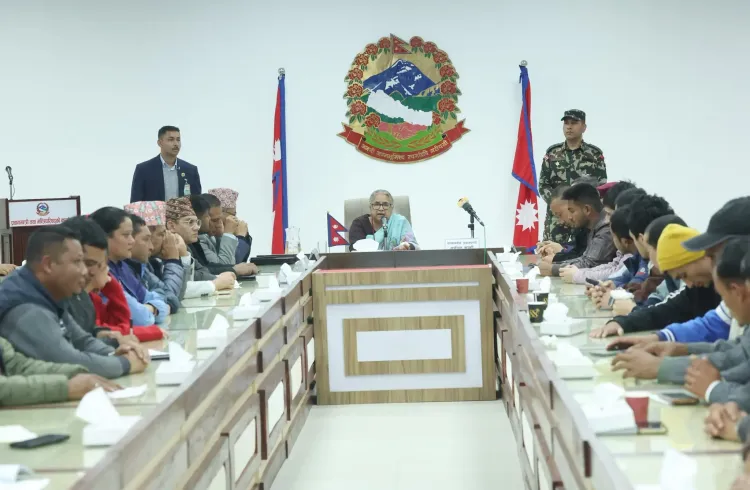
Following a crucial 10-point agreement made between representatives of Gen-Z and the government on Wednesday evening, a high-level 'Constitution Amendment Recommendation Commission' will be established, involving relevant stakeholders, including independent experts and Gen-Z representatives.
This commission will be responsible for delivering a report with suggestions for progressive constitutional modifications, aligning with the desires of Gen-Z protesters who played a pivotal role in toppling the former K.P. Sharma Oli-led government, which led to the current administration under Sushila Karki.
The commission's recommendations will include essential reforms to the electoral framework to ensure comprehensive proportional and inclusive representation based on community demographics.
At present, Nepal's constitution employs a mixed electoral system, combining first-past-the-post (FPTP) and proportional representation (PR) methods for electing members to the House of Representatives and Provincial Assemblies. In the FPTP system, 60 percent of representatives are elected, while the remaining 40 percent are through proportional representation.
In accordance with the agreement, the commission will also propose term limits for the head of state, heads of government at all levels—federal, provincial, and local—and members of executive bodies, restricting their tenure to a maximum of two terms, not exceeding a total of 10 years.
Currently, term limits are applicable only to the president, vice president, and heads of local governments, with no restrictions on the leaders of federal or provincial governments.
The recurring pattern of the same political leaders returning to power without delivering results—compared to a game of musical chairs—has frustrated Nepal's youth, as vividly demonstrated during the Gen-Z protests in September.
In the lead-up to the Gen-Z movement, prominent leaders like Sher Bahadur Deuba from the Nepali Congress, K.P. Sharma Oli of the Communist Party of Nepal (Unified Marxist-Leninist), and Pushpa Kamal Dahal 'Prachanda' from the restructured Nepal Communist Party repeatedly held governmental positions. They became targets of Gen-Z protesters, whose residences were set ablaze and vandalized during the protests.
The commission will also explore the suggestion to lower the minimum candidacy age for the House of Representatives, Provincial Assembly, and local-level elected roles to 21 years. Currently, the candidacy age for federal parliament and provincial assemblies is set at 25 years, while local-level positions require a minimum age of 21.
Considering the increasing trend of appointing individuals to state roles based on political allegiance and financial interests, the commission will investigate necessary reforms to the existing structures managing such appointments.
For instance, it will review reforms to the Constitutional Council and Judicial Council—overseeing appointments to constitutional commissions and judges—to ensure complete independence from political and partisan influences, facilitating autonomous and independent operations, while also ensuring representation and participation of youth in state structures.
When the K.P. Sharma Oli-led government was established in July 2024, its two coalition partners—the Nepali Congress and CPN (UML)—had committed to amending the constitution to foster political stability. Leaders from both parties had suggested that the proportional electoral system should be eliminated to enable a single party to gain enough seats to form a government.
However, no actions were taken to amend the constitution before that government was dismissed following the Gen-Z protests in September.
While the government has now agreed to pursue constitutional amendments, it remains uncertain how the major political parties—who were instrumental in enacting the current constitution—will react to these proposed changes.
Upon its promulgation in 2015, the constitution was anticipated to herald political stability and prosperity. Instead, Nepal has faced ongoing political turmoil and ineffective governance, ultimately leading to the Gen-Z protests earlier this year.
Point of View
It's vital to recognize the significance of the proposed constitutional amendments in Nepal. These changes, sparked by the passionate Gen-Z movement, reflect a growing demand for political accountability and inclusivity. The potential reforms present a historic opportunity to reshape Nepal's political framework, ensuring that the voices of the youth are not just heard but represented. The journey ahead will determine how effectively these changes can be implemented, fostering a stable and prosperous Nepal.
NationPress
12/12/2025
Frequently Asked Questions
What are the key changes proposed in the constitutional amendment?
The key changes include ensuring full proportional and inclusive representation based on population, introducing term limits for elected officials, and reviewing the minimum age for candidacy.
Who will be involved in the Constitution Amendment Recommendation Commission?
The commission will include Gen-Z representatives, independent experts, and other concerned stakeholders to ensure diverse perspectives in the amendment process.
Why are term limits being proposed for elected officials?
Term limits aim to prevent the same political leaders from repeatedly assuming power without delivering results, promoting fresh leadership and accountability.
How will the proposed changes affect the electoral system in Nepal?
The proposed changes aim to ensure that the electoral system allows for full proportional representation, enhancing the democratic process and inclusivity.
What impact did the Gen-Z protests have on these proposed amendments?
The Gen-Z protests were instrumental in highlighting the need for change, ultimately leading to the government's willingness to discuss constitutional amendments.