New Zealand 2026 budget: NZ$3.8bn spending, surplus target moved to 2028-29

Synopsis
New Zealand's pre-election 2026 Budget skips giveaways and bets on fiscal discipline instead — moving the surplus target a full year forward to 2028-29. With NZ$5.8bn for health and NZ$450m set aside for a looming fuel crisis, Finance Minister Nicola Willis is threading a narrow needle between austerity and service protection, while Labour warns the country is being left 'worse off.'
Key Takeaways
New Zealand's 2026 Budget was delivered on 29 May 2026 in Wellington , the last before the November general election .
Finance Minister Nicola Willis targets a return to surplus by 2028-29 , one year earlier than previously forecast.
New spending totals NZ$3.8 billion , partially offset by NZ$1.7 billion in savings.
Health receives the largest single allocation at NZ$5.8 billion , though primary care funding sees no significant increase.
A NZ$450 million fuel contingency fund has been set aside to manage sustained energy price pressures.
Opposition Labour Party leader Chris Hipkins says the budget leaves New Zealanders 'worse off' and fails to address cost-of-living pressures.
The New Zealand government on Thursday, 29 May 2026 presented a fiscally restrained 2026 Budget in Wellington, anchored by NZ$3.8 billion in new spending, NZ$1.7 billion in savings, and a revised target to return the country to surplus by 2028-29 — one year ahead of the previous forecast. The budget, the last before the November general election, deliberately avoids pre-election giveaways in favour of debt reduction and frontline service maintenance.
Key Fiscal Measures
Finance Minister Nicola Willis said the improved deficit outlook is driven by tighter expenditure controls and rising tax revenue. The net new spending of NZ$3.8 billion (approximately US$2.24 billion) is partially offset by NZ$1.7 billion in identified savings, reflecting the government's emphasis on fiscal discipline amid global economic uncertainty.
A new levy on banks and financial institutions is expected to generate over NZ$200 million, while a NZ$400 million housing incentive fund has been established to support local councils in expanding housing supply.
Health Gets the Largest Allocation
Health emerged as the single biggest beneficiary, receiving NZ$5.8 billion in new funding. The allocation covers frontline services, hospital upgrades, and medical equipment procurement. Notably, primary care funding saw no significant increase — a gap critics are likely to highlight in the weeks ahead.
Infrastructure and the Fuel Contingency
Infrastructure investment includes NZ$1.77 billion to extend the Waikato Expressway on the North Island and more than NZ$1 billion for rail network upgrades. Separately, the government has set aside NZ$450 million as a contingency fund to manage sustained fuel price pressures, according to budget documents — a signal that energy costs remain a live risk to the fiscal outlook.
Political Response
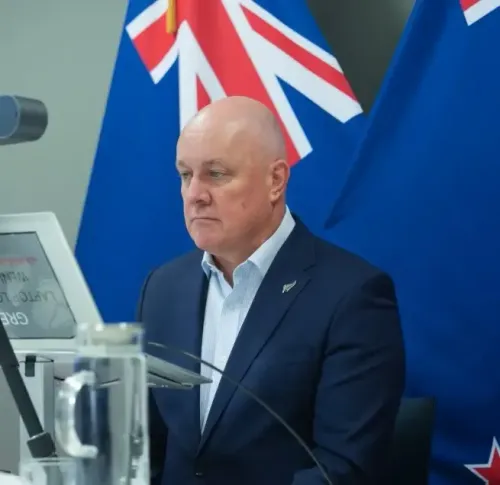
Prime Minister Christopher Luxon described the budget as 'fiscally responsible,' arguing it strikes a balance between debt reduction and protecting essential services in a period of global uncertainty.
The opposition Labour Party was sharply critical. Leader Chris Hipkins said the budget leaves New Zealanders 'worse off,' accusing the government of prioritising cuts over cost-of-living relief. Labour's Finance spokesperson Barbara Edmonds argued that rising unemployment and higher living costs demonstrate the government is 'shrinking' the economy rather than strengthening it.
What Comes Next
With the November 2026 general election on the horizon, the budget sets the fiscal battleground for the campaign. Labour's criticism of inadequate cost-of-living support is expected to feature prominently in election messaging, while the government will point to the earlier-than-forecast surplus target as evidence of sound management. The effectiveness of the NZ$450 million fuel contingency and the absence of primary care funding increases will face close scrutiny in parliamentary debate ahead.
Point of View
Which remains the dominant voter anxiety. The NZ$5.8 billion health allocation is substantial on paper, yet the omission of primary care funding is a structural blind spot: without investment at the community level, hospital pressure will not ease. The NZ$450 million fuel contingency is an acknowledgment that energy risk is real and unresolved, not a solution. Most critically, the one-year advancement of the surplus target rests on rising tax revenue holding — a projection that global headwinds could quickly erode.
NationPress
26 Sept 2026
Frequently Asked Questions
What is New Zealand's 2026 Budget focused on?
The 2026 Budget prioritises fiscal discipline, gradual deficit reduction, and increased health spending, while avoiding pre-election giveaways. It includes NZ$3.8 billion in new spending offset by NZ$1.7 billion in savings, with a target to return to surplus by 2028-29.
When does New Zealand expect to return to a budget surplus?
Finance Minister Nicola Willis has set a revised surplus target of 2028-29, one year earlier than previously forecast. The improvement is attributed to tighter spending controls and rising tax revenue.
How much funding does health receive in the 2026 Budget?
Health receives NZ$5.8 billion in new funding, covering frontline services, hospital upgrades, and medical equipment. However, primary care funding has not seen a significant increase, which critics have flagged as a gap.
Why has New Zealand set aside NZ$450 million as a fuel contingency?
The NZ$450 million contingency fund is intended to manage sustained fuel price pressures that the government has identified as a near-term risk to the fiscal outlook. It reflects ongoing global energy market volatility rather than a specific domestic fuel crisis.
How has the Labour Party responded to the 2026 Budget?
Labour leader Chris Hipkins said the budget leaves New Zealanders 'worse off' and accused the government of prioritising cuts over cost-of-living support. Finance spokesperson Barbara Edmonds argued that rising unemployment and higher living costs show the government is shrinking the economy rather than growing it.