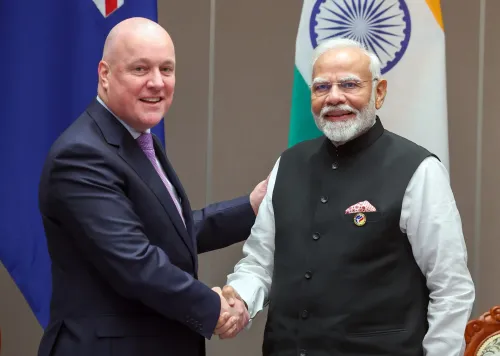
New Zealand PM Christopher Luxon survives caucus confidence vote, stays National leader

Synopsis
Christopher Luxon has now survived two caucus confidence votes within months — the latest coming fewer than 90 days before New Zealand's general election. With National polling at 31 per cent but having touched a three-year low of 28.7 per cent in July, the party heads into its most consequential campaign with a leader whose caucus has twice put his tenure to a formal test.
Key Takeaways
Christopher Luxon survived a caucus confidence vote on 12 August , retaining leadership of the governing National Party .
This is his second confidence vote since becoming prime minister — the first was held in April .
The vote was triggered by controversies including Luxon's 'parent-child' business comment, use of a military plane to Auckland , and a proposed referendum on the electoral system.
New Zealand's general election is scheduled for 7 November , fewer than 90 days away.
A Taxpayers' Union-Curia poll (7 August) placed National at 31 per cent ; a Radio New Zealand-Reid Research poll in July put it at a three-year low of 28.7 per cent .
The main opposition Labour Party fell to 27.8 per cent in the August poll.
New Zealand Prime Minister Christopher Luxon survived a caucus confidence vote on Wednesday, 12 August, retaining his leadership of the governing National Party following an hours-long caucus meeting in the capital Wellington. Luxon confirmed at a parliamentary press conference that he had the 'full support' of his caucus and would continue as party leader.
What Triggered the Vote
The confidence vote was called amid mounting speculation over Luxon's grip on the party, fuelled by a series of controversies in recent weeks. These included his 'parent-child' characterisation of businesses, his use of a military plane for travel to Auckland, and a proposal to hold a referendum on New Zealand's mixed-member proportional electoral system if the National-led coalition is re-elected. The cumulative pressure prompted caucus members to demand a formal reckoning.
Second Vote in Months
Notably, this is the second confidence vote Luxon has faced since becoming prime minister — the first was held in April. That two such votes have occurred within months signals persistent unease within the National caucus, even as the party officially rallies behind its leader ahead of a critical election cycle.
The Electoral Stakes
The vote comes fewer than 90 days before New Zealand's general election, scheduled for 7 November. Luxon used the post-vote press conference to stress the imperative of defeating the Labour-led opposition. A Taxpayers' Union-Curia poll released on 7 August — conducted between 1 and 4 August among 1,000 eligible and likely voters — placed National at 31 per cent, up 0.5 percentage points from the previous poll, with the National-led coalition projected to retain a narrow parliamentary majority. The poll carries a maximum margin of error of plus or minus 3.1 percentage points.
Opposition Reading the Polls
The main opposition Labour Party fell 3.7 points to 27.8 per cent in the same Taxpayers' Union-Curia survey. However, a separate Radio New Zealand-Reid Research poll conducted in July put National at 28.7 per cent — its lowest level since Luxon assumed the party leadership in 2021. The divergence between the two polls underscores the volatility of voter sentiment this close to election day.
What Comes Next
With the leadership question formally settled — at least for now — National must pivot swiftly to campaign mode. The party's ability to consolidate its coalition partners and sharpen its economic messaging will be closely watched. A third confidence vote before the election would be politically devastating; Luxon will need to avoid further missteps to keep caucus cohesion intact through 7 November.
Point of View
But survival is not the same as authority. The controversies that prompted this vote — a tone-deaf business metaphor, a military plane, a referendum kite-fly — are not policy failures; they are communication failures, which are harder to fix on the campaign trail. With National's polling ranging from 28.7 to 31 per cent depending on the survey, the margin for further self-inflicted damage is razor-thin. The real question is whether the caucus has genuinely rallied or merely deferred a reckoning to after 7 November.
NationPress
12 Aug 2026
Frequently Asked Questions
What is the New Zealand caucus confidence vote and why did it happen?
A caucus confidence vote is an internal party ballot in which elected members decide whether to retain their leader. Luxon called the vote on 12 August after a series of controversies — including his 'parent-child' remark on businesses, use of a military plane for domestic travel, and a proposed electoral referendum — fuelled speculation that his leadership was under threat.
Has Christopher Luxon faced a confidence vote before?
Yes. Wednesday's vote was Luxon's second confidence vote since becoming prime minister. The first was held in April. Two such votes within months is unusual and reflects ongoing unease within the National caucus.
When is New Zealand's next general election?
New Zealand's general election is scheduled for 7 November, fewer than 90 days from the date of the confidence vote. The proximity makes the leadership question especially consequential for the National Party's campaign.
How is the National Party polling ahead of the election?
A Taxpayers' Union-Curia poll released on 7 August placed National at 31 per cent, up 0.5 percentage points from the previous survey, with the National-led coalition projected to hold a narrow parliamentary majority. However, a Radio New Zealand-Reid Research poll in July put National at 28.7 per cent — its lowest since Luxon became party leader in 2021.
How is the Labour Party performing in the polls?
The main opposition Labour Party fell 3.7 percentage points to 27.8 per cent in the Taxpayers' Union-Curia poll released on 7 August, suggesting it trails National ahead of the November election, though polling margins remain within the survey's error range.