What led to Nicolas Maduro becoming the first working-class President of Venezuela?
Click to start listening
Synopsis
Venezuelan President Nicolas Maduro, who has faced allegations of power retention and foreign intervention, has made significant strides since his early days as a union leader. Discover the journey of a leader who has shaped Venezuelan politics and navigated complex international relations. Can Maduro maintain his grip on power amidst growing tensions?
Key Takeaways
- Nicolas Maduro has been a prominent figure in Venezuela since the 1990s.
- He was appointed as President after Hugo Chavez's death in 2013.
- Maduro has faced significant challenges, including accusations of foreign intervention.
- His government aims to establish new reforms to address economic issues.
- He remains a controversial leader on the international stage.
Caracas, Jan 3 (NationPress) Venezuelan President Nicolas Maduro Moros, who was reportedly "captured and flown out" of the country by US forces early Saturday, had previously accused Washington of engaging in a "dangerous game" in the region.
"The actions of the current US administration are fabricating a false narrative to legitimize military intervention, aiming to instigate a conflict in South America for regime change," Maduro stated in an interview with former Ecuadorian President Rafael Correa on Russian news outlet RT.
Maduro was born in Caracas on November 23, 1962, and completed his secondary education at Jose Avalos High School. He joined the Socialist League and began his career as a driver for the Caracas Metro, where he ascended to the Board of Directors and became a union leader, also founding the Caracas Metro Workers' Union (SITRAMECA).
As a member of the Bolivarian Revolutionary Movement 200 (MBR-200), Maduro actively campaigned for the liberation of Venezuelan politician and revolutionary Hugo Chavez, who later named him as his successor during Chavez’s imprisonment following the 1992 military uprising.
He clandestinely collaborated with social groups supporting the revolutionary agenda and held a significant role in the National Directorate of the MBR-200 from 1994 to 1997. He was also a National Founder and Coordinator of the Bolivarian Workers' Force (FBT).
Maduro was elected as Principal Deputy for the Federal District for the five-year term of 2000-2005 and presided over the National Assembly from January to August 2006, after which he was appointed as Minister of Foreign Affairs. In this capacity, he worked closely with Hugo Chavez to establish and develop ALBA (2001), Petrocaribe (2005), Unasur (2008), and CELAC (2010).
On October 10, 2012, he became Executive Vice President, and shortly after Chavez's passing on March 8, 2013, he was appointed as the Acting President of Venezuela by constitutional mandate.
On April 14, 2013, he won the election to become the Constitutional President of the Bolivarian Republic of Venezuela, marking a historic moment as the first Chavista and working-class President in modern Venezuelan history.
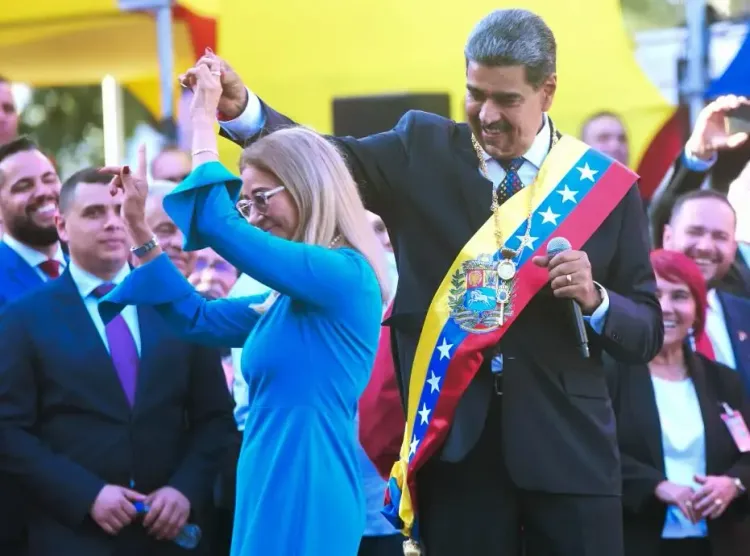
Following his victory in the July 2024 presidential election, where he secured 51.95% of the vote, Maduro was sworn in for a third term in January 2025.
During his oath-taking ceremony, he pledged before National Assembly President Jorge Rodriguez and the Constitution to ensure "peace, prosperity, equality, and a new democracy" in Venezuela.
In his inaugural address, Maduro urged for a comprehensive dialogue within the nation to push towards a significant constitutional reform aimed at further democratizing Venezuela.
This reform is intended to modernize the "principles of the Constitution based on the evolving economy and society" and to "protect the nation from emerging technological threats."
Later that year, according to reports from Xinhua, Maduro stressed that, contrary to accusations from Donald Trump's administration linking his government to drug cartels, "Venezuela is entirely free from the scourge of drug trafficking."
He claimed that Washington's true concern lies with oil, not drugs, as it seeks control over the nation's abundant natural resources.
In November 2025, US President Donald Trump indicated that he would not dismiss the possibility of deploying military force in Venezuela to dismantle what his administration labels as "narco-terrorists."
Reports suggested that Maduro allegedly declined to relinquish power while making demands, including global immunity from prosecution and retaining military control upon stepping down.
On Saturday, Trump announced that the United States had executed a significant operation against Venezuela, capturing its President, who was subsequently flown out of the country alongside his wife.
"The United States of America has successfully carried out a large-scale operation against Venezuela and its leader, President Nicolas Maduro, who, along with his wife, has been captured and transported out of the country," Trump stated in a post on Truth Social, adding that the mission was executed in collaboration with US law enforcement.
Point of View
It is essential to approach this evolving situation with a balanced perspective. Maduro’s leadership reflects the complexities of Venezuelan politics, marked by both domestic challenges and international scrutiny. The implications of his presidency extend beyond national borders, and it is crucial to monitor developments closely as they unfold.
NationPress
04/01/2026
Frequently Asked Questions
Who is Nicolas Maduro?
Nicolas Maduro is the current President of Venezuela, known for being the first working-class president in the nation's history.
What accusations has Maduro made against the US?
Maduro has accused the US of creating a false narrative to justify military intervention in Venezuela.
What was Maduro's early career like?
Before entering politics, Maduro worked as a driver for the Caracas Metro and became a union leader.
When did Maduro become President of Venezuela?
Maduro was elected President on April 14, 2013, after the death of Hugo Chavez.
What significant reforms is Maduro proposing?
Maduro has called for a constitutional reform aimed at modernizing Venezuela's governance and addressing technological challenges.