Pakistan's Palestine policy masks 'institutionalised deception': analyst
Synopsis
A detailed analysis by Middle East affairs expert Michael Arizanti accuses Pakistan's establishment of running two parallel foreign policies on Palestine — fierce public solidarity masking quiet strategic accommodation with Washington and Israeli-linked networks. The contradiction reportedly became undeniable in October 2025, when Islamabad backed a Trump-linked Gaza proposal while simultaneously dispersing pro-Palestine protests at home.
Key Takeaways
Michael Arizanti , a Middle East affairs expert, has described Pakistan's Palestine policy as a pattern of 'institutionalised deception' in an analysis published on Medium .
Pakistan publicly maintains it will never normalise ties with Israel until Palestinians have a state, but reportedly pursues back-channel contacts and informal engagements in parallel.
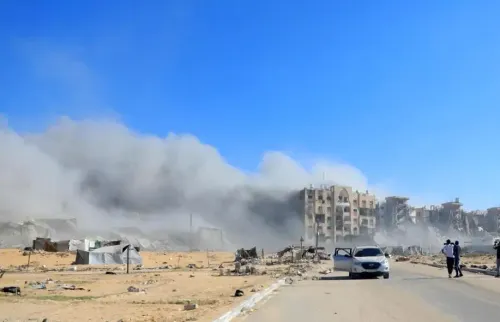
On 8 October 2025 , Pakistan reportedly backed a Gaza peace proposal linked to the Trump administration, even as authorities dispersed pro-Palestine protests in Lahore and Karachi .
The Abraham Accords of 2020 are cited as the point at which shifts beneath the surface of Pakistani diplomacy reportedly began accelerating.
Arizanti warns that the widening gap between public rhetoric and private diplomacy is eroding Pakistan's foreign policy credibility — both internationally and domestically.
Pakistan's leadership has long maintained two sharply divergent positions on the Palestine issue — projecting fierce solidarity domestically while quietly pursuing strategic accommodations abroad, according to an analysis by Michael Arizanti, a writer and expert on Middle East affairs, published in the US-based platform Medium. The pattern, Arizanti argues, amounts not to pragmatic statecraft but to 'institutionalised deception' — one whose costs are borne most heavily by the Pakistani public.
The Double Narrative
For years, Pakistan's political establishment has built its public identity around unwavering support for Palestinian statehood. Parliament has passed resolutions, ministers have delivered impassioned speeches, and official statements have consistently condemned Israel as an illegitimate occupier. The declared position has been unambiguous: no normalisation with Israel until Palestinians have a state.
Yet, according to Arizanti, a quieter diplomatic reality runs in parallel. 'Follow the quieter corridors of Pakistani diplomacy, and a starkly different picture emerges,' he wrote. Since the Abraham Accords of 2020 — when the UAE, Bahrain, and others formalised ties with Israel — back-channel contacts, managed media access, and informal engagements have reportedly continued, even as public rhetoric remained defiantly unchanged.
October 2025: The Moment the Gap Became Visible
The contradictions reportedly came into sharp relief in October 2025. On 8 October, Pakistan reportedly joined several Muslim and Arab nations in backing a Gaza peace proposal linked to the administration of US President Donald Trump. Within days, Pakistani authorities were reportedly dispersing pro-Palestine demonstrations in Lahore and Karachi, leaving students and activists confronting a state that was simultaneously supporting a diplomatic framework they opposed.
'The establishment miscalculated. Populations can be managed by rhetoric only as long as the gap between rhetoric and reality stays invisible. October 2025 made it visible,' Arizanti noted.
Public Betrayal and Radicalisation of Distrust
For ordinary Pakistanis, Arizanti argues, Palestine is not a foreign-policy variable — it is a moral absolute that cuts across class, ideology, and generation. Watching the state suppress street protests while reportedly pursuing private accommodation with Washington and Israeli-linked networks was, he said, 'a radicalising experience in distrust' for many citizens.
The analysis draws on what it describes as Pakistan's establishment playbook: tolerating sensitive initiatives when they serve strategic interests, then publicly distancing itself when domestic pressure mounts — a pattern, the report contends, that has repeated across multiple administrations.
Credibility at Stake
Arizanti argues that foreign partners — in Washington, Tel Aviv, and Western lobbying circles — encounter a version of Pakistani foreign policy that differs fundamentally from what the domestic audience is told. 'The truth lies somewhere in the widening gap between the two narratives,' he wrote.
'Until Pakistan's leadership is willing to close that gap openly, the credibility of its foreign policy commitments — on Palestine and everything else — will continue to erode. Not just abroad. At home, where it matters most,' he stressed. Whether Islamabad moves to reconcile its public and private positions remains, for now, an open question.
Point of View
Not a bug. The October 2025 episode — backing a Trump-linked Gaza framework while cracking down on domestic protesters — is not an anomaly; it fits a decades-long pattern of managing inconvenient business through back channels. What has changed is the visibility. In an era of social media and instant information, the gap that once stayed invisible is now a political liability. The deeper risk for Islamabad is not international credibility — foreign capitals have long discounted Pakistani public rhetoric — but domestic legitimacy, where Palestine functions as a moral touchstone rather than a policy variable. Suppressing protest while accommodating the very framework protesters oppose is a recipe for sustained public distrust that no amount of parliamentary rhetoric can paper over.
NationPress
26 Oct 2026
Frequently Asked Questions
What does the report say about Pakistan's Palestine policy?
The report, authored by Middle East affairs expert Michael Arizanti and published on Medium, argues that Pakistan maintains two parallel positions on Palestine — emotive public solidarity at home and quiet strategic accommodation abroad. Arizanti calls this a pattern of 'institutionalised deception' rather than pragmatic statecraft.
What happened in October 2025 that drew attention to Pakistan's stance?
On 8 October 2025, Pakistan reportedly joined several Muslim and Arab nations in backing a Gaza peace proposal linked to the Trump administration. Within days, Pakistani authorities were dispersing pro-Palestine demonstrations in Lahore and Karachi, creating a visible contradiction between the country's public rhetoric and its reported diplomatic actions.
How have ordinary Pakistanis responded to this contradiction?
According to Arizanti, many Pakistanis view the state's simultaneous backing of a diplomatic framework and suppression of protests as a betrayal. He describes it as 'a radicalising experience in distrust', noting that Palestine holds the status of a moral absolute — not a policy variable — in the Pakistani public imagination.
What is the significance of the Abraham Accords in this context?
The Abraham Accords of 2020, under which the UAE, Bahrain, and others formalised ties with Israel, are identified in the report as the point at which shifts in Pakistani back-channel diplomacy reportedly began accelerating, even as public rhetoric remained unchanged.
What does the report say about Pakistan's foreign policy credibility?
Arizanti argues that the widening gap between Pakistan's domestic narrative and its private diplomacy is steadily eroding its foreign policy credibility — not only with international partners but, critically, with its own public. He warns that unless leadership closes the gap openly, that erosion will continue.