How is Pakistan's Punjab Province Facing Financial Struggles Due to the Afghanistan Border Closure?
Click to start listening
Synopsis
Pakistan's Punjab province is experiencing a grave economic crisis due to the extended closure of its border with Afghanistan, with losses exceeding 80 billion PKR monthly. This situation endangers the livelihoods of thousands of traders and disrupts vital trade routes to Central Asia. Protesters demand government action, highlighting the urgent need to address this economic blockade.
Key Takeaways
- Punjab faces 80 billion PKR monthly losses
- 3,000 traders stranded due to border issues
- Protesters demand government action
- Impact on agricultural and industrial exports
- Rising inflation and economic pressure
Quetta, Jan 3 (NationPress) The province of Punjab in Pakistan is currently grappling with a significant economic downturn attributed to the extended closure of its border crossings with Afghanistan. Monthly financial losses have been estimated to exceed 80 billion Pakistani rupees, as reported by the Lahore Chamber of Commerce and Industry (LCCI) on Saturday.
LCCI President Faheem-ur-Rehman Saigol highlighted that the ongoing closure of trade routes has substantially hindered bilateral commerce, particularly affecting the cement and agricultural chemicals industries. He noted that the closure of all major trade routes followed the border clashes in October 2025, which halted cross-border trade, according to the Balochistan Post.
“The halt in trading activities has not only harmed the economies of both nations but also jeopardized the livelihoods of thousands of traders on either side of the border,” stated Saigol.
According to sources from LCCI, nearly 3,000 traders are stranded due to these border restrictions, comprising approximately 1,200 Pakistani and 1,800 Afghan traders.
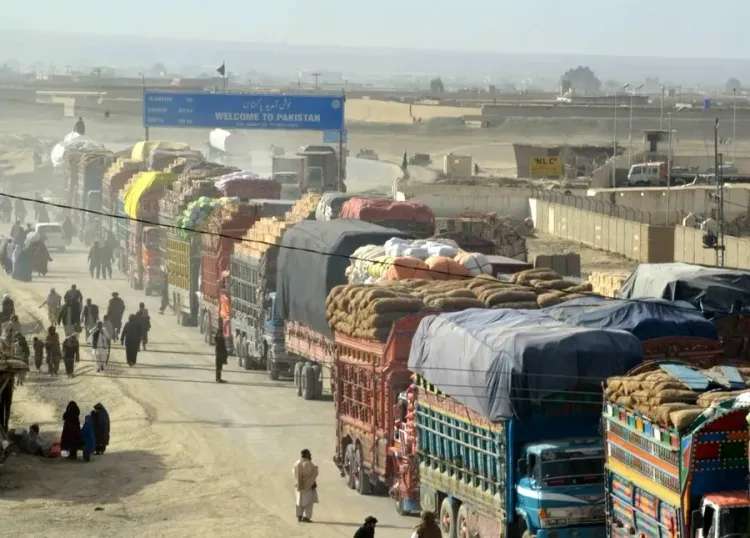
Reports indicate that a large quantity of fresh and dry fruits, as well as other food items from Afghanistan, are decaying in trucks stationed at border points, leading to substantial financial losses.
Saigol emphasized that Pakistan’s agricultural and industrial exports are heavily reliant on the Afghan border, which also acts as a vital transit route to Central Asian nations. “The trade halt is intensifying economic stress. Income levels are declining, inflation is escalating, and both the public and investors are becoming increasingly uneasy,” he remarked.
In response to the border closures, residents involved in trade in Balochistan’s Turbat organized a protest on Thursday against the closure of the Abdoi border crossing with Afghanistan, asserting that the actions of the Pakistani government have deprived them of their primary income source.
The demonstration, led by border movement activist Sardar Wali Yalanzai, began at Ghulam Nabi Chowk and concluded at Shaheed Fida Chowk, where protesters voiced their grievances against the government and characterized the restrictions as an “economic blockade.”
The protesters expressed that the prolonged closure has inflicted economic damage in the region, where cross-border fuel and goods trading is the main income source.
Yalanzai and other speakers accused authorities of providing traders with “false hopes” by repeatedly stating that the crossing would reopen “today or tomorrow.”
Point of View
It is imperative to highlight the detrimental impact of the border closure on economic stability in Punjab. The plight of traders and the resultant financial losses underscore the urgent need for government intervention. This situation not only affects Pakistan but also has broader implications for regional trade and stability.
NationPress
05/01/2026
Frequently Asked Questions
What is the estimated monthly loss for Punjab due to border closures?
The estimated monthly loss for Punjab due to the border closures with Afghanistan is over 80 billion Pakistani rupees.
How many traders are reported to be stranded?
Approximately 3,000 traders are reported to be stranded due to the border closures, including around 1,200 Pakistani and 1,800 Afghan traders.
What sectors are most affected by the border closures?
The cement and agricultural chemicals sectors have been identified as the hardest hit by the border closures.
What are the implications of the border closure on the economy?
The border closure is increasing economic pressure, with falling incomes and rising inflation affecting both public and investor confidence.
What actions have been taken by traders in response to the closures?
Traders have staged protests, claiming that the closure has deprived them of their primary source of income and calling it an economic blockade.