Police Directive Against Carrom and TV in Ramadan Sparks Controversy in Bangladesh
Synopsis
A police officer's controversial order to halt carrom games and TV viewing during Ramadan in Bangladesh has raised eyebrows. Despite no official directive, the incident highlights tensions around religious observance and community recreation.
Key Takeaways
Police intervention in community activities raises concerns.
Absence of official directives creates confusion.
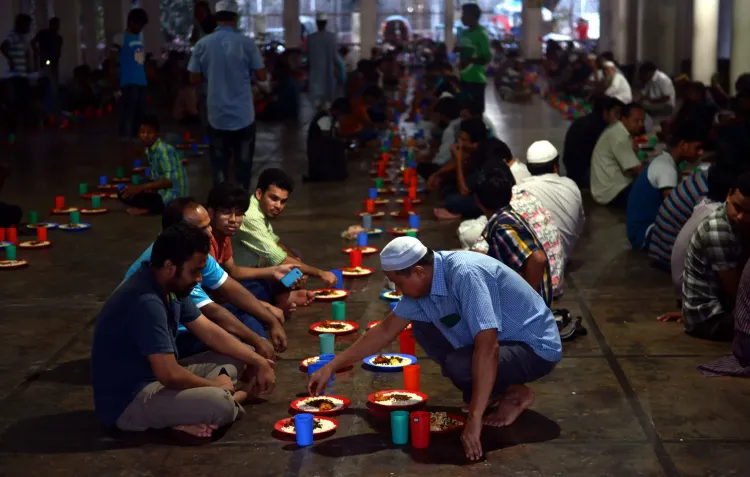
Community sentiment plays a significant role during Ramadan.
Need for recreational activities is highlighted amidst religious observance.
Balancing tradition and modernity remains a challenge.
Dhaka, Feb 23 (NationPress) A police official in Bangladesh directed a tea stall proprietor to cease the playing of carrom and watching television during the holy month of Ramadan in the Kushtia Sadar upazila, despite no formal order from higher authorities, as reported by local media.
The occurrence transpired in the Patikabari Bazar area during a visit from Kushtia-3 Jamaat-e-Islami MP Amir Hamza, who was accompanied by Moshiul Azam, the officer in charge of the Patikabari Police Camp under the Islamic University Police Station.
A video captured on the night of February 20 and widely shared on social platforms shows Moshiul Azam emphatically gesturing at the tea stall owner and stating, “No carrom, no TV — that’s the final decision during Ramadan.”
“They are playing carrom there. Didn’t I order it to stop? Why is it still going? Shall I have you punished? Didn’t I recently inform the market committee that for one month during Taraweeh, no carrom or TV should be allowed? Why is it still happening?” Bangladesh’s prominent newspaper, The Daily Star, quoted the police officer as saying.
At that moment, MP Amir Hamza, who was standing next to the police officer, calmly remarked: “This is Ramadan, a month of devotion. Whatever activities you engage in, at least refrain from them during prayer times.”
Reports indicate that the following evening, on February 21, most shops in the market, including the tea stall, were shut down, while a few remained partially open with shutters half-closed as work continued inside.
Another tea stall owned by Ramzan remained operational. The television was on, but no carrom games were taking place.
When questioned about the police warning regarding TV viewing, Ramzan lowered his gaze and replied, “Only a few customers are here. They just watch TV for a little while.”
Kashem, a ward council member of Patikabari union, who arrived at the stall at that time, expressed that it was inappropriate to abruptly halt everything, emphasizing that young people require some recreational activities.
However, Officer-in-Charge Masud Rana of the Islamic University Police Station stated that no such directives had been issued to his subordinates, as reported by The Daily Star.
Kushtia Superintendent of Police Jasim Uddin also confirmed that the incident did not represent any official police mandate.
“The operation of tea stalls during fasting is not a legal issue. It pertains to the sentiments of the people — whether they adhere to it or not. We cannot penalize anyone for that,” he stated.
Point of View
It's crucial to highlight the balance between community norms and individual freedoms. While religious observance is paramount during Ramadan, the need for recreational activities, especially for youth, cannot be overlooked. This incident reflects broader societal tensions that deserve careful consideration.
NationPress
19 Sept 2026
Frequently Asked Questions
What prompted the police officer's order?
The order was issued during a visit by MP Amir Hamza, emphasizing the need for restraint during Ramadan.
Was there any official directive regarding the ban?
No, both the Officer-in-Charge and the Superintendent of Police clarified that no formal instructions were given.
How did the local community react to the order?
Community members expressed concern about the abrupt halt to recreational activities, emphasizing the need for balance during Ramadan.
What are the implications of this incident?
The incident raises questions about the enforcement of religious observance and community rights.
Are tea stalls allowed to operate during Ramadan?
Yes, operating tea stalls during fasting is not illegal; it is a matter of community sentiment.