Rajnath Singh Urges Germany: Co-Develop Niche Defence Tech With India
Synopsis
Defence Minister Rajnath Singh's Munich visit has yielded a landmark Defence Industrial Roadmap with Germany, with India pushing for co-development of AI drones, advanced radar, and submarine technology — a strategic pivot that could reshape India's defence supply chain away from Russia toward Western partners.
Key Takeaways
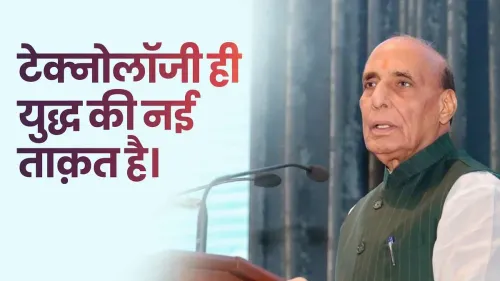
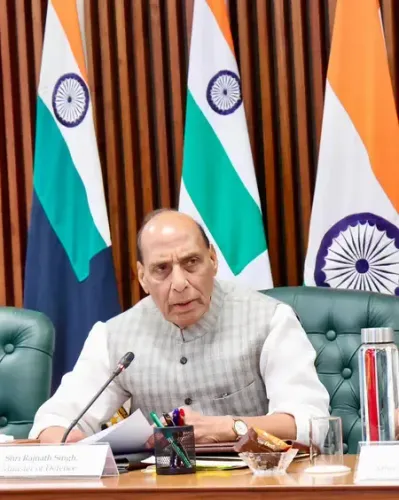
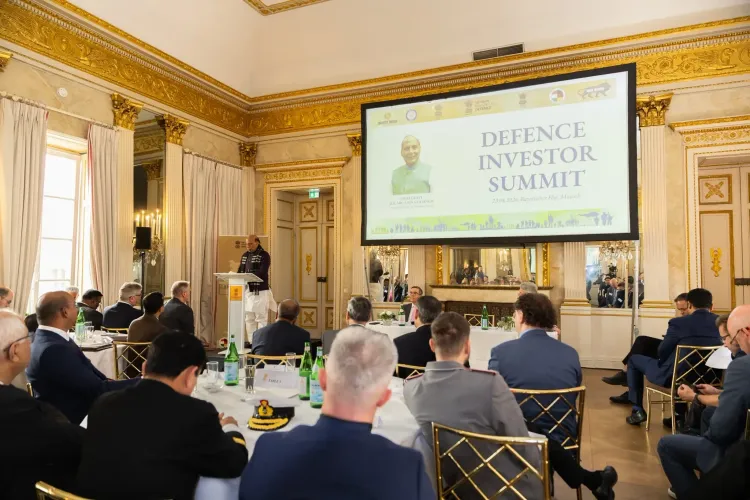
Defence Minister Rajnath Singh addressed a Defence Round Table in Munich on April 23, 2025 , urging German firms to co-develop niche military technologies with India.
Key technology areas identified include AI-enabled Unmanned Aerial Systems , advanced radar and sensor technology , Sonobuoys , and High Power Low Frequency Underwater Transmitters .
India and Germany signed a Defence Industrial Roadmap and an Implementing Arrangement for Cooperation in UN Peacekeeping , marking a shift from buyer-seller to co-production partnership.
Singh visited the TKMS submarine facility in Kiel alongside German Defence Minister Boris Pistorius , signalling India's interest in advanced undersea warfare capabilities.
Singh was transported in a Special German Air Force aircraft escorted by fighter jets from Munich to Berlin — an unusual military honour reflecting the visit's strategic weight.
India's defence exports have grown from under Rs 2,000 crore in 2016-17 to over Rs 21,000 crore in 2023-24 , strengthening India's credibility as a co-production partner.
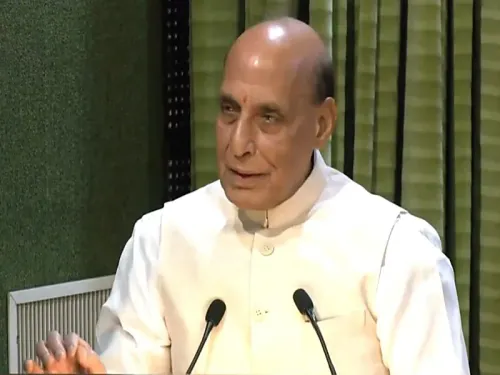
Defence Minister Rajnath Singh called on German defence industry leaders to jointly develop and produce advanced military technologies with India, addressing a high-level Defence Round Table in Munich, Germany on Thursday, April 23. Singh spotlighted the significant untapped synergies between Germany's ReArm Europe initiative and India's Atmanirbhar Bharat defence self-reliance programme, positioning the two nations as natural strategic partners in an increasingly volatile global security landscape.
Key Technology Areas Flagged for Joint Development
Singh identified several cutting-edge domains where Indian and German defence companies can collaborate meaningfully. These include advanced radar and sensor technology, multi-sensor Artificial Intelligence-enabled Unmanned Aerial Systems (UAS), Sonobuoys, and High Power Low Frequency Underwater Transmitters — all critical components in modern naval and aerial warfare.
The selection of these specific technologies is not incidental. India's expanding naval ambitions in the Indian Ocean Region, combined with Germany's world-class submarine and sensor manufacturing capabilities, makes this a strategically complementary partnership. Sonobuoys and underwater transmitters are vital for anti-submarine warfare — an area of growing importance as China rapidly expands its submarine fleet.
After the meeting, Singh posted on X (formerly Twitter): Had extensive discussions with the defence industry leaders from Germany and India on tremendous potential available in the defence sector. They were appreciative of India's defence industrial reform trajectory. Urged the German industries to co-develop and co-produce with India in niche tech for secured national interests and global stability and resilience.
Historic Defence Industrial Roadmap Signed
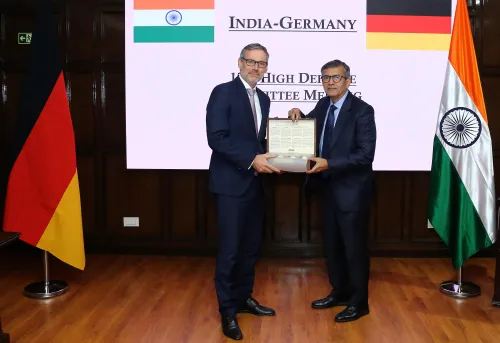
India and Germany formalised their growing defence partnership by signing a Defence Industrial Roadmap and an Implementing Arrangement for Cooperation in UN Peacekeeping — a landmark step that provides a structured framework for bilateral defence collaboration over the coming years.
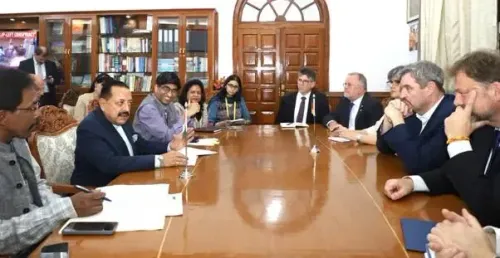
Singh also met German Federal Defence Minister Boris Pistorius in Berlin, where both leaders exchanged views on deepening defence cooperation and addressing emerging geopolitical challenges. The signing of the Defence Industrial Roadmap moves the India-Germany defence relationship from intent to institutional commitment, creating accountability mechanisms for joint projects.
TKMS Submarine Facility Visit and Military Honours
On Wednesday, April 22, Singh visited the TKMS submarine manufacturing facility in Kiel, accompanied by Minister Boris Pistorius. ThyssenKrupp Marine Systems (TKMS) is one of the world's premier submarine builders, and the visit signals India's serious interest in advanced undersea warfare capabilities — potentially relevant to India's Project-75I submarine programme.
Singh was accorded a ceremonial Guard of Honour at the German Ministry of Defence and placed a wreath at the Bundeswehr Memorial, honouring German military personnel who died in service. In a rare display of bilateral respect, the Indian Defence Minister was transported in a Special German Air Force aircraft escorted by fighter jets during his flight from Munich to Berlin.
Strategic Context: Why This Visit Matters Now
This visit carries outsized geopolitical significance. Germany's ReArm Europe initiative — announced in early 2025 — commits hundreds of billions of euros to rebuilding European defence capabilities in the wake of the Russia-Ukraine war. Simultaneously, India's defence exports have surged from under Rs 2,000 crore in 2016-17 to over Rs 21,000 crore in 2023-24, reflecting a transformed domestic defence industrial base.
This visit represents a qualitative leap — moving from buyer-seller dynamics toward genuine co-production partnerships. The broader context also includes India's shifting strategic calculus as New Delhi deepens ties with Western defence partners including the US, France, and now Germany, building a multi-polar defence supply chain that reduces dependence on Russia, historically India's largest arms supplier.
What Comes Next
The Defence Industrial Roadmap is expected to outline specific timelines and working groups for joint technology development. Industry watchers will monitor whether German firms like TKMS, Rheinmetall, and Hensoldt move swiftly to establish India-based joint ventures or technology transfer agreements. With India's defence budget crossing Rs 6.21 lakh crore in 2024-25, the commercial opportunity for German firms is substantial. The next milestone will likely be a formal industry-to-industry dialogue facilitated by both governments under the newly signed roadmap framework.
Point of View
Reducing structural dependence on Russia that has long complicated India's strategic autonomy. The signing of a Defence Industrial Roadmap with Germany — a nation now spending massively under ReArm Europe — creates a rare alignment of interests that could yield real industrial outcomes if New Delhi ensures accountability mechanisms are built into the framework. The focus on AI-enabled drones, sonobuoys, and underwater transmitters reveals India's specific anxiety about the Indo-Pacific undersea balance, where China's submarine expansion is a clear and present concern. This visit is also a signal to Washington that India is building a diversified Western defence network on its own terms, not as a junior partner.
NationPress
19 Sept 2026
Frequently Asked Questions
What did Rajnath Singh discuss at the Munich Defence Round Table?
Rajnath Singh urged German defence companies to co-develop and co-produce advanced military technologies with India, including AI-enabled drones, advanced radar systems, Sonobuoys, and High Power Low Frequency Underwater Transmitters. He highlighted synergies between Germany's ReArm Europe and India's Atmanirbhar Bharat initiatives.
What agreements did India and Germany sign during Rajnath Singh's visit?
India and Germany signed a Defence Industrial Roadmap and an Implementing Arrangement for Cooperation in UN Peacekeeping during Singh's three-day visit to Germany in April 2025. These agreements provide a structured institutional framework for bilateral defence collaboration.
Why did Rajnath Singh visit the TKMS facility in Kiel?
Singh visited the ThyssenKrupp Marine Systems submarine manufacturing facility in Kiel alongside German Defence Minister Boris Pistorius to explore advanced submarine technology cooperation. TKMS is one of the world's leading submarine builders, relevant to India's expanding naval ambitions.
What is the significance of India-Germany defence cooperation in 2025?
The partnership is strategically significant as Germany ramps up defence spending under ReArm Europe while India seeks to diversify its defence supply chain away from Russia. The Defence Industrial Roadmap signed in April 2025 marks a shift from a buyer-seller relationship to genuine co-production.
What is Atmanirbhar Bharat's role in India's defence exports?
Atmanirbhar Bharat has driven India's defence exports from under Rs 2,000 crore in 2016-17 to over Rs 21,000 crore in 2023-24, transforming India into a credible defence manufacturing partner. The initiative now forms the backbone of India's pitch to global partners like Germany for joint development programmes.