Ramaswamy champions early literacy at Ohio childcare event
Synopsis
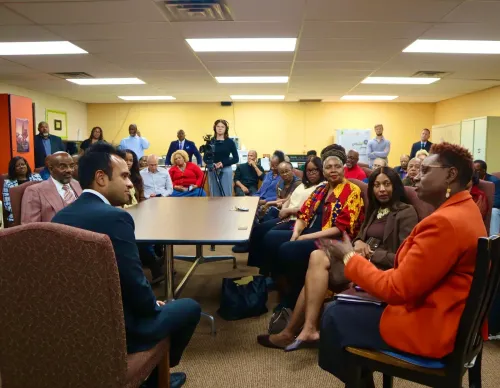
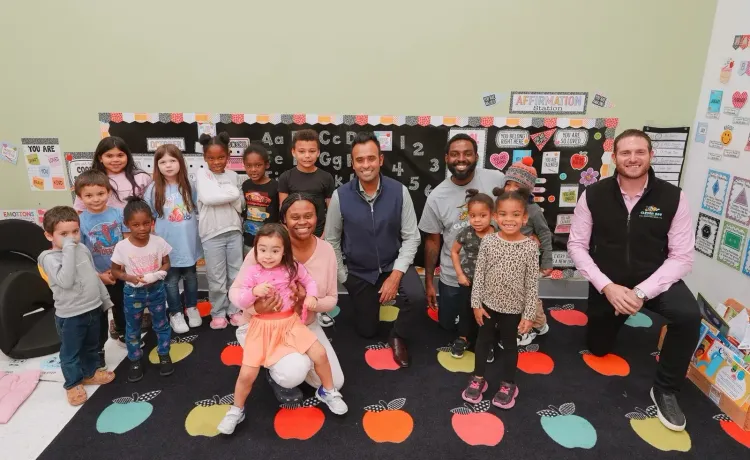
Entrepreneur Vivek Ramaswamy participated in a community reading event at an Ohio childcare center on October 23, declaring his goal that every Ohio student should read fluently by the end of third grade, with kindergarten preparedness as the key starting point.
Key Takeaways
Vivek Ramaswamy attended a community reading session at a local Ohio childcare center on October 23, 2026 .
He stated his goal: every Ohio student reading by the end of third grade , ideally earlier.
He identified kindergarten preparedness as the foundational step toward that goal.
Ohio's Third Grade Reading Guarantee (enacted 2012 ) already mandates reading benchmarks and early interventions before grade promotion.
More than a dozen US states have adopted similar third-grade literacy benchmarks since the 2010s.
The event marks a locally focused education engagement from a figure known nationally for the 2024 Republican presidential race and the DOGE advisory effort.
With a goal as concrete as it is ambitious — every Ohio child reading fluently by the end of third grade — entrepreneur Vivek Ramaswamy stepped into a local childcare center on Friday, October 23, 2026, to put that conviction into practice, joining a community reading session aimed at the youngest learners in the state.
A personal pledge rooted in state policy
Ramaswamy framed his participation not as a one-off photo opportunity but as an extension of a stated education priority: 'My goal is for every student in Ohio to be able to read by the end of 3rd grade — ideally much earlier.' The emphasis on 'ideally much earlier' signals his belief that the real intervention window opens long before third grade — in preschool and kindergarten classrooms where foundational language habits are formed.
That instinct aligns closely with existing Ohio law. The state's Third Grade Reading Guarantee, enacted in 2012, requires third-grade students to meet reading benchmarks before advancing to fourth grade, with targeted assessments and support beginning in earlier grades. The policy was built on a body of research showing that children who cannot read proficiently by third grade face dramatically steeper odds of academic success for the rest of their schooling.
Why kindergarten preparedness is the real battleground
Ramaswamy's explicit mention of 'kindergarten preparedness' moves the conversation upstream from the third-grade assessment itself. A child who arrives at kindergarten without basic phonemic awareness — the ability to hear, identify, and manipulate sounds in spoken words — is already playing catch-up. Childcare centers and preschool programs are therefore not just daycare; they are, in policy terms, the first classroom where reading trajectories diverge.
Across the United States, more than a dozen states have adopted third-grade reading benchmarks since the 2010s, each grappling with the same upstream question: how early is early enough to intervene? Ohio's model has been cited as one of the more structured frameworks, tying mandatory assessments to specific intervention plans for struggling readers well before the third-grade gate.
From the campaign trail to the childcare mat
For Ramaswamy — who rose to national prominence as a 2024 Republican presidential candidate and later served as co-lead of the US Department of Government Efficiency (DOGE) advisory effort before returning to his home state — the community reading session marks a deliberately local pivot. The move underscores a pattern visible among ambitious Ohio figures: building state-level credibility through visible, retail engagement on kitchen-table issues like education before any larger policy push.
Whether this signals a formal policy initiative, a legislative push on kindergarten-readiness funding, or simply a public statement of values, the direction is clear. Early literacy is Ramaswamy's declared education north star — and Ohio's existing policy architecture gives him a ready framework to build on or expand.
Point of View
He is effectively arguing for moving intervention earlier, a stance that could press Ohio lawmakers on preschool and childcare funding. For a figure with national ambitions who has pivoted back to Ohio, retail-level education engagement is a classic credibility-building move that keeps a public profile warm without requiring a formal office. The open question is whether personal conviction translates into concrete legislative proposals on kindergarten-readiness assessments or childcare infrastructure.
NationPress
23 Oct 2026
Frequently Asked Questions
What is Vivek Ramaswamy's education goal for Ohio?
Ramaswamy has stated his goal is for every student in Ohio to be able to read by the end of third grade, with a preference for achieving that milestone even earlier through stronger kindergarten preparedness.
What is Ohio's Third Grade Reading Guarantee?
Ohio's Third Grade Reading Guarantee, enacted in 2012, requires third-grade students to meet specific reading proficiency benchmarks before being promoted to fourth grade, with mandatory assessments and intervention supports starting in earlier grades.
Why does kindergarten preparedness matter for reading?
Children who arrive at kindergarten without foundational language and phonemic-awareness skills are statistically more likely to fall behind in reading by third grade; early childcare and preschool settings are where those foundational skills are first developed.
What is Vivek Ramaswamy's political background?
Ramaswamy is an entrepreneur and founder of Strive Asset Management who ran as a Republican presidential candidate in 2024 and later co-led the US Department of Government Efficiency (DOGE) advisory effort before returning to focus on Ohio.
How does Ohio's literacy policy compare with other US states?
More than a dozen US states have adopted third-grade reading benchmarks as part of standards-based education reforms since the 2010s; Ohio's model is considered one of the more structured frameworks, linking mandatory assessments to specific intervention plans.