Ramaswamy Puts Individual and Nation Above Identity Politics
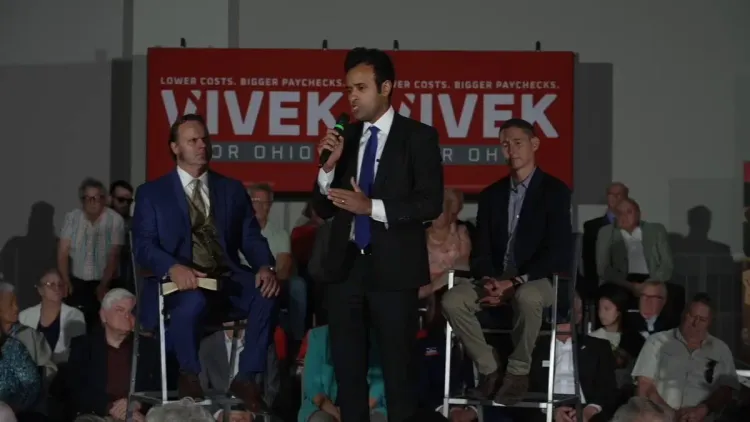
Synopsis
Former DOGE co-lead and entrepreneur Vivek Ramaswamy posted on X on May 27, 2026, declaring that individual, family, nation, and God represent higher values than race, gender, sexuality, and climate — a sharp one-line encapsulation of his longstanding critique of identity-based politics and ESG-driven governance.
Key Takeaways
Vivek Ramaswamy posted on X on May 27, 2026 , asserting a values hierarchy: individual, family, nation, and God above race, gender, sexuality, and climate.
The statement is consistent with arguments in his 2022 book Woke, Inc. and his 2024 Republican presidential primary campaign.
Ramaswamy co-led the Department of Government Efficiency (DOGE) advisory effort and is founder of Strive Asset Management , which opposes ESG investing.
No specific triggering event for the post has been confirmed from the public record.
The post is expected to resonate with conservative voters and traditional-values constituencies while drawing pushback from civil rights and climate advocacy groups.
Ramaswamy remains a prominent figure in US conservative politics and is closely watched by the Indian-American community given his Tamil immigrant heritage.
Entrepreneur and former DOGE co-lead Vivek Ramaswamy posted a pointed cultural declaration on X on Wednesday, May 27, 2026, asserting that individual, family, nation, and God represent higher-order values than race, gender, sexuality, and climate.
Context
In a single-sentence post, Ramaswamy wrote: 'Individual, family, nation, and God beats race, gender, sexuality, and climate.' The statement frames two competing hierarchies of values — one rooted in classical liberal and religious tradition, the other in what critics of the American left describe as identity-based and environmental politics. No specific triggering event has been confirmed for the timing of this post.
The declaration is consistent with positions Ramaswamy has held publicly since at least 2022, when his book Woke, Inc. argued that corporate and institutional preoccupation with race, gender, and climate had displaced a focus on individual merit and national interest. His 2024 Republican presidential primary campaign repeated those themes at scale.
Policy Backdrop
Ramaswamy rose to national prominence in the United States as founder and executive chairman of Strive Asset Management, a firm explicitly built around the idea of shareholder value over environmental, social, and governance (ESG) criteria. His co-leadership of the Department of Government Efficiency (DOGE) advisory effort under the Trump administration brought that anti-ESG, anti-DEI philosophy into the machinery of federal governance.
The broader conservative movement in the US has, since 2021, pursued state and federal legislation emphasising parental rights in education, merit-based hiring in government, and rollbacks of corporate diversity mandates — all policy expressions of the value hierarchy Ramaswamy articulates here. His framing of 'God' as a top-tier value also signals alignment with the religious-conservative wing of the Republican Party.
Stakeholders and Impact
For conservative voters and traditional families in the United States, the post functions as an affirmation of a worldview that feels marginalised in mainstream media and corporate culture. It is likely to circulate widely in right-leaning networks as a rallying formulation.
Critics on the left are expected to argue that dismissing race, gender, and climate as lower-order concerns ignores structural inequalities and an existential environmental crisis. Advocacy groups focused on civil rights and climate action will likely treat the post as evidence of the ideological direction Ramaswamy would pursue in any future public role.
For Indian observers, the statement carries relevance because Ramaswamy — an Ohio-born son of Tamil immigrant parents — has become one of the most visible non-white faces of American conservatism, and his cultural positions are watched closely by the Indian-American community as well as by analysts tracking the global right.
What's Next
Ramaswamy remains a significant voice in US conservative politics following his departure from DOGE and his return to full-time work at Strive Asset Management. Future public appearances, potential legislative testimony, or a follow-up book on cultural policy could flesh out the framework he compressed into this single post. Whether the formulation becomes a campaign slogan — should he seek office again — is a question political observers will be tracking.
Point of View
Gender, sexuality, and climate as the opposing cluster, he defines his adversary precisely, which is useful for future electoral messaging. Whether this signals a renewed political ambition or simply reinforces his brand as a cultural commentator will become clearer with his next major public move.
NationPress
20 Sept 2026
Frequently Asked Questions
What did Vivek Ramaswamy post on X in May 2026?
Ramaswamy posted: 'Individual, family, nation, and God beats race, gender, sexuality, and climate,' framing a values hierarchy that places classical and religious priorities above identity-based and environmental concerns.
Who is Vivek Ramaswamy?
Vivek Ramaswamy is an American entrepreneur, founder and executive chairman of Strive Asset Management, former co-lead of the DOGE advisory effort under the Trump administration, and a 2024 Republican presidential candidate of Tamil immigrant heritage.
What is Strive Asset Management?
Strive Asset Management is an investment firm founded by Ramaswamy that explicitly rejects ESG (environmental, social, and governance) criteria and focuses on maximising shareholder returns.
What is Ramaswamy's book Woke, Inc. about?
Published in 2022, Woke, Inc. argues that corporations and institutions have adopted race, gender, and climate as political agendas at the expense of individual merit and national interest — the same theme his May 2026 post encapsulates.
Why do Indians follow Vivek Ramaswamy's political statements?
Ramaswamy is one of the most prominent non-white faces of American conservatism and is the son of Tamil immigrants, making his cultural and political positions of particular interest to the Indian-American community and analysts tracking the global right.