Ramaswamy on Governance: 'We Deserve the Govt We Elect'
Synopsis
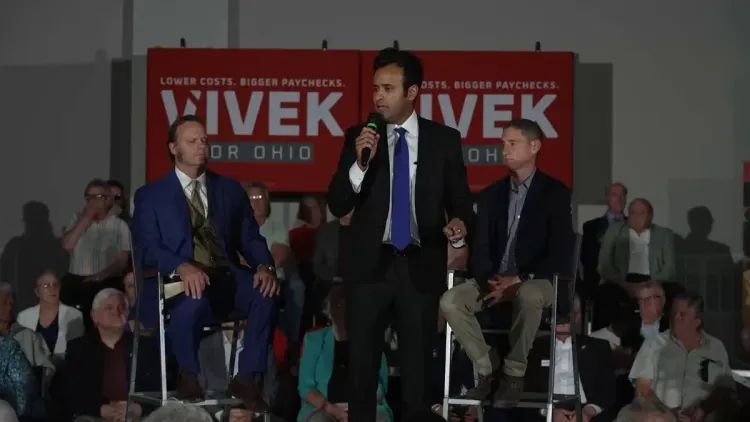
Former DOGE co-lead and Strive Asset Management founder Vivek Ramaswamy posted a sharp, seven-word statement on X on 28 May 2026, arguing that citizens are ultimately responsible for the quality of their elected governments — a theme central to his political identity.
Key Takeaways
Vivek Ramaswamy posted on X on 28 May 2026 : 'The government we elect is the government we deserve.' Ramaswamy is founder and executive chairman of Strive Asset Management and former co-lead of the DOGE advisory effort.
The statement echoes a core argument from his 2024 Republican presidential campaign — that voter behaviour shapes institutional quality.
The post carries no specific policy target but aligns with his sustained critique of federal bureaucracy and calls for greater civic accountability.
The universality of the phrase gives it resonance beyond the United States , touching democratic accountability debates globally.
Entrepreneur and former DOGE co-lead Vivek Ramaswamy posted a pointed statement on accountability in governance on Thursday, 28 May 2026, writing on X: 'The government we elect is the government we deserve.'
Context
The seven-word post distils a centuries-old principle in democratic theory — that citizens bear collective responsibility for the quality of their elected institutions. The phrase echoes a sentiment often attributed to 18th-century political thinkers and has resurfaced repeatedly in American public discourse during periods of institutional frustration.
Ramaswamy, who founded Strive Asset Management and ran as a 2024 Republican presidential candidate, has consistently argued that bloated, unaccountable bureaucracy is a symptom of voter disengagement rather than a structural inevitability. His brief tenure as co-lead of the Department of Government Efficiency (DOGE) advisory effort placed him at the centre of the most high-profile federal cost-cutting exercise in recent US history.
Policy Backdrop
The statement lands against a backdrop of ongoing debate in the United States about the effectiveness of administrative reforms initiated under the DOGE framework. Critics of those reforms argued that rapid agency restructuring undermined service delivery; proponents, including Ramaswamy, maintained that the status quo represented a failure of democratic accountability.
His 2024 campaign platform repeatedly stressed that voters who tolerate fiscal excess and regulatory overreach are themselves participants in perpetuating those conditions. The post reads as a continuation of that argument, condensed to its philosophical core.
Stakeholders and Impact
American voters are the implied audience, though the universality of the statement gives it resonance beyond any single electorate. In democracies globally — including India, where electoral accountability debates are perennial — the sentiment carries direct relevance.
For Ramaswamy's supporters, the post reinforces a call to civic vigilance ahead of any future electoral cycle. For critics, it risks deflecting structural critiques of institutional design onto individual voters. Neither reading is foreclosed by the text itself.
What's Next
Ramaswamy has signalled through prior statements and his continued role at Strive Asset Management that he intends to remain a vocal presence in US policy debates. Whether this post presages a formal re-entry into electoral politics, a new policy initiative, or simply reflects ongoing public commentary remains to be seen.
As 2026 mid-term electoral dynamics in the United States continue to evolve, statements that frame civic duty as inseparable from governance outcomes are likely to gain further traction — and scrutiny.
Point of View
Deniable form. By placing responsibility squarely on voters, he sidesteps structural critiques of institutional design while keeping his own reform agenda morally intact. The timing, amid evolving US mid-term dynamics, suggests he is positioning himself as a conscience voice rather than a candidate — for now. Whether this signals a forthcoming policy push or electoral re-entry, the post keeps his name and his argument in circulation at minimal political cost.
NationPress
13 Oct 2026
Frequently Asked Questions
What did Vivek Ramaswamy post on X on 28 May 2026?
Ramaswamy posted: 'The government we elect is the government we deserve,' a statement on electoral accountability and civic responsibility.
Who is Vivek Ramaswamy?
Vivek Ramaswamy is the founder and executive chairman of Strive Asset Management, a former co-lead of the DOGE advisory effort under the US federal government, and a 2024 Republican presidential candidate.
What is DOGE and what was Ramaswamy's role?
DOGE, the Department of Government Efficiency, was a high-profile US federal advisory effort focused on reducing bureaucracy and cutting costs. Ramaswamy served as its co-lead before stepping back from the role.
What does 'the government we deserve' mean in political theory?
The phrase reflects a democratic accountability principle — that citizens who vote, or fail to vote, bear collective responsibility for the quality and conduct of their elected institutions.
Is Vivek Ramaswamy running for office in 2026?
No formal announcement of a 2026 candidacy has been made by Ramaswamy. His post is consistent with ongoing public commentary rather than a declared electoral campaign.