Rohingya camps in Bangladesh turn militant hotspot amid stalled repatriation
Synopsis
Bangladesh's Rohingya camps — home to over 1.19 million registered refugees — are no longer just a humanitarian crisis. With multiple armed factions competing for control, TTP-linked arrests in Teknaf and Dhaka, and 37 killed in 2025 alone, the camps are fast becoming a regional security flashpoint that repatriation deadlock and statelessness continue to fuel.
Key Takeaways
The Rohingya refugee crisis in Bangladesh is shifting from a humanitarian emergency into a serious security threat, according to a Stringer Asia report.
At least 4 people were killed and 3 injured in insurgency-linked incidents in Bangladesh up to 24 May 2026 ; 37 were killed in 2025 and 42 in 2024 .
A Rohingya youth was arrested in Teknaf in May 2026 for alleged TTP links via WhatsApp; four ARSA cadres were arrested in Dhaka in April 2026 for similar alleged ties.
UNHCR 2026 data shows approximately 1,194,123 registered Rohingya refugees in Bangladesh, with 149,769 newly registered between December 2024 and 31 March 2026 .
Stalled repatriation to Myanmar and prolonged statelessness are cited as the structural drivers enabling armed-group recruitment and online radicalisation.
The Rohingya refugee crisis in Bangladesh is entering a significantly more dangerous phase, transitioning from a large-scale humanitarian emergency into a serious security threat with implications for local communities and the wider region, according to a detailed report by Stringer Asia. The shift is being driven by stalled repatriation, persistent instability in Myanmar, and a near-total absence of viable prospects for one of the world's largest stateless populations.
Rising Armed-Group Violence in the Camps
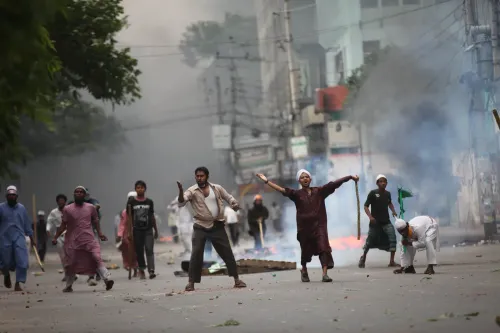
The camps — particularly those concentrated in Cox's Bazar — are no longer troubled merely by isolated criminal rivalries, the report warned. According to Stringer Asia, 'the camps are increasingly becoming spaces where humanitarian vulnerability and armed-group violence overlap,' with multiple Rohingya armed factions now engaged in a 'sustained and fragmented contest' for territorial control, recruitment networks, and access to illicit economies.
Partial data compiled by the Institute for Conflict Management underscores the trend. At least four people were killed and three injured in Rohingya-insurgency-linked incidents in Bangladesh up to 24 May 2026. The toll stood at 37 killed in 2025 and 42 deaths in 2024, pointing to a pattern of sustained, if fluctuating, violence.
Transnational Extremist Linkages Emerge
Concerns have deepened over potential connections between camp residents and international militant networks. In May 2026, Bangladeshi police arrested a Rohingya youth in Teknaf for alleged involvement with Tehreek-e-Taliban Pakistan (TTP) through an Urdu-language WhatsApp group reportedly used to encourage terrorist activity. Earlier, in April 2026, four alleged ARSA cadres were arrested in Dhaka for suspected links with the same organisation.
The report was careful to note that 'these cases do not yet prove the existence of a formal TTP infrastructure inside the Rohingya camps,' but said they reveal the vulnerability of displaced Rohingya youth to online radicalisation. Prolonged statelessness, unemployment, insecurity, and frustration, the report argued, create conditions in which digital propaganda can find receptive audiences.
Scale of Displacement Continues to Grow
At the heart of the crisis is the unresolved legal and political status of the Rohingya people. According to UNHCR 2026 data cited in the report, approximately 149,769 Rohingya refugees were newly registered in Bangladesh between December 2024 and 31 March 2026, bringing the total registered Rohingya refugee population in Bangladesh's camps to roughly 1,194,123. The report described this continued displacement as a direct reflection of the failure to create 'safe, dignified, and voluntary conditions for return to Myanmar.'
Bangladesh's Dual Challenge
Bangladesh now faces the complex task of maintaining security within the camps while upholding essential humanitarian safeguards — a balance that is increasingly difficult to strike. The report stressed that unless the structural roots of displacement, statelessness, and political exclusion are addressed, armed factions will continue to find space to recruit, intimidate, and expand their influence. This comes amid broader regional anxieties about spillover effects into neighbouring countries and the potential for the camps to serve as nodes in transnational extremist networks.
With repatriation to Myanmar showing no credible near-term prospects, analysts warn that the security trajectory inside the camps is likely to worsen before it improves.
Point of View
Not an isolated incident; online radicalisation does not require physical infrastructure, only despair and connectivity. Bangladesh is being asked to police a population it never agreed to host permanently, without a credible repatriation framework from Myanmar and without adequate international burden-sharing. The longer the international community treats this as a refugee management issue rather than a geopolitical one, the more the camps risk becoming what no one wants to name them: a recruitment ecosystem for transnational militancy.
NationPress
27 Oct 2026
Frequently Asked Questions
Why are Rohingya refugee camps in Bangladesh considered a growing security threat?
Multiple Rohingya armed groups are now competing for territorial control, recruitment networks, and illicit economies inside the camps, particularly in Cox's Bazar. Recent arrests linking camp residents to Tehreek-e-Taliban Pakistan have further elevated concerns about transnational extremist connections.
How many Rohingya refugees are currently registered in Bangladesh?
According to UNHCR 2026 data cited in the Stringer Asia report, approximately 1,194,123 Rohingya refugees are registered in Bangladesh's camps. Around 149,769 were newly registered between December 2024 and 31 March 2026.
What are the TTP-linked arrests in Bangladesh about?
In May 2026, Bangladeshi police arrested a Rohingya youth in Teknaf for alleged involvement with Tehreek-e-Taliban Pakistan through an Urdu-language WhatsApp group. In April 2026, four alleged ARSA cadres were arrested in Dhaka for suspected TTP links. The report notes these cases do not yet confirm a formal TTP infrastructure inside the camps.
How many people have been killed in Rohingya-insurgency-linked violence in Bangladesh?
According to partial data from the Institute for Conflict Management, at least 4 people were killed and 3 injured up to 24 May 2026. The toll was 37 killed in 2025 and 42 in 2024.
Why has repatriation of Rohingya refugees to Myanmar stalled?
Repatriation has stalled because safe, dignified, and voluntary conditions for return to Myanmar have not been established, according to the report. Continued instability inside Myanmar means the displaced population has no credible pathway home, prolonging statelessness and deepening vulnerability to radicalisation.