South Korea births hit 7-year high in April, up 18% year-on-year
Synopsis
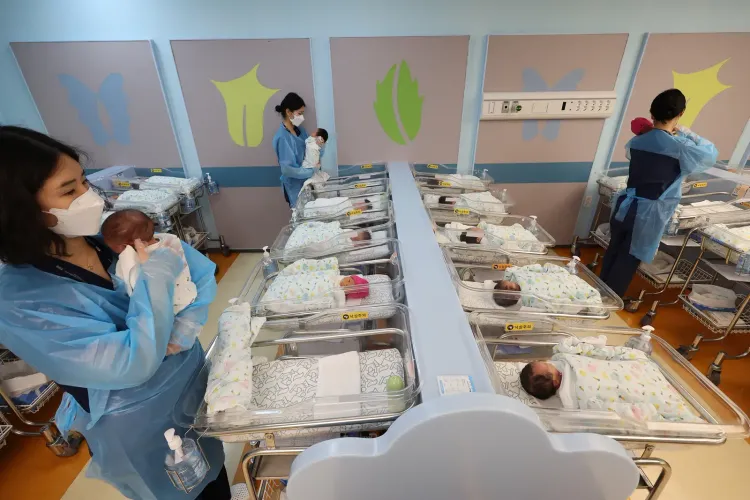
South Korea's birth count hit a seven-year high in April 2025, jumping 18% year-on-year to 24,521 — and the January–April total of 99,534 is also the strongest in seven years. It is a rare bright spot for a country that posted the world's lowest fertility rate in 2023, though at 0.93, the TFR remains less than half the 2.1 needed to stop population shrinkage.
Key Takeaways
24,521 babies were born in South Korea in April 2025 — an 18% rise year-on-year and a seven-year high for any April.
The January–April 2025 total reached 99,534 births , also the highest in seven years , up 15.5% from a year earlier.
The total fertility rate rose to 0.93 in April, up 0.13 year-on-year, but still well below the 2.1 replacement level.
Marriages in April rose 9% to 20,622 — the highest April figure since 2016 ; experts cite this as a key driver of the birth rebound.
Despite the uptick, South Korea recorded a natural population decline of 3,884 in April, with deaths outpacing births at 28,405 .
The newborn count has been rising steadily since July 2024 , suggesting the trend has multi-month momentum.
South Korea recorded its highest number of births for any April in seven years, with 24,521 babies born during the month — an 18% jump from 20,787 in the same period a year earlier, according to data released by South Korea's Ministry of Data and Statistics on Wednesday, 24 June 2025. The figure surpasses the previous April peak of 26,104 births set in 2019.
Key Developments
The surge was not limited to a single month. Over the January–April 2025 period, total births reached 99,534 — also the highest in seven years and a sharp 15.5% rise from the corresponding period a year earlier. Notably, the growth rate for both April alone and the four-month cumulative period set record highs, signalling an accelerating trend rather than a one-off spike.
The country's total fertility rate (TFR) — the average number of children a woman is expected to have in her lifetime — climbed to 0.93 in April, up 0.13 from a year earlier, according to reports citing Yonhap. The number of newborns has been on a consistent upward trajectory since July 2024.
What Is Driving the Rebound
Experts attribute the uptick primarily to a rise in marriages and what analysts describe as a more positive public perception of childbirth among younger South Koreans. The number of marriages in April climbed 9% from a year earlier to 20,622 — the highest April marriage count since 22,844 was recorded in April 2016. Marriages typically precede birth increases by roughly one to two years, suggesting the current birth rebound may have further momentum.
This comes amid years of sustained demographic alarm in South Korea, which had posted a record-low TFR of 0.72 in 2023 — the lowest of any country in the world at the time. The government has spent an estimated ₩280 trillion (approximately $200 billion) over two decades on pro-natalist policies with limited measurable impact until this recent upturn.
The Demographic Gap That Remains
Despite the encouraging trend, the fertility rate of 0.93 remains far below the 2.1 births per woman required to maintain a stable population without net immigration. South Korea continues to record a natural population decline: deaths in April stood at 28,405, down 1.3% from a year earlier, but still resulting in a natural population deficit of 3,884 for the month.
The number of divorces also rose 7.3% from a year earlier to 7,829 in April, a data point that demographers will watch alongside marriage rates to assess whether the marriage-birth correlation holds over subsequent quarters.
What Comes Next
Analysts caution against reading the uptick as a structural reversal. The critical question is whether the post-pandemic marriage surge — and the attitudinal shift it reflects — translates into sustained multi-year birth growth, or whether it represents a deferred cohort catching up. South Korea's government is expected to release second-quarter data in the coming months, which will offer a clearer picture of whether the July 2024-onward trend is durable.
Point of View
But South Korea has been here before — short-term surges followed by renewed decline. The fertility rate of 0.93 is still less than half the replacement threshold, and the natural population deficit persists. What is different this time is that the uptick is marriage-led rather than policy-led, which gives it more organic credibility. Yet the divorce rate also rose, and marriage rates in South Korea have historically been volatile. The government should resist declaring a demographic turning point until at least two or three years of sustained above-trend data are in hand — premature optimism has repeatedly led Seoul to ease pressure on structural reforms around housing costs, childcare access, and workplace gender equity that are the real long-term levers.
NationPress
22 Sept 2026
Frequently Asked Questions
How many babies were born in South Korea in April 2025?
A total of 24,521 babies were born in South Korea in April 2025, up 18% from 20,787 in April 2024. This is the highest number of births recorded for any April since 2019 , when 26,104 births were logged.
What is South Korea's total fertility rate in 2025?
South Korea's total fertility rate rose to 0.93 in April 2025, up 0.13 from the same month a year earlier. This remains far below the 2.1 births per woman needed to maintain a stable population without immigration.
Why are births increasing in South Korea?
Experts attribute the rebound to a rise in marriages — which climbed 9% in April to a nine-year high — alongside a reportedly more positive public attitude toward childbirth among younger South Koreans. The birth uptick has been sustained since July 2024 .
Is South Korea's population still declining despite the birth rise?
Yes. Even with the birth surge, South Korea recorded a natural population decline of 3,884 in April 2025, as deaths — at 28,405 — continued to outnumber births. The country's fertility rate remains well below the replacement level of 2.1.
How does the January–April 2025 birth total compare to previous years?
The cumulative birth count for January–April 2025 reached 99,534 , the highest four-month total in seven years and a 15.5% increase over the same period a year earlier. Both the monthly and cumulative growth rates set records for their respective periods.