Sacks Warns US Must Stay Course on AI Race Strategy
Synopsis
White House AI and Crypto Czar David Sacks marked one year of President Trump's global AI race declaration, reaffirming the administration's pro-innovation, pro-infrastructure, pro-energy, and pro-export strategy and warning that deviating from it would be perilous for American competitiveness.
Key Takeaways
David Sacks posted on 28 June 2026 marking one year since President Trump declared the US was in a global AI race.
The administration's strategy rests on four pillars: pro-innovation, pro-infrastructure, pro-energy, and pro-export .
Sacks issued an explicit warning that deviating from this strategy would be done 'at our peril.' The post signals the White House has no intention of moderating its permissive, growth-first AI governance stance.
The policy has direct implications for India , a key US partner on critical and emerging technology under the iCET framework.
The statement comes amid ongoing global debate about whether AI governance should prioritise safety regulation or innovation speed.
White House AI and Crypto Czar David Sacks on Sunday, 28 June 2026 marked the one-year anniversary of President Donald Trump's declaration that the United States was engaged in a global artificial intelligence race, warning that any deviation from the administration's core strategy would be dangerous for American competitiveness.
Context
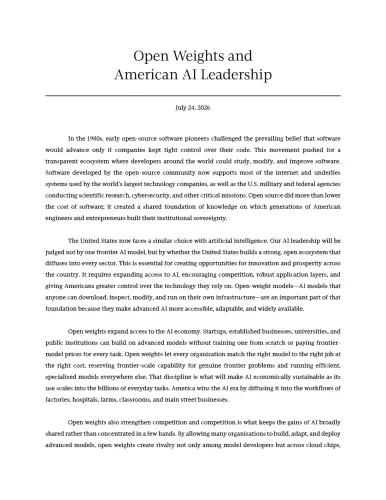
Sacks posted on X that a year ago, President Trump had declared America was in a global AI race and that the path to winning it was to be 'pro-innovation, pro-infrastructure, pro-energy, and pro-export.' He stated plainly: 'President Trump was exactly right; we deviate from that strategy at our peril.' The post, accompanied by an image, served as both a retrospective and a pointed warning to those who might push for a course correction.
The four-pillar framework Sacks cited — innovation, infrastructure, energy, and exports — has been the rhetorical and policy spine of the Trump administration's approach to AI since early 2025. It reflects a deliberate contrast with regulatory-first approaches adopted by the European Union and debated in other democratic governments.
Policy Backdrop
The Trump administration moved quickly after taking office in January 2025 to position the US as the dominant force in global AI development. A key early step was the revocation of the Biden-era AI executive order of October 2023, which had emphasised safety testing and disclosure requirements. In its place, the administration issued directives focused on removing regulatory friction and accelerating private-sector deployment.
Sacks, as AI and Crypto Czar, has been the administration's most visible spokesperson on technology policy, coordinating between the White House, federal agencies, and major technology companies. His role sits within the White House Office of Science and Technology Policy framework and carries significant convening power over industry stakeholders. The energy dimension of the strategy has translated into concrete support for expanded data-centre construction and relaxed permitting for power generation to feed AI compute demand.
On the export front, the administration has navigated a complex tension: promoting AI exports as an economic and geopolitical tool while maintaining controls on advanced semiconductor technology to strategic competitors, principally China. Sacks's post implicitly defends this balance against critics who argue either that export controls are too tight or that the administration is moving too fast without adequate safeguards.
Stakeholders and Impact
The post lands at a moment of active debate inside Washington DC and in allied capitals about how democracies should govern AI. India, which has positioned itself as a major AI talent hub and a potential manufacturing partner through the India-US Initiative on Critical and Emerging Technology (iCET), watches these signals closely. Any shift in US AI export policy directly affects Indian technology firms, research institutions, and the government's own AI mission.
For global investors and technology companies, Sacks's statement functions as a policy signal: the administration has no intention of moderating its permissive, growth-oriented stance. Startups and large model developers who have built business plans around the current regulatory environment will read the post as reassurance. Critics — including civil-society groups and some legislators — who have called for stronger AI safety legislation will see it as a rebuff.
What's Next
With the one-year mark of the Trump AI strategy now passed, attention will turn to concrete deliverables: progress on domestic AI infrastructure investment, the status of bilateral AI agreements with allied nations, and whether the administration will introduce any formal legislative framework or continue to govern AI primarily through executive action. Sacks's public reaffirmation of the four-pillar strategy suggests the White House views the current approach as vindicated and intends to accelerate rather than adjust it. How allied and rival nations respond to sustained US AI assertiveness will shape the next phase of what the administration has explicitly framed as a race with global stakes.
Point of View
Not merely a retrospective. By invoking the word 'peril,' he is pushing back against voices — inside and outside the administration — who may favour introducing guardrails or slowing AI exports. The framing of AI as a race requiring unwavering commitment is a political device that makes any regulatory proposal appear unpatriotic or strategically reckless. For countries like India that are deeply enmeshed in the US technology ecosystem, the durability of this doctrine matters enormously: it shapes chip access, data-centre investment flows, and the terms of bilateral AI cooperation for years ahead.
NationPress
27 Sept 2026
Frequently Asked Questions
What is David Sacks's role in the Trump administration?
David Sacks serves as the White House AI and Crypto Czar, acting as the administration's principal coordinator on artificial intelligence and cryptocurrency policy across federal agencies and with the private sector.
What is Trump's four-pillar AI strategy?
President Trump's AI strategy, articulated around mid-2025, rests on four pillars: being pro-innovation, pro-infrastructure, pro-energy, and pro-export, prioritising rapid development and deployment over regulatory caution.
Why did Sacks say deviating from the AI strategy would be 'at our peril'?
Sacks used the phrase to signal that the US faces serious competitive risk from rivals, particularly China, if it slows its AI development through excessive regulation or export restrictions, framing consistency as a national security imperative.
How does US AI policy affect India?
India is a key US partner under the iCET framework, and US AI export and infrastructure policy directly influences Indian access to advanced chips, cloud infrastructure, and joint research programmes.
What did Trump's original AI executive order change?
The Trump administration revoked the Biden-era AI executive order from October 2023, which had required safety testing and disclosures, replacing it with directives aimed at reducing regulatory friction and accelerating private-sector AI deployment.