Could Foreign Mercenaries Be Behind the 2024 Violence in Bangladesh? Sheikh Hasina Speaks Out (IANS Exclusive)
Synopsis
In an exclusive interview, former Bangladeshi Prime Minister Sheikh Hasina expresses concerns about potential foreign mercenary involvement in the 2024 unrest that led to her government's downfall. She emphasizes that the Yunus administration's actions raise serious questions about democracy and the future of political opposition in Bangladesh.
Key Takeaways
Ex-Prime Minister Sheikh Hasina raises concerns about foreign mercenary involvement in unrest.
The current interim government has halted investigations into the violence.
The Awami League remains a pivotal political force in Bangladesh.
Freedom of expression is severely restricted under the Yunus administration.
Current instability threatens Bangladesh's sovereignty and democracy.
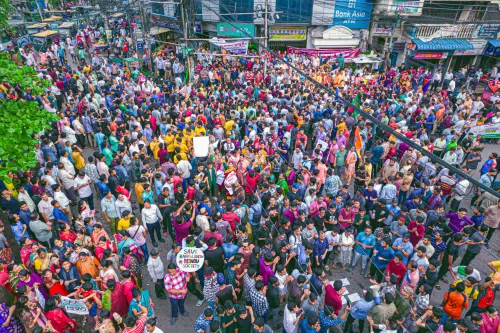
New Delhi, Jan 7 (NationPress) Former Bangladeshi Prime Minister Sheikh Hasina, during an exclusive discussion with IANS, did not entirely dismiss the idea of a foreign influence in the downfall of her administration in August 2024, expressing concerns about the role of mercenaries in inciting violence amid the student-led protests.
“I cannot confirm if foreign entities were involved in Yunus’ takeover,” she remarked to IANS on Wednesday; however, she added, “There are aspects of the 2024 uprising that remain unclear.”
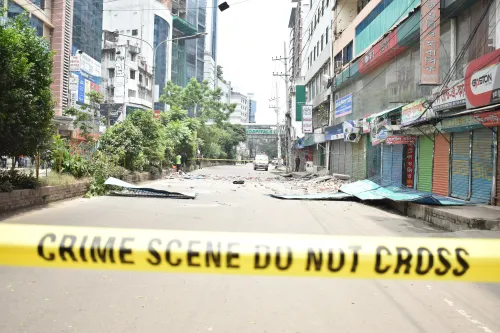
“Numerous indications suggest that instigators, potentially foreign mercenaries, played a part in escalating violence at the onset of the unrest,” she stated.
Currently in exile in India, Sheikh Hasina revealed that in July 2024, she established a Judicial Inquiry Committee to investigate these events.
However, she noted that the interim administration led by Chief Adviser Mohammad Yunus halted this investigation. “The moment Yunus assumed power, he ceased this inquiry, likely because he understood it would unveil his carefully orchestrated plan to topple my government,” asserted the daughter of Sheikh Mujibur Rahman, the founder of Bangladesh.
“This action raises significant questions regarding the motivations behind the protests, particularly concerning potential foreign involvement. Since then, there has been no thorough investigation into those events,” she said.
Sheikh Hasina further contended that the prohibition on the Awami League was a maneuver by the Yunus-led government, which she claimed is aware that her party could regain power in a genuine, fair, and inclusive election.
“The Awami League remains the nation’s largest and most deeply entrenched political party. Our history is intertwined with Bangladesh’s independence and the remarkable progress we have made as a nation,” she stated.
“The Yunus administration recognizes that in any legitimate election, the Awami League would receive overwhelming public support. That is the primary reason for our ban,” claimed Sheikh Hasina.
She emphasized that banning a political party is not a reform but a direct attack on democracy and the fundamental rights of the populace, alleging, “Instead of confronting the electorate, they have opted for exclusion and repression. The upcoming elections are a mere farce, a carefully orchestrated mockery of democracy.”
Expressing concerns about the current law-and-order situation, the 78-year-old former premier stated, “Police are arresting anyone attempting to acquire nomination forms unless they belong to or are sanctioned by the BNP or Jamaat-aligned factions, while legitimate independent candidates have been barred from participating in the elections.”
She remarked, “Under our governance, we welcomed criticism and ensured that journalists could report freely, adhering to democratic principles that necessitate healthy ideological competition where political opposition is embraced, not criminalized.”
“However, today, freedom of expression is virtually nonexistent. Those who dare to critique Yunus’ government and the realities in Bangladesh face threats of imprisonment, intimidation, or worse. Media offices have been torched merely for telling the truth. This is not governance; it is a reign of terror,” she charged.
Sheikh Hasina also told IANS that the world misjudged Yunus as a liberal, but the ongoing persecution of minorities may prompt a reevaluation.
“Yunus has long received tacit support from some Western liberals, who mistakenly considered him an ally. Now, witnessing him appoint radical extremists from Hizb-ut Tahrir to his Cabinet, permitting unchecked minority persecution, and dismantling Bangladesh’s constitution, they may be less inclined to extend their support,” she said with optimism.
More than a year prior, India prohibited Hizb-ut-Tahrir as the organization seeks to establish a global Islamic state and caliphate through terror. The group reportedly aims to impose Islamic rule worldwide, including in Israel and India.
“It is evident that Yunus has pursued a reckless and ill-conceived alliance with foreign partners whose interests conflict with Bangladesh’s prosperity. The current instability in Bangladesh is a direct consequence of extremist factions that have been emboldened and allowed to dictate our foreign policy,” added Sheikh Hasina, alleging foreign complicity.
Sheikh Hasina also mentioned Dhaka’s current diplomatic shifts and efforts at realignments.
“No unelected government possesses the authority to alter Bangladesh’s strategic trajectory or undermine decades of meticulously balanced regional relationships. Bangladesh’s sovereignty relies on democratic legitimacy. Without it, the nation becomes susceptible to external influences and internal manipulation,” she told IANS.
Point of View
It is crucial to approach Sheikh Hasina's claims with a balanced perspective, acknowledging the complexity of Bangladesh's political environment. The concerns regarding foreign involvement and the state of democracy warrant serious examination and dialogue, as they can significantly impact the country's future.
NationPress
20 Sept 2026
Frequently Asked Questions
What did Sheikh Hasina say about foreign involvement?
Sheikh Hasina expressed concerns about the possibility of foreign mercenaries playing a role in the violence that led to her government's downfall in 2024.
How has the Yunus administration responded to investigations?
Hasina claimed that the Yunus-led interim government halted the Judicial Inquiry Committee set up to investigate the unrest.
What is the current political situation in Bangladesh?
The political environment is tense, with the Awami League facing a ban and concerns about the legitimacy of the upcoming elections under the Yunus government.
What does Hasina say about freedom of expression?
She criticized the current government for suppressing freedom of expression and intimidating critics, stating that the media faces severe repression.
What are the implications of the current unrest?
Hasina warns that the ongoing instability and shift in foreign policy could have dire consequences for Bangladesh's sovereignty and democratic integrity.