India, Canada 'most natural partners', says FM Sitharaman in Toronto
Synopsis
Finance Minister Nirmala Sitharaman’s Toronto address was more than diplomatic pleasantry — it was a structured capital pitch. With CEPA negotiations live, a $70 billion trade target on the table, and GIFT City being marketed to Canadian pension funds, India is actively repositioning itself as the preferred financial partner for one of the world’s largest pools of institutional capital.
Key Takeaways
FM Nirmala Sitharaman arrived in Toronto on 26 August for a four-day official visit focused on trade, investment, and financial cooperation.
She called India and Canada the CEPA negotiations were formally launched during PM Carney’s visit to India earlier this year, alongside a Canadian $2.6 billion uranium deal with Cameco .
Both nations have set an ambition to more than double bilateral trade to Canadian $70 billion by 2030 .
Sitharaman highlighted UPI and GIFT City as key platforms for deeper India-Canada financial integration.
India has progressively opened insurance, asset management, and pensions sectors to greater foreign participation.
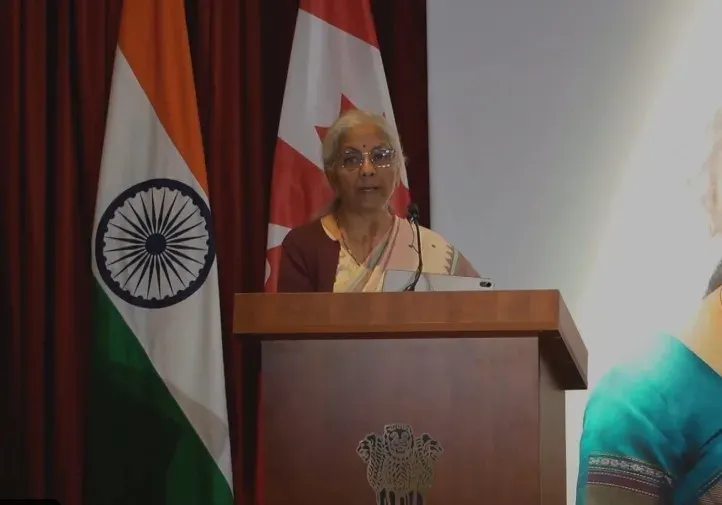
Union Finance Minister Nirmala Sitharaman declared on 26 August that India and Canada are the “most natural partners in the world,” asserting that the bond between the two nations runs “deeper than any trade agreement.” She made the remarks during a reception for the Indian diaspora business community in Toronto, on the first day of a four-day official visit to Canada focused on trade, investment, and financial cooperation.
Bilateral Ties: A Remarkable Transformation
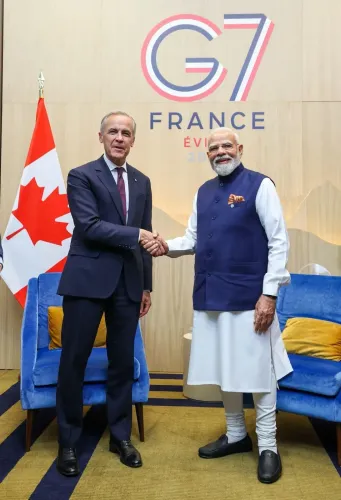
Sitharaman described India-Canada relations as having undergone a “remarkable transformation in recent times,” citing shared democratic values, pluralism, expanding economic engagement, and intensifying high-level interactions. She pointed to the meeting between Prime Minister Narendra Modi and Canadian Prime Minister Mark Carney on the sidelines of the G7 Summit in June 2025, at which both leaders agreed to reset bilateral ties through a “future-focussed strategic partnership.”
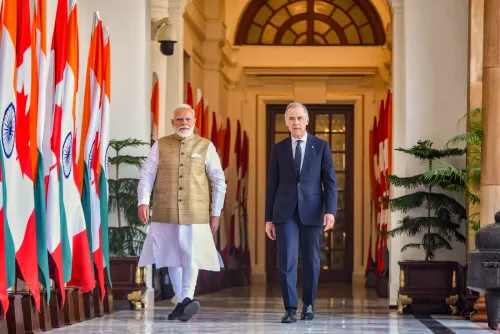
That reset was subsequently advanced during Prime Minister Carney’s visit to India earlier this year, which formally launched Comprehensive Economic Partnership Agreement (CEPA) negotiations, a Canadian $2.6 billion uranium agreement with Cameco, and the adoption of Vasudhaiva Kutumbakam as an overarching framework for the renewed partnership. Both sides also declared an ambition to more than double two-way trade to Canadian $70 billion by 2030.
The Strategic Role of the Indian Diaspora
Sitharaman paid particular tribute to the Indian business community in Canada, describing it as sitting “inside Canadian boardrooms, on the trading floors of Bay Street, inside the risk committees of the pension funds.” She called the community “a strategic bridge between two vibrant democracies and two innovation-driven economies.”
The Finance Minister argued that the two countries share Commonwealth traditions, a similar parliamentary model, the same official language, and broadly aligned positions on multilateralism, North-South cooperation, and a rules-based international order. “Canada and India are the two great multicultural societies in today’s world that truly value and cherish diversity,” she said.
India’s Economic Pitch to Canadian Capital
Sitharaman positioned India as the fastest-growing major economy in the world, offering “scale, sustained growth, a young population, expanding consumption and rapidly deepening capital markets.” She highlighted rapid urbanisation, a growing middle class, and world-class digital infrastructure as structural drivers creating opportunities across sectors.
The Finance Minister specifically flagged India’s Unified Payments Interface (UPI) as a platform for collaboration with Canadian banks, fintech companies, and regulators — “not only in payments, but in shaping the next generation of digital financial infrastructure.” She also pointed to GIFT City, India’s International Financial Services Centre, as an emerging global platform for cross-border financial activity, backed by a purpose-built regulatory and tax framework.
Opening Sectors and Deepening Markets
Sitharaman noted that India has “progressively opened” sectors including insurance, asset management, and pensions to greater foreign participation. Indian capital markets, she said, have become “deeper, more liquid and more sophisticated,” creating opportunities for Canadian institutional investors not just to participate in India’s growth but also to “use India as a platform for wider regional and global financial activity.”
The India-Canada partnership, she said, is “increasingly moving from capital flows to deeper institutional engagement” — a signal that both governments are looking beyond headline trade numbers toward structural financial integration. Sitharaman’s Toronto visit is expected to include meetings with Canadian ministers, pension fund executives, and financial regulators over the coming days.
Point of View
The Cameco uranium deal, and the $70 billion trade target are not aspirational; they are negotiating anchors. What is less clear is whether Canadian institutional capital, cautious by mandate and heavily regulated, will move at the pace India’s pitch implies. The real test of this ‘most natural partners’ framing will be in the fine print of CEPA’s market-access chapters — particularly on mobility of professionals, an issue that has derailed India-West trade talks before.
NationPress
10 Oct 2026
Frequently Asked Questions
Why is FM Nirmala Sitharaman visiting Canada?
Finance Minister Nirmala Sitharaman is on a four-day official visit to Canada, beginning 26 August, to strengthen bilateral trade, investment linkages, and financial cooperation. The visit follows a diplomatic reset initiated at the G7 Summit in June 2025, where PM Modi and PM Carney agreed to relaunch the India-Canada strategic partnership.
What is the India-Canada trade target by 2030?
India and Canada have declared a joint ambition to more than double two-way trade to Canadian $70 billion by 2030. This target was part of a joint declaration of ambition made during PM Carney’s visit to India earlier this year.
What is the Cameco uranium agreement mentioned by Sitharaman?
During PM Carney’s visit to India, a Canadian $2.6 billion uranium agreement was signed with Cameco, a major Canadian uranium producer. The deal is part of the broader package of agreements that formalised the renewed India-Canada strategic partnership.
What is CEPA and when were India-Canada negotiations launched?
CEPA stands for Comprehensive Economic Partnership Agreement, a broad free trade framework covering goods, services, and investment. India-Canada CEPA negotiations were formally launched during PM Mark Carney’s visit to India earlier in 2025.
How does GIFT City feature in India-Canada financial ties?
GIFT City is India’s International Financial Services Centre, designed for cross-border financial activity with a dedicated regulatory and tax framework. Sitharaman highlighted it as an emerging global platform and specifically invited Canadian banks, fintech firms, and institutional investors to use it as a gateway for regional and global financial operations.