Did Sri Sri Ravi Shankar Bring Lord Krishna's Meditation Teachings to the UN?
Synopsis
Sri Sri Ravi Shankar brought ancient meditation teachings to the UN, emphasizing their relevance in today’s chaotic world. Amidst global conflicts, he highlighted the importance of inner peace, drawing parallels to Lord Krishna's lessons during the Mahabharata.
Key Takeaways
Sri Sri Ravi Shankar highlighted the need for meditation in today's conflict-ridden world.
Lord Krishna's teachings on meditation were emphasized as timeless wisdom.
Collective meditation can foster peace and reduce societal tensions.
The UN recognizes the significance of meditation in promoting global harmony.
India's heritage in meditation has a vital role in the global discourse on peace.
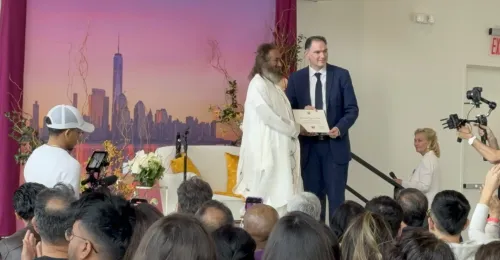
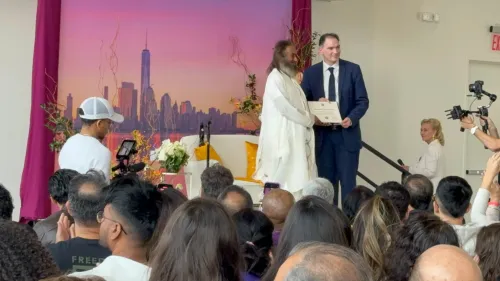
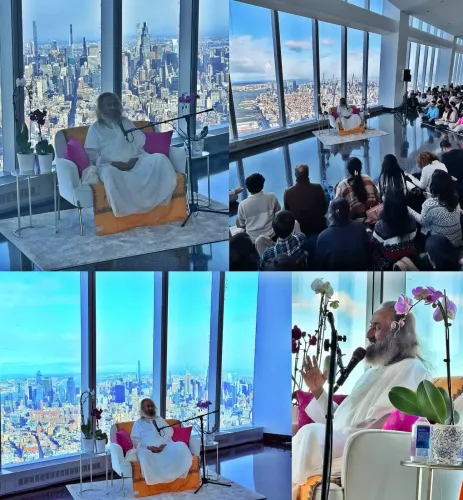
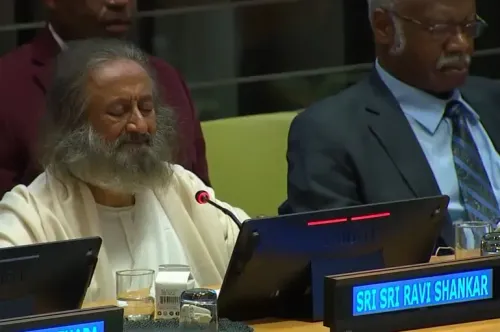
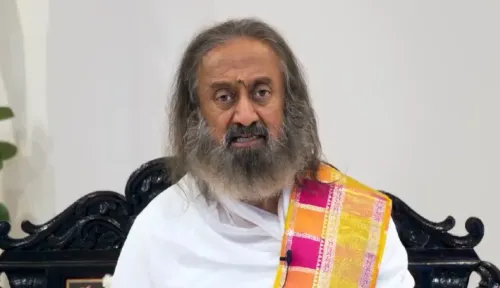
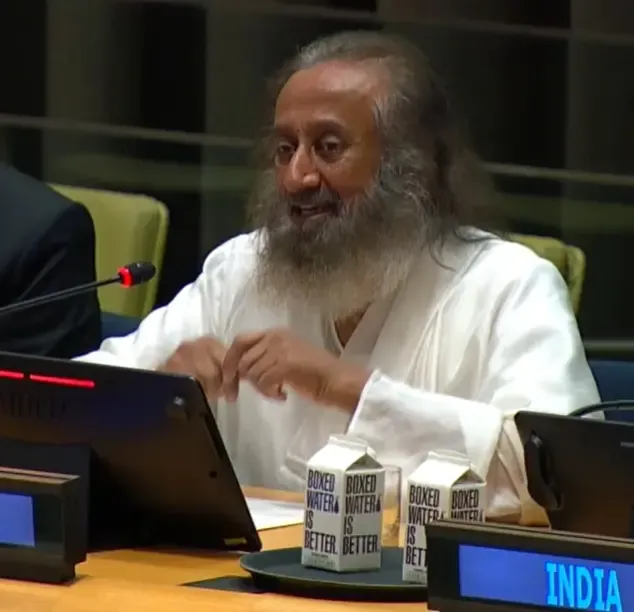
United Nations, Dec 20 (NationPress) Reflecting on the wisdom imparted by Lord Krishna to Arjuna regarding meditation during battle, Sri Sri Ravi Shankar introduced the profound lessons of this ancient practice at the UN, a forum representative of a world beset by turmoil and conflict.
During a meditation session held here on Friday (local time) to commemorate the Second World Meditation Day, the guru remarked, "When Lord Krishna instructed Arjuna on yoga and meditation, particularly Dhyana yoga, he did so amidst the chaos of the battlefield."
"Today's world is not less chaotic; various societal issues mirror the essence of a battlefield," he elaborated. "In such a conflicting environment, it is crucial for us to delve within ourselves."
Referencing Lord Krishna's teachings in the context of modern-day conflicts, he spoke of the situation in Ukraine, where 8,000 soldiers, initially engaged in combat, found solace through meditation amidst overwhelming darkness and despair.
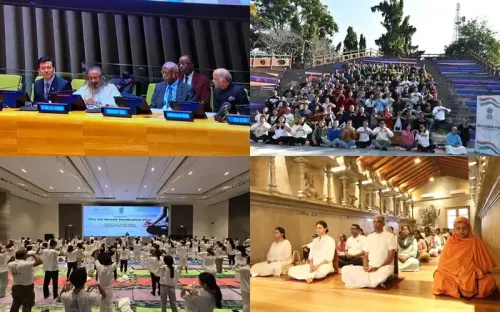
Gathered alongside diplomats from across the globe, UN officials, and yoga practitioners, the meditation session aimed to foster inner peace and promote global harmony.
This event was organized with the support of India, Andorra, Mexico, Nepal, and Sri Lanka, who sponsored a General Assembly resolution last year that designated the Winter Solstice, occurring on December 21, as World Meditation Day. (The Summer Solstice is recognized as the International Day of Yoga.)
The event took place on Friday, as this year's Winter Solstice falls on a Sunday.
India's Permanent Representative, P. Harish, stated that the resolution from the General Assembly represents a significant achievement in recognizing that meditation transcends cultural, religious, and geographical divides, offering a universal path to transformation.
"For India, this recognition is particularly meaningful," he noted, emphasizing that "meditation has roots extending over 5,000 years back to ancient India, where Patanjali's Yoga Sutra introduced the idea of Dhyana, a state of pure consciousness."
"India has consistently shared its heritage and wisdom with the world, embodying the spirit of 'Vasudeva Kutumbakam,' which signifies that the entire world is one family," he added.
Numerous yoga and meditation experts praised the ability of yoga to foster peace and mitigate violence globally.
L.P. Bhanu Sharma, co-founder of Nepal's Jeevan Vigyan Foundation, emphasized that regular meditation practice by leaders could significantly impact the quest for world peace.
"Peacebuilding, like any vital habit, requires daily practice to become second nature," he stated.
"How can we expect leaders to embody peace at the negotiating table without the daily discipline of meditation and wellness, returning to our shared human roots, not merely as members of a community but as humans first?" he questioned.
John Hagelin, a physicist and president of the Global Union of Scientists for Peace, pointed out, "The initial signs of war often arise from escalating social stress and severe religious, political, and ethnic tensions."
"If these tensions escalate unchecked, they can often lead to social violence and war," he warned.
Humanity has struggled to alleviate stressors like poverty, oppression, and injustice without complete success.
Yet, when traditional solutions fall short, transcendental meditation could effectively diminish stress that often leads to violence, he explained.
"There exists compelling, scientifically validated, evidence-based methods for alleviating acute stress, particularly those rooted in meditation, which can mitigate stress and its detrimental effects on the brain and human behavior," stated Hagelin, who is also a president emeritus of Maharishi International University.
He added that it is not essential for everyone to meditate; however, the presence of some individuals meditating could have a substantial impact.
He cited instances where collective meditation has reduced political conflicts and crime in Washington while lessening the intensity of warfare in the Middle East, all of which has been scientifically documented.
Yogmata Keiko Aikawa from Japan expressed that everyone possesses the potential for achieving enlightenment.
"Meditation serves as a guide to our true self, a state of peace and light, offering an experience that transcends time," she articulated.
Sister B.K. Gayatri from the Brahma Kumaris World Spiritual University remarked that the principle of entropy applies to our global circumstances, indicating that "the quality of the world is gradually deteriorating, distancing us from a time characterized by purity, goodness, peace, and harmony."
"However, when the source of light reenters the world, the trend of decline can be reversed, promoting a new surge of purity and truth in society," she added, emphasizing that this transformation can be achieved through Raja Yoga, which the Brahma Kumaris advocate.
Point of View
This event underscores the importance of promoting meditation as a tool for peace. In an era marked by division and conflict, the UN's recognition of meditation's transformative potential is a step towards global unity and understanding.
NationPress
24 Sept 2026