How Are India–US Tech Relations Strengthened by AI in Silicon Valley?
Synopsis
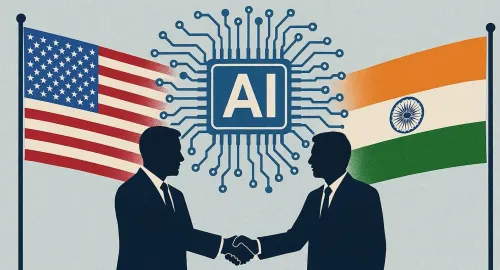
In a pivotal roundtable in Silicon Valley, India and the US forge stronger tech ties, focusing on AI's role in global trade and economic growth. With a trade agreement on the horizon, the partnership seeks to enhance cooperation and innovation, aiming for a $500 billion trade target by 2030. Discover how this collaboration could reshape the future.
Key Takeaways
Deepened cooperation in technology and AI between India and the US.
Focus on moving from strategy to execution.
Significant contributions of Indian tech firms to the US economy.
AI viewed as a transformative force in global markets.
Importance of a collaborative approach involving government, industry, and academia.
Washington, Feb 10 (NationPress) India and the United States have made significant strides in enhancing their collaboration on technology and artificial intelligence during a recent high-level roundtable held in Silicon Valley. This gathering, focused on accelerating the transition from strategy to execution, featured discussions among officials and industry leaders.
The exclusive event was organized by the Consulate General of India in San Francisco in partnership with NASSCOM, uniting key figures including senior technology executives, venture capitalists, and academic specialists from both nations. The session was aptly named “India-US Technology Partnership: From Strategic Intent to Execution.”
Participants examined how artificial intelligence is transforming global trade, labor markets, and the Indo-US technology corridor, as stated in a media release.
Speakers highlighted that AI signifies a fundamental shift in the global economy, emphasizing the necessity for enhanced collaboration among government, industry, and academia to ensure that growth remains both inclusive and sustainable, as per the media release.
The NASSCOM delegation attended the San Francisco Bay Area under the NASSCOM US CEO Forum program, featuring prominent individuals like Rajesh Nambiar, president of NASSCOM; Shivendra Singh, vice president for global trade development; and Mayank Gautam, director for global trade development. Representatives from 12 major Indian technology firms, including Infosys, Cognizant, HCL, and Nagarro, were also present.
India’s Consul General in San Francisco, Dr. K. Srikar Reddy, connected the technology discussions to larger geopolitical and economic trends. He mentioned the recent announcement of a finalized India–US trade agreement and India’s forthcoming role as host of a global AI summit.
Reddy indicated that the trade deal would lower US tariffs on Indian goods from 50% to 18%. Meanwhile, India is set to reduce or eliminate tariffs on US products. He anticipates this agreement will bolster bilateral trade and help achieve a target of $500 billion in goods and services trade by 2030, as set by leaders of both nations in February 2025.
Nambiar spotlighted the rising influence of Indian technology firms in driving global digital transformation. He underscored their role in fostering innovation, economic growth, and job creation within the United States, alongside the challenges and opportunities that generative AI presents for future collaboration between Indian and US companies.
Participants acknowledged that India’s technology sector significantly contributes to the US economy, with estimates suggesting that Indian tech firms support hundreds of thousands of jobs and contribute approximately $103 billion to US gross domestic product.
The roundtable, moderated by MR Rangaswami, founder of Indiaspora, concentrated on the future of Indian IT services and software-as-a-service firms in an AI-centric landscape. Attendees advocated for evolving business models, workforce reskilling, and a transition towards outcome-driven, AI-enabled service delivery.
The discussions also highlighted a “triple helix” approach, incorporating government, industry, and academia, with participants asserting that future skills planning, workforce transitions, and curriculum updates are vital to keeping pace with rapid technological advancements.
Point of View
It is clear that the strengthening of India-US tech ties, especially in the realm of AI, reflects a strategic alignment that benefits both nations. The collaboration could foster innovation, economic growth, and job creation, positioning both countries as leaders in the global digital landscape. This partnership is pivotal, not just for economic reasons but also for addressing broader geopolitical challenges.
NationPress
26 Oct 2026
Frequently Asked Questions
What was the main focus of the India-US tech roundtable in Silicon Valley?
The roundtable primarily focused on enhancing cooperation in technology and artificial intelligence, aiming to accelerate the transition from strategy to execution.
Who organized the high-level roundtable event?
The event was convened by the Consulate General of India in San Francisco in collaboration with NASSCOM.
What key topics were discussed during the roundtable?
Participants discussed the impact of artificial intelligence on global trade, labor markets, and the Indo-US technology corridor, as well as the need for coordinated efforts among government, industry, and academia.
What is the significance of the India-US trade agreement mentioned?
The trade agreement is expected to lower tariffs significantly and boost bilateral trade, aiming for a target of $500 billion by 2030.
What role do Indian technology firms play in the US economy?
Indian technology firms contribute significantly to the US economy, supporting hundreds of thousands of jobs and contributing approximately $103 billion to the GDP.