Should India-Australia-Japan Trilateral be Strengthened to Counter China?
Click to start listening
Synopsis
A new report emphasizes the need for strengthening the India-Australia-Japan trilateral to effectively counter China's expanding influence in the Indo-Pacific. As the U.S. reassesses its role under Trump, regional democracies must bolster their security cooperation for a stable future.
Key Takeaways
- Revitalization of the IAJ trilateral is essential for countering China's influence.
- US reliability is in question under the Trump administration.
- Maritime security is critical in light of China's expanding presence.
- Each nation faces unique challenges regarding Chinese assertiveness.
- Collaboration is key for effective regional responses to threats.
Tokyo, Jan 17 (NationPress) A recent report suggests that if the United States, under Donald Trump, is less willing to challenge China’s coercive actions in the Indo-Pacific, then regional democracies need to take on a more significant role in ensuring their own security.
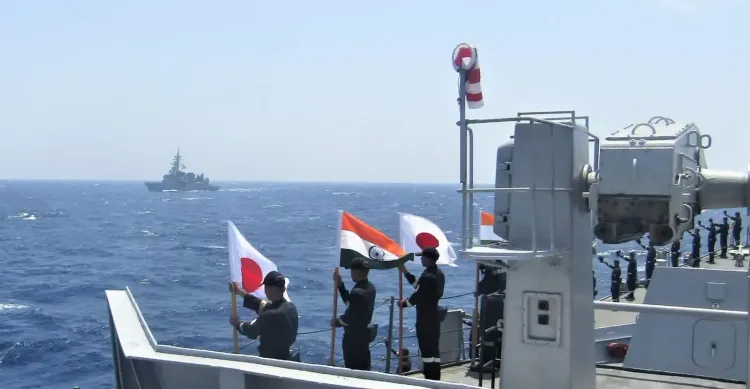
The report advocates for revitalizing the India-Australia-Japan (IAJ) trilateral as a practical and independent mechanism aimed at enhancing deterrence in the Indo-Pacific. This recommendation arises from concerns about a perceived decline in US reliability during the Trump administration, according to an article published by the European media outlet Modern Diplomacy.
It portrays the IAJ trilateral as a pragmatic, regionally-focused approach, noting that during Trump's tenure, “the US seems to be reducing its security contributions in the Indo-Pacific by not addressing Chinese coercion.” This shift is markedly different from the Cold War era when Washington played a pivotal role in ensuring the security of its allies globally.
The three nations mentioned in the article comprise the ‘Quad’ alongside the US, with India originally set to host the Quad Summit in 2025, which has been delayed amid prevailing India-US trade tensions. Questions also loom regarding the participation of the US President in the Quad, as the newly appointed New Delhi Ambassador, Sergio Gor, cautiously stated that it may occur “hopefully within a year or two,” highlighting ongoing uncertainties.
The Modern Diplomacy article further notes that the US has slowed down its cooperation in regional minilaterals intended to counter China’s influence in the Indo-Pacific.
This decline, the author argues, opens a strategic opportunity for the IAJ, independent of the US, to play a more prominent role in coordinating regional responses to maritime coercion and other forms of pressure from China.
“While the IAJ trilateral may struggle to match China’s military capabilities without US support, deterrence also encompasses perceptual factors. Thus, a revitalized IAJ trilateral, embodying the three most significant democracies of the Indo-Pacific, could serve as an essential mechanism in countering China’s maritime coercion,” the report states.
“Maritime security is increasingly vital considering China’s growing maritime footprint in the Indo-Pacific, with each of the three nations experiencing its adverse effects in various competitive arenas. For example, India contends with the expanding Chinese presence in the Indian Ocean, while Australia faces challenges in the Western Pacific, and Japan navigates tensions in the East China Sea and the South China Sea. Consequently, the trio can synergize their efforts to counter China in their respective competitive landscapes within the Indo-Pacific,” it concludes.
Point of View
I maintain that the emerging geopolitical landscape demands a strong response from regional democracies. The IAJ trilateral can serve as a pivotal mechanism in addressing the challenges posed by China's growing assertiveness, ensuring stability and security in the Indo-Pacific for all nations involved.
NationPress
17/01/2026
Frequently Asked Questions
What is the significance of the India-Australia-Japan trilateral?
The India-Australia-Japan trilateral aims to enhance security cooperation among these three democracies to counter China's influence in the Indo-Pacific region.
Why is the US role in the Indo-Pacific under scrutiny?
The US's reliability is questioned due to its perceived reluctance to confront China's coercive actions during the Trump administration.
How can the IAJ trilateral address maritime security?
The IAJ trilateral can coordinate regional responses to maritime coercion and leverage the collective strengths of India, Australia, and Japan in maintaining security.
What challenges do India, Australia, and Japan face from China?
Each country faces unique challenges, such as India's concerns in the Indian Ocean, Australia's issues in the Western Pacific, and Japan's tensions in the East and South China Seas.
What are the potential outcomes of strengthening the IAJ trilateral?
Strengthening the IAJ trilateral could enhance deterrence and cooperation among the three countries, leading to a more stable and secure Indo-Pacific region.