In America’s Wealth: Indigenous Tribes Struggle for Water Access
Synopsis
Despite being the world's wealthiest nation, many Native American tribes are grappling with severe water shortages and outdated infrastructure. A recent Senate hearing revealed the alarming reality of how these communities are often left to fend for themselves, highlighting a deep-seated inequity in access to essential resources.
Key Takeaways
Water access: Many Native American tribes lack basic access to running water.
Financial disparities: The cost of hauling water is significantly higher for these communities.
Proposed settlements: A $5 billion initiative aims to address water infrastructure needs.
Cultural significance: Water is viewed as sacred and essential for survival.
Legislative hurdles: Securing long-term solutions often takes years due to the need for congressional approval.
Washington, March 3 (NationPress) In the largest economy globally, numerous Native American tribes are still engaged in the laborious task of hauling water over long distances, relying on outdated irrigation systems, and facing financial turmoil following the closure of a single mine. This troubling reality was highlighted during a recent U.S. Senate hearing, exposing the significant disparities in development within the United States.
During a session of the Senate Committee on Indian Affairs, tribal leaders illustrated living conditions that are more often associated with drought-affected regions of the developing world than with a G7 nation.
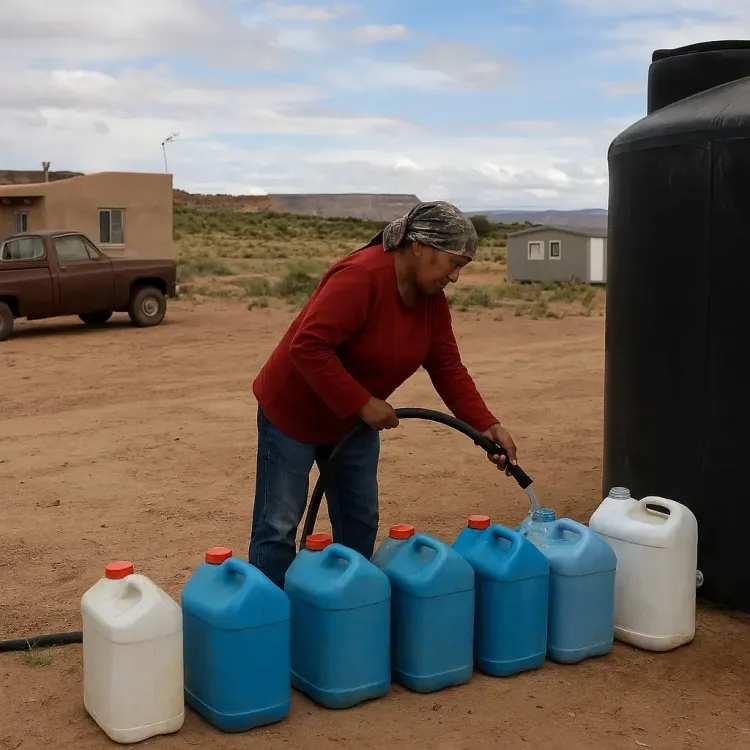
Navajo Nation President Dr. Buu Nygren informed lawmakers that “Approximately one-third of households in the Navajo Nation lack access to running water, and that is how I was raised, without running water.” He stated that countless families transport water “over 30 miles round trip on unpaved dirt roads to satisfy daily water needs.”
As the largest indigenous nation in the U.S., the Navajo Nation faces alarming cost disparities. Families that must haul their water “incur expenses equivalent to $43,000 per acre-foot, in stark contrast to the $600 per acre-foot that typical suburban residents pay.” Nygren termed this situation “completely unacceptable, as in 2024, more than one-third of our population, including children and elders, still do not have running water.”
The hearing also concentrated on a suggested $5 billion water settlement for tribes situated in northeastern Arizona. Interior Department official Bryan Newland articulated that this initiative “will ensure reliable and safe water” while “authorizing $5 billion for crucial water development and distribution projects.” Although Newland expressed support for the bill’s “goals and purposes,” he acknowledged that “significant issues” still need resolution.
For the Hopi Tribe, the issue is similar. Chairman Timothy Nuvangyaoma remarked that “about 30 percent of Hopis lack access to running water on our reservation.” He emphasized that access to water is vital for both survival and cultural identity, stating, “Water is sacred. Water is our life.”
The Zuni Tribe, located in neighboring New Mexico, described the devastating impact on traditional agriculture due to upstream diversions and ineffective federal dams. Governor Arden Kucate noted that the once-abundant Zuni River “has now dwindled to a mere trickle.” The proposed settlement aims to finance the restoration of irrigation systems along with the construction of modern drinking water and wastewater facilities.
In Montana, Crow Tribe Chairman Frank White Clay cautioned senators that the closure of a major coal mine resulted in “a 95 percent drop in revenue.” He warned that the tribe is teetering on a fiscal “cliff,” endangering funds allocated for elders, social services, and public safety.
The testimonies presented a stark contrast. While the United States excels in GDP and technological innovation, some Indigenous nations within its borders continue to grapple with basic utility access. Major settlements necessitate congressional approval and can take years to finalize, leaving these communities in a state of uncertainty.
Frequently Asked Questions
What are the main issues faced by Native American tribes regarding water access?
Many Native American tribes are forced to haul water over long distances, face outdated irrigation systems, and lack running water in their homes, leading to severe challenges in daily life.
How much do families hauling water spend compared to suburban users?
Families hauling water often spend the equivalent of $43,000 per acre-foot, whereas typical suburban users spend around $600 per acre-foot.
What is the proposed solution for water access issues?
A proposed $5 billion water settlement aims to provide reliable water access and fund essential water development projects for tribes in northeastern Arizona.
How do these water access issues impact Indigenous culture?
Access to water is viewed as fundamental to survival and cultural identity, with many tribes considering water to be sacred.
What challenges do tribes face in securing long-term solutions?
Major settlements require congressional approval and can take years to negotiate, leaving communities in a state of uncertainty.