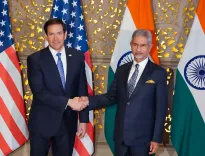
White House: Trump Admin Revoking Visas Faster Than Any in History
Synopsis
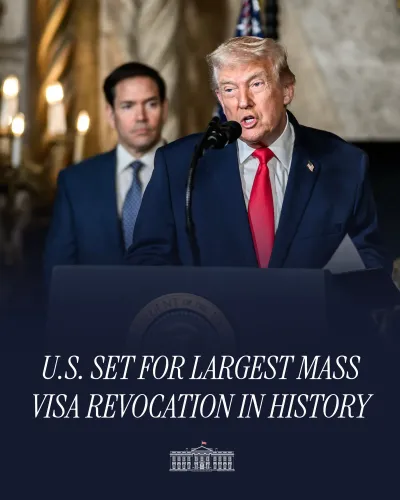
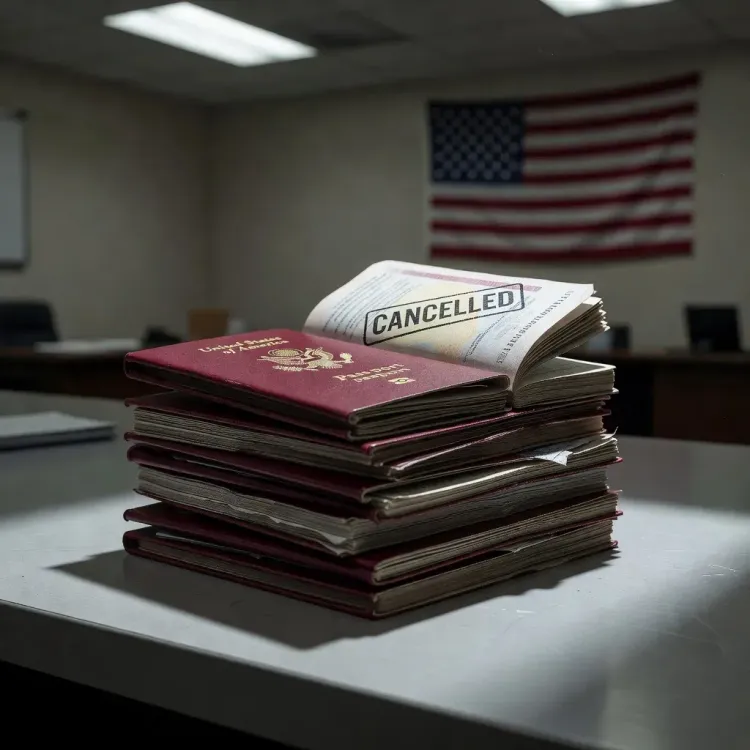
The White House announced on October 20, 2026 that the Trump administration has revoked more U.S. visas at a faster pace than any administration in history, declaring zero tolerance for foreign nationals who violate the law, commit fraud, or threaten national security.
Key Takeaways
The White House declared on October 20, 2026 that the Trump administration has revoked more visas, faster, than any administration in U.S. history.
The administration states there is 'ZERO tolerance' for foreign nationals who violate the law, commit fraud, or threaten national security.
Department of State holds the legal authority to revoke visas on grounds of fraud, legal violations, or national security risk.
The policy builds on Trump-era precedents from 2017–2020 , including tightened visa screening and revocations targeting espionage and technology-transfer risks.
India is among the top recipients of U.S. visas, making this policy shift directly relevant to Indian students and H-1B workers.
Official State Department annual statistics will be the key data point to verify the administration's historic claim.
The White House fired a stark warning to every foreign national on a U.S. visa on Tuesday, October 20, 2026: violate the law, commit fraud, or threaten national security — and your visa is gone. The official White House account declared that the Trump administration has revoked more visas, at a faster pace, than any administration in American history.
The record-pace claim and what sits behind it
The White House post stated plainly: 'There is absolutely ZERO tolerance for foreign nationals on visas who violate the law, commit fraud, or threaten national security.' The declaration signals an escalation of one of the defining throughlines of Trump-era governance — using existing visa authorities as a front-line enforcement tool, rather than waiting for legislative action on immigration.
The U.S. Department of State, which holds the legal authority to issue and revoke visas, has served as the operational arm of this policy. Under prior Trump-era frameworks going back to 2017, visa screening was dramatically tightened through executive action, and revocations targeting individuals linked to espionage, technology theft, and fraud — particularly involving nationals from China and other strategic rivals — accelerated sharply between 2018 and 2020.
From national security to zero-tolerance: the policy logic
The current posture is not a departure from that lineage — it is an intensification. The Trump administration has consistently framed aggressive visa enforcement as a national security imperative, not merely an immigration management tool. The phrase 'zero tolerance' carries deliberate weight: it forecloses any case-by-case discretion and signals to both domestic audiences and foreign governments that the policy is structural, not reactive.
For the millions of international students, skilled workers, and exchange visitors currently holding U.S. visas, the announcement is a direct warning shot. Any legal violation — however minor — is framed as sufficient grounds for revocation. The breadth of that standard is exactly what critics have historically flagged as a due-process concern.
Why Indians are watching this closely
India consistently ranks among the top three countries by volume of U.S. visa recipients — particularly H-1B skilled worker visas and F-1 student visas. Any shift in revocation pace or policy grounds carries direct, material consequences for hundreds of thousands of Indian nationals currently in the United States. A faster revocation rate, applied broadly, could compress the window between a legal infraction and deportation proceedings in ways that significantly raise the stakes for the Indian diaspora and students mid-program.
Annual visa and revocation statistics from the State Department — typically released in aggregate — will be the first hard data point against which the administration's 'fastest in history' claim can be independently measured. Those figures are among the key indicators to watch in the coming months.
The administration has set the tone with unmistakable clarity. Whether the numbers ultimately bear out the historic claim, the signal to foreign nationals — and to the governments that send them — has already landed.
Point of View
Not just domestic law. For India, the stakes are unusually concrete: with hundreds of thousands of nationals on H-1B and student visas, any acceleration of revocation proceedings — however the 'record' claim is eventually verified — creates real legal and professional risk at the individual level. The harder question, which the announcement sidesteps, is whether speed of revocation tracks with accuracy, and whether due-process safeguards are keeping pace.
NationPress
20 Oct 2026
Frequently Asked Questions
What did the White House say about visa revocations in 2026?
The White House announced on October 20, 2026 that the Trump administration has revoked more U.S. visas at a faster pace than any administration in history, with zero tolerance for foreign nationals who violate the law, commit fraud, or threaten national security.
Which U.S. agency is responsible for revoking visas?
The U.S. Department of State holds primary authority to revoke visas on grounds including fraud, legal violations, and national security threats.
How does Trump's visa revocation policy affect Indian nationals?
India is among the top recipients of U.S. visas, including H-1B skilled worker and F-1 student visas. A faster revocation rate means Indian nationals could face quicker removal proceedings if they are found to have violated any visa conditions.
What counts as grounds for U.S. visa revocation under the Trump administration?
According to the White House, grounds include violating U.S. law, committing fraud, or posing a threat to national security. The administration has described this as a zero-tolerance standard with no case-by-case exceptions.
Has the Trump administration revoked visas at a record pace before?
During Trump's first term (2017–2020), visa revocations and denials accelerated significantly, particularly targeting individuals linked to espionage and technology-transfer risks. The current administration claims the pace in this term exceeds all prior historical records, though independent verification awaits official State Department statistics.